Great Dane: gear and buying guides
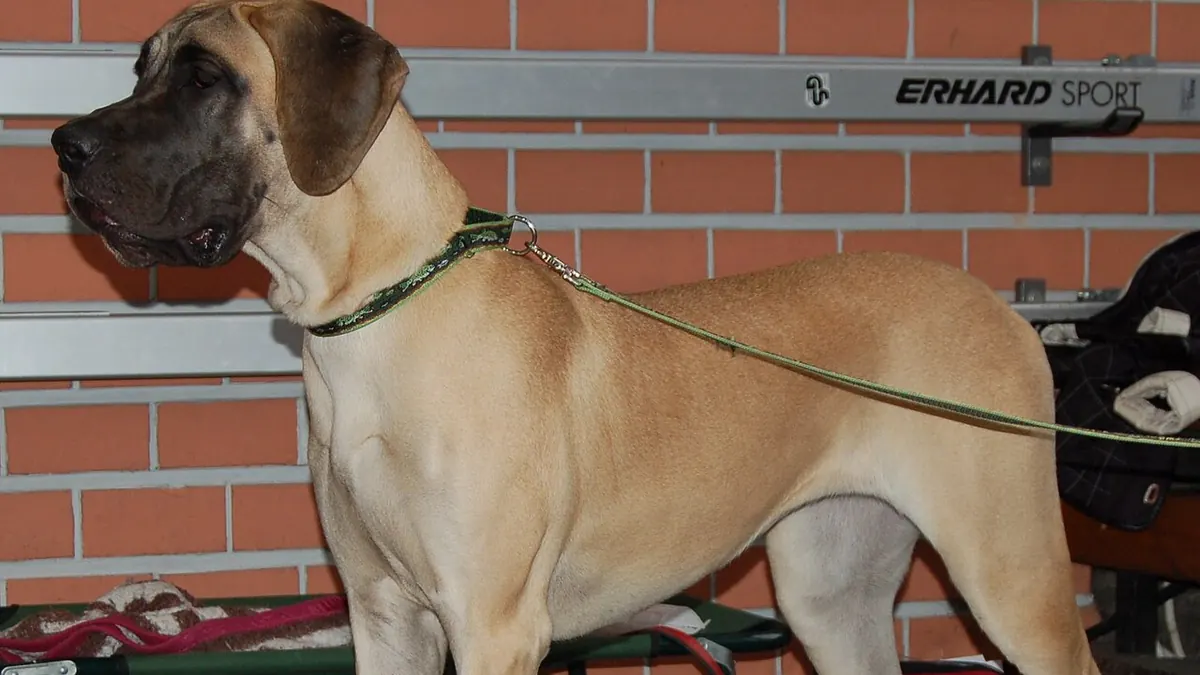

The Great Dane is a gentle, calm giant of 50 to 80 kg, often over 80 cm at the withers. All of its gear must be planned extra-large: an XXL bed of 120 cm or more, raised bowls, a spacious car, and a very long growth phase to manage carefully.
Profile : Giant dog of 50 to 80 kg, short coat, moderate energy in adulthood.
An accessory from our shop for this use: Evaporative cooling vest for dogs, with lead ring (€35.90) · the whole shop
An accessory from our shop for this use: Folding 3-step wooden pet stairs for beds and sofas ($75.90, ships from the US) · the US shop
Outside our shipping area? The downloadable practical guide: Raising Your Puppy: The First Six Months (€19)
Species profile
- Lifespan
- 8 to 10 years
- Adult weight
- 50 to 80 kg
- Size
- 72 to 86 cm
- Temperament
- A gentle, calm giant in adulthood, often nicknamed the Apollo of dogs for its bearing.
- Health watch
- gastric torsion, a major risk in the breed · dilated cardiomyopathy · hip dysplasia
🩺 Our hygiene and health advice stays general: it never substitutes for an examination by a veterinarian, the only person qualified to advise on your animal.
Great Dane gear, family by family
-
🍖
Food
Growth lasts 18 to 24 months: a large- or giant-breed junior kibble, without excess calories or unprescribed calcium supplements, protects the skeleton. The breed is highly exposed to gastric torsion: split meals and rest after eating are essential.
-
🧴
Care & grooming
The short coat is easy to maintain with a weekly mitt, but everything is XXL: sturdy nail clippers, shampoo in quantity and often a garden shower rather than a bathtub. Watch for elbow calluses, common in giants lying on hard floors.
-
🎾
Toys & enrichment
Adults are fairly placid, but the giant puppy must not jump or skid during its long growth: calm games, scent work and chewing rather than wild sprints. Pick large-format toys that cannot be swallowed.
-
🏠
Bedding & habitat
Plan on an XXL mattress of 120 to 140 cm, thick and preferably orthopedic to prevent calluses and ease the joints. Many owners simply use a single human mattress.
-
🧳
Travel & safety
Few off-the-shelf crates fit: an estate car or van with a divider and non-slip mat is the most realistic option. Teach calm loading, with a ramp to spare its joints.
-
🧰
Accessories
Raised bowls suited to its height improve comfort (ask your vet given the torsion risk). Plan on an XXL harness and a larger overall budget: each accessory often costs 30 to 50 percent more than standard sizes.
🍖 Feeding a Great Dane: portions, kibble and budget
The right daily ration for a Great Dane
For an adult of 50 to 80 kg, plan on 420 to 650 g of complete kibble per day, split into two meals and adjusted for age, neutering and actual activity. The reference is the weight curve: you should feel the ribs without seeing them.
Matching the food to the breed
Like every breed this size, the Great Dane should eat two calm meals a day, with no intense exercise in the following hour: the basic precaution against gastric dilatation-volvulus. Choose large-breed kibble (slow growth, joint support) and a stable, wide bowl.
Budget and smart buying
The kibble line for an adult Great Dane runs €80 to €140 a month. Large bags save per kilo — if stored airtight, dry, and finished within six weeks of opening. All our label-reading pointers are on the full Great Dane profile.
Quick answers
- How much kibble per day for a Great Dane?
- 420 to 650 g daily over two meals for an adult of 50 to 80 kg, adjusted for activity and the food’s density — the bag’s table gives the starting point, body condition the correction, the vet the verdict.
- How many meals a day for a Great Dane?
- Two meals for an adult — essential at this size, which is exposed to gastric torsion, three to four for a growing puppy.
In our shop, for this use: 1.5 L anti-splash water bowl with floating disc (€37.90) · the whole shop
Our products don’t ship to you yet, but the PDF practical guide is instant: Raising Your Puppy: The First Six Months (€19)
🧴 Grooming and care for a Great Dane: brush, bath, health
Coat care, brush by brush
Plan, for a Great Dane, on a grooming glove or rubber brush, once a week; note that its shedding stays moderate, with two seasonal peaks in spring and autumn. Start early and reward: a few positive minutes per session build an adult that accepts grooming without drama.
Baths, claws, ears, teeth
Plan a bath roughly quarterly, exceptional messes aside, with a specifically canine shampoo: a dog’s skin pH is not yours. Check claws monthly, inspect ears at the same time, and brush teeth two or three times a week.
Health watch-points for the Great Dane
Breeders and vets monitor this breed for: gastric torsion, a major risk in the breed, dilated cardiomyopathy and hip dysplasia. These known risks guide day-to-day care, and any out-of-the-ordinary symptom deserves a consult rather than a miracle product. Life expectancy sits around 8 to 10 years.
Quick answers
- Which brush for a Great Dane?
- For its coat, plan on a grooming glove or rubber brush, once a week.
- How often should a Great Dane be bathed?
- Two to three months between baths is a good rhythm, muddy accidents aside; the shampoo, always, is a dog product.
In our shop, for this use: Stainless steel nail clippers for small dogs and puppies (€17.90) · the whole shop
Outside our shipping area? The downloadable practical guide: Raising Your Puppy: The First Six Months (€19)
🏠 Bed and sleeping setup for a Great Dane: size and materials
What bed size for a Great Dane?
The maths for a Great Dane of 72 to 86 cm at the withers: a bed of about 135 cm, in which it lies fully stretched on its side — the curl is only one of its positions. When torn between two sizes, always take the larger.
Materials and comfort
At this size, memory foam is not a luxury: it relieves joints and pressure points — a real issue in a breed concerned by gastric torsion, a major risk in the breed. Three non-negotiables: a removable cover washable at 60°C, bolsters to rest the head on, and a non-slip underside for smooth floors.
Where to put it?
A chilly breed, the Great Dane sleeps away from draughts and never on a cold floor without an insulating mattress — a cave bed or a blanket to burrow in suits it well, and a coat is justified outdoors in winter. An adult dog sleeps 12 to 15 hours a day: placement matters as much as the bed.
Quick answers
- What bed size suits a Great Dane?
- 135 cm of internal length is the right target for its 72 to 86 cm at the withers; if it cannot stretch out fully, it is too small.
- Can a Great Dane sleep outside?
- Not advisable: its sensitivity to cold and need for contact make it an indoor dog, with daytime garden access.
See it in the Planète Pets shop: Ice-silk cooling mat for dogs (62 × 50 to 100 × 70 cm) (€40.90) · the whole shop
See it in the Planète Pets shop: Folding 3-step wooden pet stairs for beds and sofas ($75.90, ships from the US) · the US shop
We don’t ship products to your country yet; our practical guide downloads anywhere: Raising Your Puppy: The First Six Months (€19)
🧳 Travelling with a Great Dane: car, crate and rules
In the car with a Great Dane
At 50 to 80 kg, the only genuinely safe option is a crash-tested crate of about 130 cm secured in the boot — failing that, a solid partition grille. An unrestrained dog of this weight becomes a projectile under braking — and a possible fine for distracted driving.
Trains, planes, holidays
Too big for the cabin, the Great Dane flies in the pressurised hold in an IATA-approved crate — an ordeal to reserve for unavoidable trips. On trains, a muzzle and lead meet the rules. Get it used to the crate weeks before departure: left open at home with treats inside, it becomes a den rather than a trap.
Identification and good habits
Before any departure, check the trio: microchip, up-to-date vaccines and an EU passport for trips abroad. In warm weather a Great Dane never stays in a parked car: fifteen minutes is enough for tragedy.
Quick answers
- What crate size for a Great Dane?
- The rule: roughly 130 cm, i.e. room to stand and turn without contortion. For air travel, check the specific model’s IATA approval.
- Can a Great Dane fly in the cabin?
- No, it exceeds the cabin limit (8 kg including the bag): it travels in the pressurised hold in an IATA crate — avoid it when you can.
In our shop, for this use: Dog car seat belt with elastic shock absorber (€30.90) · the whole shop
In our shop, for this use: Folding wire dog crate 24 in (61 cm), single door, with tray ($62.90, ships from the US) · the US shop
We don’t ship products to your country yet; our practical guide downloads anywhere: Raising Your Puppy: The First Six Months (€19)
Guides to read
- No-pull front-clip harness for dogs: what does the science actually show?Accessories
Front-clip no-pull harness for dogs: what a recent study measured on pulling force, compared with a plain collar and a prong-style collar.
- Why does my dog eat grass? What the research actually saysCare & grooming
Dog eating grass: what two studies show about how common the behavior is, its link with vomiting, and the cases that should raise concern.
- Reflective vest vs light-up collar for dogs: what's the real difference?Accessories
Dog visibility at night: what pedestrian-conspicuity research reveals about the real gap between a reflective vest and a light-up collar.
- Anxious dog in the car: motion sickness or real fear of the ride?Travel & safety
Dog car travel anxiety: what a veterinary study shows about the signs of travel-related problems and the factors that explain them best.
- BARF raw diet for dogs: what are the real benefits, what are the real risks?Food
Raw BARF diet for dogs: what studies actually show about the claimed benefits, bacterial risk, and real nutritional balance.
- Separation anxiety in dogs: what does research show, what actually helps?Care & grooming
Dog separation anxiety: what a veterinary study reveals about how common it is, its risk factors, and the solutions that actually work.
- Mental activities for dogs in winter: which indoor games actually work?Toys & enrichment
Winter mental enrichment for dogs: what a study shows about scent games and indoor activities that make up for shorter walks.
- Microchip or tattoo: which ID actually gets a lost dog home?Travel & safety
Dog identification: what a study shows about return-to-owner rates depending on whether the dog is microchipped or not.
Free guide: the 10 mistakes new owners make
New dog or cat owner? Our guide walks through the ten classic first-year mistakes — food bowl, vet, training, budget — so you avoid them from day one. Instant access after signing up.
✅ All set! Read the guide now.