Accessories for a Great Dane: harness, bowls and essentials
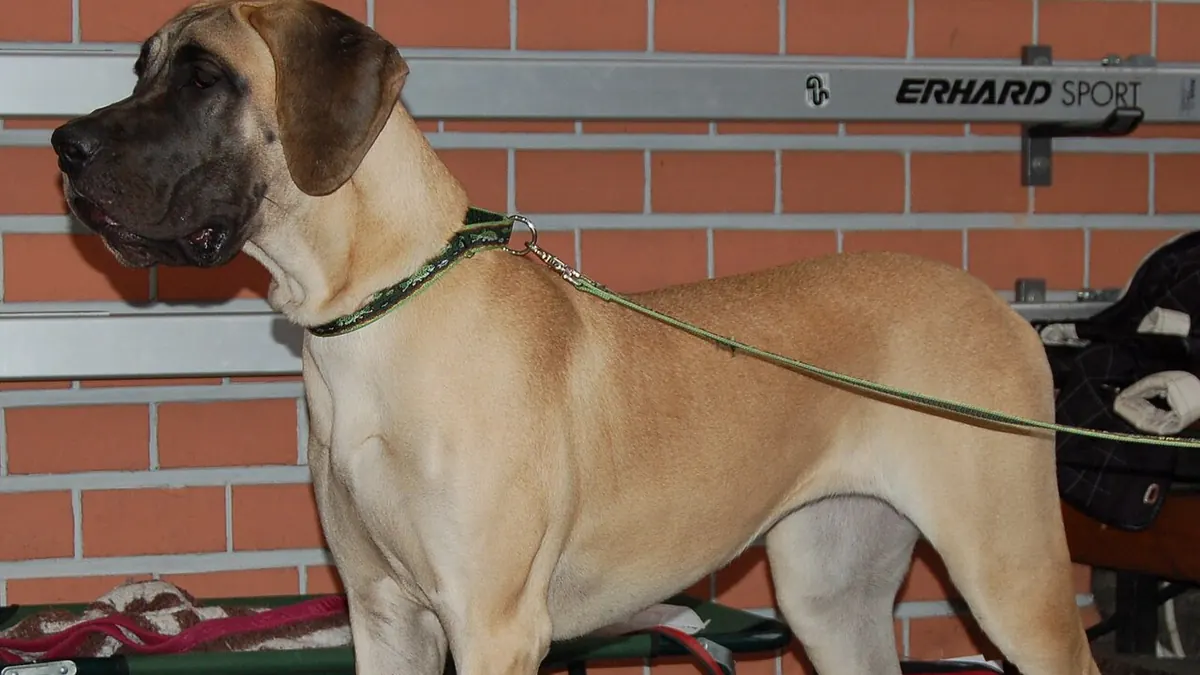

Great Dane: Raised bowls suited to its height improve comfort (ask your vet given the torsion risk). Plan on an XXL harness and a larger overall budget: each accessory often costs 30 to 50 percent more than standard sizes.
To go further, our PDF practical guides: Course: Train Your Dog in 8 Weeks — 2 PDF guides (85 pages in English (86 in French)), in English and French, instant download. Get my bundle — €49
In short: Giant dog of 50 to 80 kg, short coat, moderate energy in adulthood. A gentle, calm giant in adulthood, often nicknamed the Apollo of dogs for its bearing. Its growth stretches over 18 to 24 months and dictates everything: giant-breed junior food, no jumping, and a 120-140 cm bed that few standard shelves stock.
Harness and lead sized for the Great Dane
Aim for a Y-fit harness in size XL to XXL, adjustable at two points minimum, tried on if possible: at 50 to 80 kg, a loose harness spins, a tight one blocks the shoulder. A 2-metre lead in town and a longer one for strolls match its steady pace.
Bowls and daily kit
A stable stainless bowl sized to its ration (420-650 g/day), slow-feed if meals last under a minute. Complete the set with an always-full water point, a mat under the bowls and an airtight bin for the kibble.
The extras that genuinely matter for this breed
a lined waterproof coat for winter; a boot ramp to spare its joints — each under €40. The detailed picks are on the full Great Dane profile.
Frequently asked questions
What harness size for a Great Dane?
Size XL to XXL for an adult of 50 to 80 kg, in an adjustable Y-cut — measure the girth behind the elbows to decide between two sizes.
What starter budget for a Great Dane?
Expect €250 to 450 for the full kit (bed, harness and lead, bowls, crate, toys, brush), food excluded.
The guides that apply to you
- Collar, harness, prong collar: a 2024 study actually measures the pulling force of each type
A study fitted 23 dogs with a strain gauge to compare four leash walking setups: the force differences measured change the calculus for choosing anti-pulling equipment.
- American Staffordshire Terrier: why visual breed identification is unreliable
A large-scale study shows that even canine professionals often misidentify breeds by sight alone. What that means for the legal status and required gear of the American Staffordshire Terrier in France.
- Head halters for dogs: what the research shows about stress and the differences between models
Two studies compare the head halter to a plain collar and test four models against each other: neither finds measurable physiological stress, despite the real nose-pawing seen in early sessions.
- English Setter: coat-linked congenital deafness and the gear that helps
The English Setter is among the breeds at higher risk of congenital deafness linked to its speckled coat. What the landmark study shows and which accessories ease daily life for a hearing-impaired dog.