American Staffordshire Terrier: gear and buying guides
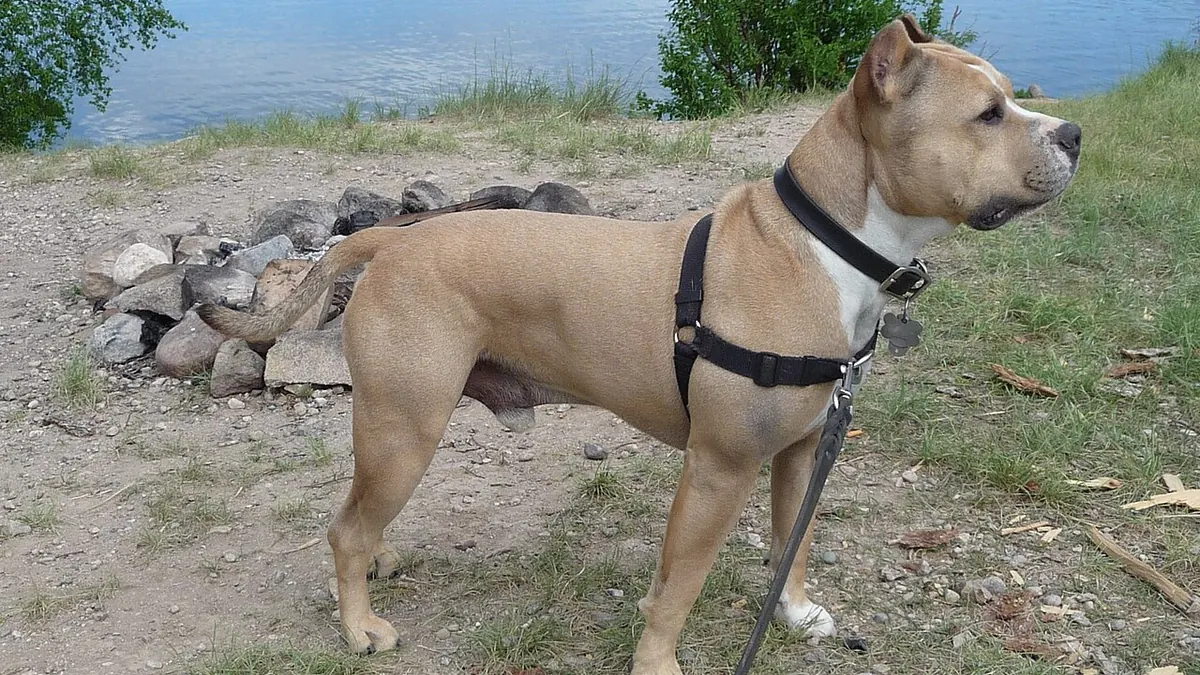

The American Staffordshire Terrier, or Amstaff, is a powerful, athletic 25-32 kg dog that is deeply devoted to its family. In France, pedigree Amstaffs fall under legal category 2: a lead and muzzle are mandatory in public spaces, which directly shapes the equipment you need. Its sheer strength also calls for reinforced gear and near-indestructible toys.
Profile : Heavily muscled medium dog, 43-48 cm at the withers (25-32 kg), short glossy coat, high energy level.
In our shop, for this use: Wobble treat-dispensing toy for dogs, adjustable opening (€21.90) · the whole shop
In our shop, for this use: Folding 3-step wooden pet stairs for beds and sofas ($75.90, ships from the US) · the US shop
Our products don’t ship to you yet, but the PDF practical guide is instant: Raising Your Puppy: The First Six Months (€19)
Species profile
- Lifespan
- 10 to 15 years
- Adult weight
- 25 to 32 kg
- Size
- 43 to 48 cm
- Temperament
- A powerful, athletic dog, deeply devoted to its family and eager for contact.
- Health watch
- hip dysplasia · hereditary cerebellar ataxia · skin allergies
- Legal status
- A restricted breed in France (law of 6 January 1999): category 2 if registered with the LOF studbook, category 1 otherwise. Owners need a holding permit, and the dog must be muzzled and kept on a lead by an adult in public spaces.
🩺 Reminder: this page informs, it does not diagnose. For any symptom or health question, your veterinarian remains the only reference.
American Staffordshire Terrier gear, family by family
-
🍖
Food
Plan on roughly 280-380 g of kibble per day for an active 30 kg adult. Its substantial muscle mass benefits from a protein-rich diet; watch its weight, as extra kilos quickly stress the joints.
-
🧴
Care & grooming
Its short coat only needs a weekly rub with a grooming mitt. The breed is prone to skin allergies and irritation: mild shampoo, regular skin checks and consistent parasite prevention are recommended.
-
🎾
Toys & enrichment
One of the strongest jaws among companion dogs: only solid rubber power-chewer toys survive (15-30 € each). Tug and scent games are excellent outlets for its energy.
-
🏠
Bedding & habitat
Plan on a 90-110 cm bed, in tough material if your dog is a chewer. Its short coat makes it feel the cold, so it appreciates a thick bed away from draughts.
-
🧳
Travel & safety
In France, category 2 rules require pedigree Amstaffs to be muzzled and leashed in public: invest in a well-fitted basket muzzle (25-60 €) that lets the dog pant and drink, introduced gradually. In the car, use a size L crate or a robust safety harness.
-
🧰
Accessories
A reinforced wide-strap harness, a thick leather or biothane lead and a basket muzzle form the practical, legally compliant trio. A winter coat helps this short-coated dog despite its rugged looks.
🍖 Feeding a American Staffordshire Terrier: portions, kibble and budget
The right daily ration for a American Staffordshire Terrier
The baseline for a 25 to 32 kg American Staffordshire Terrier: 160 to 270 g of complete kibble daily, served in two meals and corrected for age, neutering and activity. The reference is the weight curve: you should feel the ribs without seeing them.
Matching the food to the breed
For a 25 to 32 kg American Staffordshire Terrier, no exotic range needed: a good bag shows in its ingredient list — named animal proteins in first position — not in its packaging promises. Treats count towards the ration: past 10% of daily intake, the complete food is no longer balanced.
Budget and smart buying
Plan €30 to €60 monthly to feed a American Staffordshire Terrier properly. Big-bag buying pays off as long as an airtight bin and a six-week turnaround protect the food. All our label-reading pointers are on the full American Staffordshire Terrier profile.
Quick answers
- How much kibble per day for a American Staffordshire Terrier?
- For an adult of 25 to 32 kg: 160 to 270 g a day depending on activity and food, in two meals. Follow the manufacturer’s table and adjust to body condition; your vet has the final say.
- How many meals a day for a American Staffordshire Terrier?
- Two meals for an adult, three to four for a growing puppy.
In our shop, for this use: Fish-shaped silicone lick mat (24.5 × 19 cm) (€32.90) · the whole shop
Our products don’t ship to you yet, but the PDF practical guide is instant: Raising Your Puppy: The First Six Months (€19)
🧰 Accessories for a American Staffordshire Terrier: harness, bowls and essentials
Harness and lead sized for the American Staffordshire Terrier
Aim for a Y-fit harness in size M to L, adjustable at two points minimum, tried on if possible: at 25 to 32 kg, a loose harness spins, a tight one blocks the shoulder. Add a 10-metre long line for outings: freedom without escape risk — it transforms walks for such an active dog.
Bowls and daily kit
A stable stainless bowl sized for its 160-270 g a day — switching to slow-feed once meals vanish in under a minute. A water bowl or fountain always full, a mat under the bowls and an airtight kibble bin complete the basics.
The extras that genuinely matter for this breed
a lined waterproof coat for winter — each under €40. The detailed picks are on the full American Staffordshire Terrier profile.
Quick answers
- What harness size for a American Staffordshire Terrier?
- Size M to L for an adult of 25 to 32 kg, in an adjustable Y-cut — measure the girth behind the elbows to decide between two sizes.
- What starter budget for a American Staffordshire Terrier?
- Expect €150 to 300 for the full kit (bed, harness and lead, bowls, crate, toys, brush), food excluded.
An accessory from our shop for this use: Adjustable-frequency dog recall whistle with lanyard (€17.90) · the whole shop
Outside our shipping area? The downloadable practical guide: Raising Your Puppy: The First Six Months (€19)
Guides to read
- No-pull front-clip harness for dogs: what does the science actually show?Accessories
Front-clip no-pull harness for dogs: what a recent study measured on pulling force, compared with a plain collar and a prong-style collar.
- Why does my dog eat grass? What the research actually saysCare & grooming
Dog eating grass: what two studies show about how common the behavior is, its link with vomiting, and the cases that should raise concern.
- Reflective vest vs light-up collar for dogs: what's the real difference?Accessories
Dog visibility at night: what pedestrian-conspicuity research reveals about the real gap between a reflective vest and a light-up collar.
- Anxious dog in the car: motion sickness or real fear of the ride?Travel & safety
Dog car travel anxiety: what a veterinary study shows about the signs of travel-related problems and the factors that explain them best.
- BARF raw diet for dogs: what are the real benefits, what are the real risks?Food
Raw BARF diet for dogs: what studies actually show about the claimed benefits, bacterial risk, and real nutritional balance.
- Separation anxiety in dogs: what does research show, what actually helps?Care & grooming
Dog separation anxiety: what a veterinary study reveals about how common it is, its risk factors, and the solutions that actually work.
- Mental activities for dogs in winter: which indoor games actually work?Toys & enrichment
Winter mental enrichment for dogs: what a study shows about scent games and indoor activities that make up for shorter walks.
- Microchip or tattoo: which ID actually gets a lost dog home?Travel & safety
Dog identification: what a study shows about return-to-owner rates depending on whether the dog is microchipped or not.
Free guide: the 10 mistakes new owners make
The ten mistakes almost every new dog or cat owner makes, and how to avoid them: first-year food, health, training and budget, in one clear guide with instant access.
✅ All set! Read the guide now.