Green anole care: terrarium, UVB, temperature and diet

Published by Planète Pets · managing editor: Clément Lacaille · reference guide rewritten with every source checked
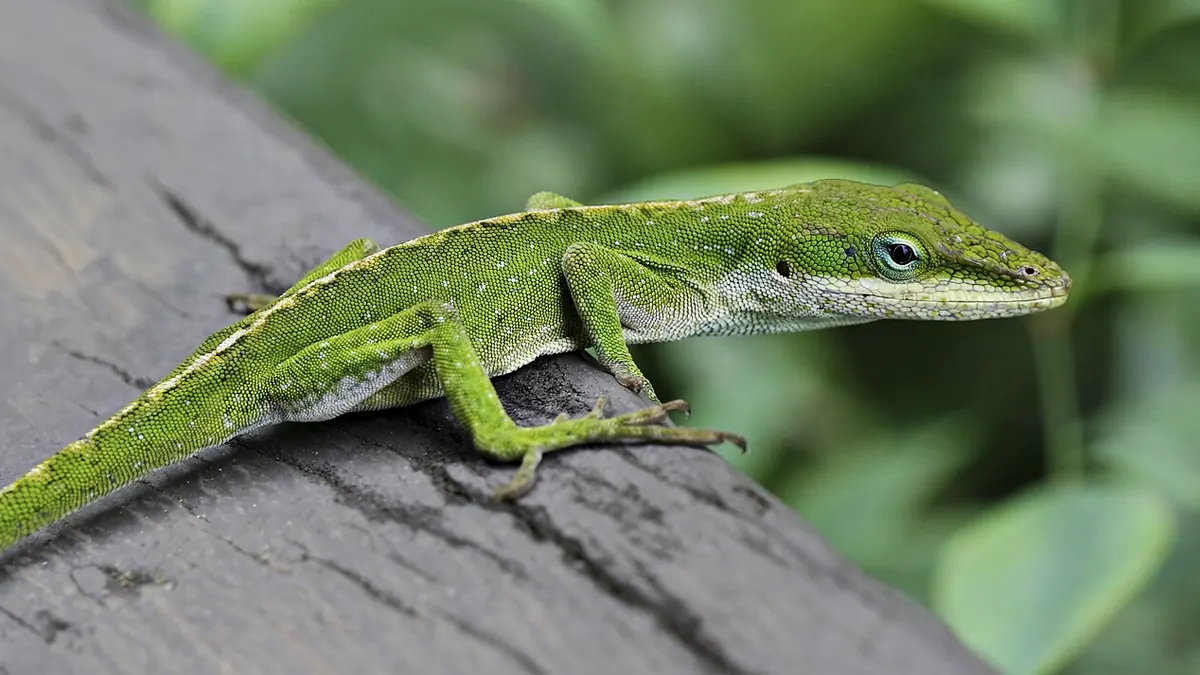
The green anole is a small, quick and territorial diurnal lizard, stunning in a planted tropical terrarium, but too fast and fragile for handling: it is a display species. It does well in a modest vertical enclosure (45 x 45 x 60 cm) with UVB, daily misting and temperatures of 24 to 29 °C.
Profile : 15 to 20 cm including tail as an adult, around 4 to 6 years of lifespan, beginner to intermediate level.
An accessory from our shop for this use: 100 × 90 cm escape-proof net with 4 corner brackets for turtle tanks (€44.90) · the whole shop
We don’t ship products to your country yet; our practical guide downloads anywhere: Your First Terrarium: Leopard Gecko, Bearded Dragon, Corn Snake, Ball Python (€15)
Species profile
- Lifespan
- 4 to 6 years
- Adult size
- 15 to 20 cm
- Basking spot
- 29 to 32 °C
- Humidity
- 60 to 80 %
- Minimum enclosure
- 45 × 45 × 60 cm
- Temperament
- A small, quick and territorial diurnal lizard, stunning in a planted terrarium but too fast and fragile to handle: a display species.
- Health watch
- metabolic bone disease and dehydration from insufficient misting · chronic stress (permanent brown colour and weight loss) needing prompt attention
🩺 Our hygiene and health advice stays general: it never substitutes for an examination by a veterinarian, the only person qualified to advise on your animal.
Keeping a green anole (Anolis carolinensis) takes little space but precise conditions: a planted vertical terrarium of at least 45 × 45 × 60 cm for one adult, UVB lighting, a 29-32 °C basking spot, 60 to 80% humidity, small calcium-dusted insects and never two males together. This small diurnal lizard measures 15 to 20 cm including the tail and lives 4 to 6 years according to our attribute database. It is a display species: fast and fragile, it is not for handling.
Care parameters at a glance
| Parameter | Value | How to check it |
|---|---|---|
| Terrarium (1 adult) | 45 × 45 × 60 cm minimum, vertical | Height comes first: branches and vines all the way up |
| Basking spot | 29 to 32 °C | Probe at the height of the basking area, on a thermostat |
| Cool zone and night | 20 to 22 °C | Thermometer low in the terrarium, read in the evening |
| Humidity | 60 to 80% | Hygrometer; misting the foliage twice a day |
| UVB | Essential | UVB tube on the lid, shaded areas among the plants |
| Adult size | 15 to 20 cm including tail | — |
| Lifespan | 4 to 6 years | — |
The terrarium: vertical, planted and tightly closed
The green anole is arboreal: it lives up high, not on the ground. Choose a terrarium taller than it is wide, filled with thin branches, vines and live plants with dense foliage, over a substrate that holds moisture. The lid must close perfectly, as this lizard weighing a few grams slips through the smallest gap. A mesh lid or a ventilated front limits condensation on the glass while keeping the humidity in; the choice of tank material is compared in our guide to glass or OSB terrariums. For the decor, multiply the routes it can travel: branches at several heights, vines, dense foliage and a structured background provide perches, hides and shade, and reassure a lizard that watches more than it hides.
UVB and temperatures: why there are no shortcuts
Like many diurnal lizards, anoles make vitamin D3 in their skin under UVB, then use it to absorb calcium. A study by Ferguson and colleagues, published in 2005 in Physiological and Biochemical Zoology on two other anole species from Jamaica, found that the species basking in full morning sun received more UVB and also got more vitamin D3 from its food, while the shade-dwelling species had skin that produced it more efficiently. Needs therefore vary between species; the authors suggest that a lizard able to regulate its own exposure benefits from it. In practice: a UVB tube above the upper branches, plus shaded areas in the foliage so it can choose. Without UVB, our database flags the risk of metabolic bone disease. Choosing the lamp is explained in our guide to UVB lighting for green anoles.
Diet and hydration
An insectivore, the green anole eats small crickets, fruit flies and micro roaches sized to its small mouth, dusted with calcium. It drinks droplets from leaves and almost never from a dish, so misting serves as much to hydrate it as to hold humidity. Too little misting leads, according to our database, to dehydration. Feeding frequency and prey size are covered in our guide on feeding the green anole: which insects and how often.
Cohabitation: one male per terrarium
A study by Borgmans, Van den Panhuyzen and Van Damme, published in 2020 in Zoology, notes that male green anoles fight and form dominance hierarchies when resources are limited, which is always the case in a terrarium. In their group of several males, the dominant male got priority access to prey and to females. For the others, that means less food and constant stress. A single anole does very well; a male with females needs a large planted enclosure. The classic mistakes are listed in our guide to green anoles in groups: cohabitation and beginner mistakes.
Handling and stress
A study by Greenberg, published in 1985 in Zeitschrift für Tierpsychologie, described exploratory behaviour in the green anole: low and steady in a familiar setting, it rises in a new environment, while stressful restraint lowers almost all of its exploratory behaviours. In other words, being held is not neutral for it. Keep handling to essential care and avoid rearranging everything at once. An anole that stays brown all the time and loses weight is, according to our database, stressed or ill: review your parameters and see a reptile vet, the only person who can make a diagnosis.
What about breeding?
The female lays one egg at a time, at regular intervals through the warm season, often buried in moist substrate, and the eggs are incubated separately. A female laying over several weeks draws on her reserves: varied, calcium-dusted insects support her through this period. Mating, egg-laying, incubation and hatchling care have their own guide: green anole breeding: egg-laying, incubation and hatchling care.
What we checked
- The DOI of each of the three studies was resolved on Crossref and its abstract re-read; the UVB study covers two Jamaican anoles, not the green anole, and is presented as such.
- Dimensions, temperatures, humidity, UVB need, size, lifespan, diet and health points come from our species attribute database; the misting frequency comes from our species profile.
- We did not keep anoles or test equipment for this update.
- Since 2026-09-22, this profile has absorbed the useful content of two former guides on the site (keeping in groups and terrarium size), which now redirect here: tank ventilation, decor layout and egg-laying conditions.
Sources
- Ferguson, G. W., Gehrmann, W. H., Karsten, K. B., Landwer, A. J., Carman, E. N., Chen, T. C., & Holick, M. F. (2005). Ultraviolet exposure and vitamin D synthesis in a sun-dwelling and a shade-dwelling species of Anolis: are there adaptations for lower ultraviolet B and dietary vitamin D3 availability in the shade? Physiological and Biochemical Zoology, 78(2), 193-200. doi:10.1086/427055
- Borgmans, G., Van den Panhuyzen, S., & Van Damme, R. (2020). The (dis)advantages of dominance in a multiple male group of Anolis carolinensis lizards. Zoology, 139, 125747. doi:10.1016/j.zool.2020.125747
- Greenberg, N. (1985). Exploratory behavior and stress in the lizard, Anolis carolinensis. Zeitschrift für Tierpsychologie, 70(2), 89-102. doi:10.1111/j.1439-0310.1985.tb00503.x
Frequently asked questions
What size terrarium does a green anole need?
At least 45 × 45 × 60 cm for a single adult, in a vertical format, with branches, vines and plants all the way up. For a male with females, plan for a much larger enclosure.
Does a green anole need UVB?
Yes, our database rates it as essential. Without UVB it makes too little vitamin D3 and risks metabolic bone disease. Also provide shaded areas so it can regulate its exposure.
Can two green anoles live together?
Never two males: they fight and the dominant one monopolises prey and females (Borgmans et al., 2020). A male can live with females in a large planted terrarium; a single anole does very well.
Why is my green anole staying brown?
Switching between green and brown during the day is normal. An anole that stays brown and loses weight, however, signals stress or illness: check temperature, UVB, humidity and cohabitation, then see a reptile vet.
How long does a green anole live?
Our attribute database gives 4 to 6 years in captivity, for an adult size of 15 to 20 cm including the tail.
📘 “Beginner green anole terrarium” ebook — €19
Everything a first green anole terrarium needs, in one clear guide: dimensions, heating, UVB, humidity, feeding, cohabitation and a detailed budget — so you start without putting the animal at risk.
Buy the ebook — €19 See the contents and guarantee
📄 Delivered as a PDF in French (printable). 14-day money-back guarantee.
📋 Free checklist: the green anole terrarium (equipment, temperatures, humidity, budget)
The whole green anole setup on one printable page: the equipment checklist, the target temperatures and humidity and the budget ranges. Leave your email for instant access.
✅ All set! Open the checklist now (printable as a PDF).
Green anole gear, family by family
-
🍖
Food
Insectivorous: small crickets, fruit flies and micro roaches sized to its small mouth, dusted with calcium. It drinks droplets from leaves and rarely from a dish.
-
🧴
Care & grooming
Two daily mistings cover hydration and 60 to 70% humidity. An anole that stays brown and loses weight is stressed or unwell and needs prompt attention.
-
🎾
Toys & enrichment
Dense plants, thin vines and elevated basking spots: males display by extending their pink dewlap, fascinating to watch. Never house two males together.
-
🏠
Bedding & habitat
A planted vertical terrarium of at least 45 x 45 x 60 cm for one individual, low to medium UVB, a 29-30 °C basking spot and nights around 20-22 °C. A tight lid is a must, as it slips through any gap.
-
🧳
Travel & safety
A small vented box or faunarium with foliage and damp paper towel, handled as little as possible: its tail breaks easily and its skin is delicate.
-
🧰
Accessories
A sprayer, a small UVB tube, a light basking spot, live plants and cultured fruit flies as backup food. A complete setup stays affordable, often between 150 and 300 €.
🎾 Enrichment for a Green anole: decor that does the work
Enrichment, reptile-style
The toy aisle is irrelevant to a Green anole: its enrichment is built into the enclosure’s very architecture. For this arboreal, everything happens up high: interlaced branches, vines and dense foliage, with the floor as mere backdrop.
Varying the hunt and the exploration
Release live insects at different points of the enclosure rather than always tong-feeding: hunting is an insectivore’s first enrichment. Handling stays stressful for most reptiles: ten calm minutes beat a constrained hour.
What is useless (or harmful)
A tankmate “for company” (cohabitation means stress or injuries in most species), rodent wheels and toys, scented resinous decor, imposed daily handling: all false good ideas. A Green anole that explores, hunts and uses its whole volume is an enriched animal — the decor does the work, not you.
Quick answers
- How do you keep a Green anole occupied?
- A dense network of branches and foliage, rearranged regularly, plus food to find rather than served at the same spot.
- Can you handle a Green anole?
- Sparingly: the species tolerates handling more than it enjoys it — favour observation.
Our products don’t ship to you yet, but the PDF practical guide is instant: Your First Terrarium: Leopard Gecko, Bearded Dragon, Corn Snake, Ball Python (€15)
🧳 Transporting a Green anole: box, temperature and escape-proofing
Transporting an ectotherm
For a 15 to 20 cm Green anole, pick a rigid, ventilated box just big enough to prevent sliding, lined with paper or cloth and kept dark: deprived of visual stimulation, it stays calm. In winter, a chemical heat pack wrapped and fixed OUT of direct contact: a Green anole does not always feel a burn before the lesion.
Temperature: the journey’s only real constraint
Set a numeric goal: 20-22°C to 29-32°C inside the box, from departure to arrival. That means a car brought to temperature before the animal, no boot in summer, no extended stops in the sun. Long trips are planned for early morning in summer, midday in winter.
Safety and escape-proofing
Day-to-day Green anole safety comes down to locks: sliding glass fitted with a stop, vents screwed down, and a reflex inspection after every opening — an escape ends in hypothermia behind furniture. Also check misting-system cable ports: small species squeeze through.
Quick answers
- How do you take a Green anole to the vet?
- The protocol: a snug dark rigid box, mental thermometer set to 20-22°C to 29-32°C, a wrapped heat pack in cold weather, and the most direct route possible.
- Can a Green anole escape its enclosure?
- Better than you would think: the three classic exits are unlocked glass, an unclipped vent and decor rising too close to the lid. An indoor escapee usually turns up near a heat source.
An accessory from our shop for this use: 100 × 90 cm escape-proof net with 4 corner brackets for turtle tanks (€44.90) · the whole shop
We don’t ship products to your country yet; our practical guide downloads anywhere: Your First Terrarium: Leopard Gecko, Bearded Dragon, Corn Snake, Ball Python (€15)
Guides to read
- Vertical terrarium for a crested gecko: height, ventilation and humidityBedding & habitat
Vertical terrarium for a crested gecko: why height matters more than floor space, what size fits each age, and how to manage the humidity cycle.
- Feeding a crested gecko: CGD powder, fruit and occasional insectsFood
Feeding a crested gecko: why complete CGD powder remains the base diet, when to add insects, and how often to feed by age.
- Tail loss in crested geckos: why you should never grab one by the tailCare & grooming
Tail loss (autotomy) in crested geckos: why the tail never grows back in this species, what handling mistakes to avoid, and what to do if it drops.
- Terrarium enrichment for a crested gecko: branches, hides and climbing supportsToys & enrichment
Terrarium enrichment for a crested gecko: why climbing supports matter as much as décor, what hides to provide, and whether to rotate the layout.
- Transporting a Green Iguana to the Vet: Carrier, Heat and StressTravel & safety
Rigid carrier, keeping the animal warm on the road, and grips to avoid with the tail: how to transport a green iguana to the vet without adding to its stress.
- Humidity and Shedding in the Chinese Water Dragon: Avoiding Skin ProblemsCare & grooming
Why the Chinese water dragon needs high humidity, how to maintain it without stagnation, and the early signs of an incomplete shed.
- Feeding a Green Anole: Which Insects, and How Often?Food
Small live insects, prey size and feeding frequency: the complete guide to feeding a green anole, a strict insectivore and a tiny lizard.
- Handling and Transporting a Pacman Frog: Limiting Stress and ContactTravel & safety
Why the Pacman frog's permeable skin means handling should stay minimal, and how to transport it safely for a vet visit.