Chinese water dragon: gear and buying guides
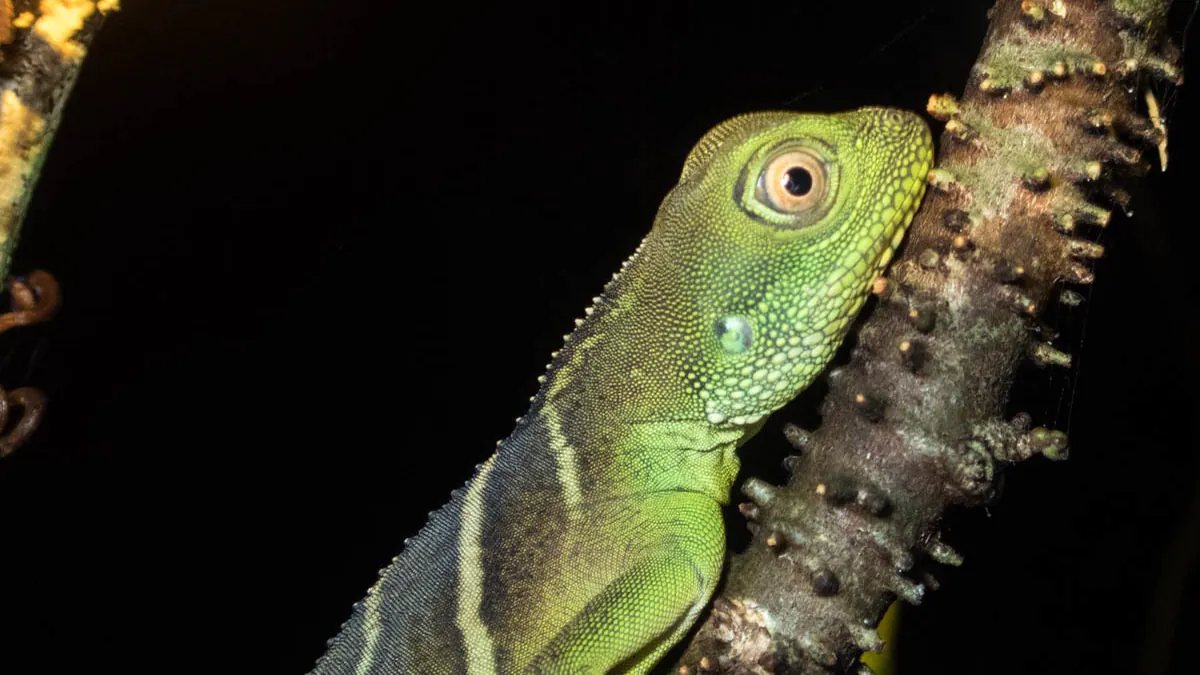

The Chinese water dragon is a bright green, lively and endearing arboreal lizard, but a nervous one: it easily injures its snout on glass when cramped. It demands a large, tall and humid enclosure with a genuine swimming area, decent UVB and 70 to 80% humidity, which suits experienced keepers.
Profile : 80 to 100 cm including tail for an adult male, 10 to 15 years of lifespan, intermediate level.
See it in the Planète Pets shop: Ventilated clear box for feeder insects, transport and quarantine, 19 cm (€17.90) · the whole shop
We don’t ship products to your country yet; our practical guide downloads anywhere: Your First Terrarium: Leopard Gecko, Bearded Dragon, Corn Snake, Ball Python (€15)
Species profile
- Lifespan
- 10 to 15 years
- Adult size
- 80 to 100 cm
- Basking spot
- 32 to 35 °C
- Humidity
- 70 to 80 %
- Minimum enclosure
- 150 × 80 × 150 cm
- Temperament
- A bright green arboreal lizard, lively and endearing but nervous, it dives into water from its branches whenever it feels threatened.
- Health watch
- snout lesions (rostral abrasions) from rubbing against the walls · metabolic bone disease and infections favoured by fouled swimming water
🩺 This health information is general in nature and does not replace a consultation: at the slightest doubt about your animal’s condition, talk to your vet.
Chinese water dragon gear, family by family
-
🍖
Food
Mainly insectivorous: crickets, roaches and worms, supplemented in adults with a little fish and some greens. Regular calcium-D3 dusting and varied prey prevent food boredom.
-
🧴
Care & grooming
Regularly inspect the snout and chin: rubbing against enclosure walls causes frequent lesions. Swimming water must be filtered or changed very often, as it readily defecates in it.
-
🎾
Toys & enrichment
Sturdy angled branches, dense plants masking the glass and a large water section to dive into: it leaps into water from branches when threatened, a behaviour to accommodate rather than prevent.
-
🏠
Bedding & habitat
An enclosure of roughly 150 x 80 x 150 cm minimum for an adult, a 32-35 °C basking spot, UVB, 70 to 80% humidity and a water basin covering a good share of the floor. Visible walls benefit from planted cover.
-
🧳
Travel & safety
A dark, padded rigid box, as it panics and leaps: never transport it in a transparent container. Keep trips short and maintain warmth and humidity.
-
🧰
Accessories
An automatic mister, basking and UVB lamps, a basin filter, a hygrometer and robust plants such as pothos. A complete setup often reaches 600 to 1 000 €.
🎾 Enrichment for a Chinese water dragon: decor that does the work
Enrichment, reptile-style
Forget the notion of toys: for a Chinese water dragon, enrichment means living in a complex environment to explore. Its days are organised around rocks to climb, hides split between warm and cool zones and substrate to scratch at.
Varying the hunt and the exploration
Release live insects at different points of the enclosure rather than always tong-feeding: hunting is an insectivore’s first enrichment. Handling stays stressful for most reptiles: ten calm minutes beat a constrained hour.
What is useless (or harmful)
The list of false good ideas is well known: providing an enclosure “buddy” (cohabitation stresses or injures most species), recycling rodent toys, installing scented resin decor, imposing daily handling. A Chinese water dragon that explores, hunts and uses its whole volume is an enriched animal — the decor does the work, not you.
Quick answers
- How do you keep a Chinese water dragon occupied?
- A complex layout (hides, relief, diggable substrate) refreshed in small touches, plus food to find rather than served at the same spot.
- Can you handle a Chinese water dragon?
- Sparingly: the species tolerates handling more than it enjoys it — favour observation.
We don’t ship products to your country yet; our practical guide downloads anywhere: Your First Terrarium: Leopard Gecko, Bearded Dragon, Corn Snake, Ball Python (€15)
🧳 Transporting a Chinese water dragon: box, temperature and escape-proofing
Transporting an ectotherm
A Chinese water dragon’s vehicle: a snug rigid box (sliding causes injuries), a few air holes, a paper or cloth floor, and complete darkness standing in for an anxiolytic. In winter, a chemical heat pack wrapped and fixed OUT of direct contact: a Chinese water dragon does not always feel a burn before the lesion.
Temperature: the journey’s only real constraint
Set a numeric goal: 24-26°C to 32-35°C inside the box, from departure to arrival. That means a car brought to temperature before the animal, no boot in summer, no extended stops in the sun. Long trips are planned for early morning in summer, midday in winter.
Safety and escape-proofing
Treat every enclosure opening as a risk: an escaped Chinese water dragon hides behind furniture and chills dangerously. Lock on the glass, vents secured, a systematic check when closing up. Also check misting-system cable ports: small species squeeze through.
Quick answers
- How do you take a Chinese water dragon to the vet?
- In a dark rigid box sized to fit, holding the 24-26°C-32-35°C range (wrapped heat pack in winter), and keeping the trip to a minimum.
- Can a Chinese water dragon escape its enclosure?
- Better than you would think: the three classic exits are unlocked glass, an unclipped vent and decor rising too close to the lid. An indoor escapee usually turns up near a heat source.
In our shop, for this use: Ventilated clear box for feeder insects, transport and quarantine, 19 cm (€17.90) · the whole shop
We don’t ship products to your country yet; our practical guide downloads anywhere: Your First Terrarium: Leopard Gecko, Bearded Dragon, Corn Snake, Ball Python (€15)
Guides to read
- Vertical terrarium for a crested gecko: height, ventilation and humidityBedding & habitat
Vertical terrarium for a crested gecko: why height matters more than floor space, what size fits each age, and how to manage the humidity cycle.
- Feeding a crested gecko: CGD powder, fruit and occasional insectsFood
Feeding a crested gecko: why complete CGD powder remains the base diet, when to add insects, and how often to feed by age.
- Tail loss in crested geckos: why you should never grab one by the tailCare & grooming
Tail loss (autotomy) in crested geckos: why the tail never grows back in this species, what handling mistakes to avoid, and what to do if it drops.
- Terrarium enrichment for a crested gecko: branches, hides and climbing supportsToys & enrichment
Terrarium enrichment for a crested gecko: why climbing supports matter as much as décor, what hides to provide, and whether to rotate the layout.
- Transporting a Green Iguana to the Vet: Carrier, Heat and StressTravel & safety
Rigid carrier, keeping the animal warm on the road, and grips to avoid with the tail: how to transport a green iguana to the vet without adding to its stress.
- Humidity and Shedding in the Chinese Water Dragon: Avoiding Skin ProblemsCare & grooming
Why the Chinese water dragon needs high humidity, how to maintain it without stagnation, and the early signs of an incomplete shed.
- Feeding a Green Anole: Which Insects, and How Often?Food
Small live insects, prey size and feeding frequency: the complete guide to feeding a green anole, a strict insectivore and a tiny lizard.
- Handling and Transporting a Pacman Frog: Limiting Stress and ContactTravel & safety
Why the Pacman frog's permeable skin means handling should stay minimal, and how to transport it safely for a vet visit.