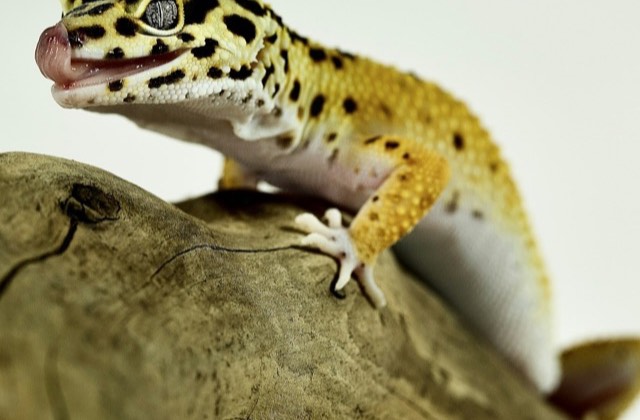
Leopard gecko: what a study on the detached tail changes about your reaction
Published by Planète Pets · managing editor: Clément Lacaille · how our guides are written
Watching a leopard gecko's (Eublepharis macularius) tail keep moving on its own after autotomy startles, or even worries, most owners. A study by Higham and Russell, published in 2010 in the journal Biology Letters, filmed detached leopard gecko tails in detail, revealing movement far more complex than a simple reflex twitch (see the study). Find all our pointers in the care and grooming section.
Contents · 5 sections
A movement that is far from random
Video analysis showed that the detached tail does not just twitch randomly: it produces jumps, flips and movement sequences that vary over time, with rhythm changes resembling coordinated motor control rather than a simple leftover nerve discharge. This variability would make the tail harder for a predator to anticipate, prolonging the distraction while the animal escapes.
Why this detail is reassuring about welfare
This sophisticated motor control suggests the tail's peripheral nervous system stays active for a while after separation, independently of the animal's brain. That does not mean the gecko itself is in pain while its tail keeps moving: autotomy is a mechanism that evolved precisely to limit the animal's overall physiological stress when caught.
What this changes about your immediate reaction
Faced with a still-moving tail, the best approach remains to leave the gecko undisturbed in a calm, secure space, without unnecessary handling, while bleeding stops on its own — usually quick in this species. Removing the detached tail from the terrarium simply prevents it from drawing prolonged attention, either the gecko's own or a tankmate's in a cohabitation setup.
What this does not change about good practice
This study does not remove the need to monitor the wound over the following days: excessive redness, swelling or unusual discharge remain signs that warrant veterinary advice, even though autotomy itself is a normal process usually free of complications in an otherwise healthy animal.
- Main finding: the detached tail produces varied, coordinated movement, not just a leftover reflex.
- Assumed function: making the distraction more effective by staying unpredictable to a predator.
- Good practice: leave the gecko undisturbed, remove the detached tail, monitor the wound without panicking.
- Warning sign: excessive redness, swelling or persistent discharge warranting veterinary advice.
This topic complements our notes on transporting and handling a leopard gecko, and connects with our study on tail diameter as a health indicator, which changes precisely as the tail regrows.
FAQ
Can the detached tail still bite or sting?
No, its movements are muscular and reflexive, with no offensive capability toward the animal itself or its owner.
How long does the tail keep moving after autotomy?
Usually a few minutes, with intensity and frequency gradually declining.
Should the tail base be disinfected after autotomy?
A clean, dry environment is usually enough; if in doubt or bleeding persists, ask an exotics vet rather than applying a random product.
An accessory from our shop for this use: Stick-on digital thermometer for aquarium and terrarium glass (€18.90) · the whole shop
This guide is part of Planète Pets’s Reptiles universe. Our advice is general in nature: for any health concern, your veterinarian remains the only reference.