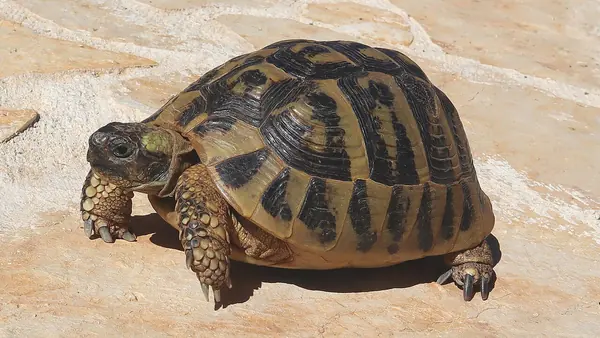
Hermann's tortoise inactive in midsummer: warning sign or normal behaviour?
Published by Planète Pets · managing editor: Clément Lacaille · how our guides are written
A Hermann's tortoise nowhere to be found on a scorching afternoon often worries its owner, when it's usually a perfectly normal behaviour. A study by Huot-Daubremont, Grenot and Bradshaw, published in 1996 in the journal Amphibia-Reptilia, fitted wild Hermann's tortoises (Testudo hermanni) with implanted temperature probes and tracked their thermoregulation over nine months: the tortoises kept their body temperature close to their preferred optimum for several hours a day, with activity turning clearly bimodal in summer, marked by a break through the hottest part of the day (see the study). Find our other pointers in the care and grooming section.
Contents · 5 sections
A two-phase activity pattern once heat sets in
In spring and autumn, the tracked tortoises stayed active almost continuously through the day. As soon as summer temperatures climbed, that same pattern gave way to two activity peaks, early morning and late afternoon, with an almost complete pause during the hottest hours.
Why this pause isn't a red flag
This break corresponds to an active search for shade to keep body temperature from exceeding the thermal optimum, rather than a sign of illness or distress. A tortoise nowhere to be found between noon and 4pm in summer, after being active that morning, is simply applying this field-documented strategy.
What it means for the outdoor enclosure
This study confirms the importance of genuinely dense shade zones, accessible at any time of day, alongside sunny spots for the morning basking session. A fully open enclosure, with no vegetation or shaded shelter, prevents the tortoise from applying this natural regulation and raises the real risk of heatstroke.
Practical pointers
- Normal in summer: bimodal activity, morning and late afternoon, a pause at midday.
- Warning sign: no activity at all even early morning, or refusing to leave shelter for several days running.
- Layout: dense shade zones (bushes, shelter) available at all times in the enclosure.
- Heatwave watch: check access to shade and water during exceptional heat spikes.
Managing shade starts right at the outdoor enclosure's construction; our article on the outdoor enclosure for Hermann's tortoise details the layout and regulations to follow. See also our Hermann's tortoise profile for its full picture.
Frequently asked questions
Should a Hermann's tortoise be brought indoors during a heatwave?
Not necessarily if the enclosure offers dense shade and accessible cool water; it's mainly a lack of sufficient shaded area that justifies a temporary indoor solution.
Does a juvenile Hermann's tortoise follow the same bimodal rhythm in summer?
The study looked at adults, but juveniles, more prone to dehydration, do better with even more generous shade access from the first heat spells onward.
How do you tell a normal summer pause from a real sign of illness?
Activity resuming as soon as temperatures drop, a good appetite morning and evening, and the absence of other symptoms (prolonged lethargy, closed eyes, total refusal to drink) are reassuring; when in doubt, an exotics vet visit is the safest call.
See it in the Planète Pets shop: Stick-on digital thermometer for aquarium and terrarium glass (€18.90) · the whole shop
This guide is part of Planète Pets’s Reptiles universe. Our advice is general in nature: for any health concern, your veterinarian remains the only reference.