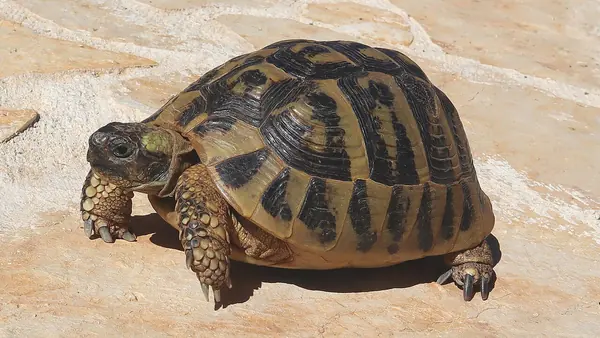
Outdoor enclosure for a Hermann's tortoise: building and safety
Published by Planète Pets · managing editor: Clément Lacaille · how our guides are written
An outdoor enclosure for a Hermann's tortoise must provide at least 5 to 10 m² per adult, escape-proof buried walls and an insulated shelter: it is the way of life closest to its natural needs. Important reminder: the Hermann's tortoise is a protected species whose keeping is strictly regulated in France (identification, declaration or authorisation depending on the number of animals, mandatory origin paperwork); check with the competent authorities before any acquisition.
Contents · 5 sections
What area and location should you choose?
Pick the sunniest part of the garden, facing south or south-east, with naturally shaded areas. The bigger the enclosure, the better: the tortoise finds temperature gradients, grazing zones and resting spots. A gently sloping plot drains rainwater; avoid damp hollows.
How do you secure the enclosure walls?
- Height: at least 40 cm above ground — tortoises climb surprisingly well;
- Walls buried 20 to 30 cm deep: this is a determined digger;
- Opaque materials (boards, breeze blocks): if it can see through, it will try to get through;
- No climbable 90° corners, and no stones near the edges;
- Netting or mesh cover for juveniles, targeted by magpies, crows and rats.
What fittings go inside?
A dry, insulated shelter (a straw-lined wooden box, 30-80 € or DIY), a shallow water dish, flat stones for thermoregulation, and edible plants: dandelion, clover, plantain, sedum. A varied substrate — soil, plus sandy areas for egg-laying — completes the setup. Total budget: 100 to 400 € depending on materials.
Is the enclosure enough all year round?
In southern regions, a healthy adult Hermann's tortoise lives outdoors year-round, with hibernation in the enclosure or in a monitored box. Elsewhere, plan a fallback: a cold frame or greenhouse over the enclosure, or hibernation in a cool room. Juveniles, being more fragile, need extra protection. Full guides on the reptile hub, in the bedding and habitat category.
Frequently asked questions
Can a tortoise roam free in the garden?
It is risky: escapes, lawnmowers, dogs, gaps in fences. A dedicated, secure enclosure protects the animal while still giving it plenty of space.
Should you keep a male and a female together?
No: in a confined space the male harasses the female. Breeding is in any case regulated for this protected species; keeping a single animal is perfectly appropriate.
See it in the Planète Pets shop: Stump-effect resin islet and hide for young aquatic turtles (€21.90) · the whole shop
This guide is part of Planète Pets’s Reptiles universe. Our advice is general in nature: for any health concern, your veterinarian remains the only reference.