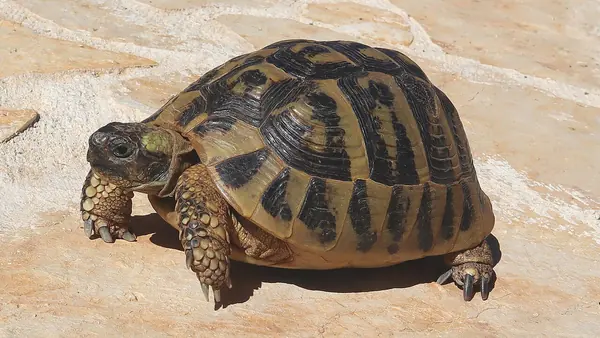
The Hermann’s and Greek Tortoise Handbook
“The Hermann’s and Greek Tortoise Handbook” is a 51-page printable PDF guide published by Planète Pets (October 2026 edition), sold for €15 VAT included: 14 chapters, 16 studies cited with their DOI, checklists, schedules and a costed budget, instant download after payment.
Choose, house, feed, hibernate and protect your Hermann’s or Greek tortoise, with a step-by-step method, schedules, checklists and a real budget.
- Clear numbers for the enclosure, hot spot, UVB, substrate and hibernation
- The legal side explained: CITES, Annex A, French paperwork, UK and US notes
- A real budget collected in 10/2026, seasonal schedules and 7 printable checklists
€15 51-page PDF to read or print
Buy the guide — €15Secure Stripe payment · Instant download after payment · 14-day money-back guarantee
Key facts
- Price
- €15 VAT included, one-off payment
- Format
- A4 PDF, 51 pages, to read or print
- Languages
- English and French (two PDFs)
- Contents
- 14 chapters, checklists, schedules, budget
- Sources
- 16 studies with verified DOI; 88 sources in all, full list at the end of the guide
- Edition
- October 2026
- Seller
- Lacangel Group (SAS, France), card payment via Stripe
- Guarantee
- 14-day money-back on a simple email
What the guide contains
14 chapters, 51 A4 pages, with tick-box checklists, schedules and a budget built from prices recorded at real retailers. Studies are cited with their DOI. The French edition is included with your purchase.
- Before You Begin. What the guide contains, how to use it, and the poison lines to know.
- Deciding: Hermann’s or Greek Tortoise?. Telling Hermann’s from Greek tortoises and their subspecies, a 50 to 100-year life, CITES and Annex A, French paperwork, with UK and US notes.
- The Outdoor Enclosure. 108 sq ft (10 m²) per tortoise, an 18 in (45 cm) fence buried 6 in (15 cm), a sunny shelter, shade, plants, predators and water.
- The Indoor Set-Up. Tortoise table or vivarium, a 95 °F (35 °C) hot spot, a 68–77 °F (20–25 °C) cool end, T5 10–12% UVB, Ferguson zone 3, replacement, thermostat and timer.
- Substrate. Fertilizer-free topsoil and play sand at least 2 in (5 cm) deep, what to avoid (gravel, shavings, litter), humidity and cleaning.
- Humidity and Water. Dry air and a moist refuge, baths twice a week, and what three sources really say about pyramiding.
- Feeding. Over 70% wild plants, a table of plants to feed and avoid, cuttlebone, calcium, frequency by age.
- Hibernation. Week-by-week preparation, box or fridge, 36–48 °F (2–9 °C), weighing and the 8–10% threshold, 6 weeks to 3 months, waking and the 7-day rule.
- Handling, Transport and Everyday Life. Picking up, children and Salmonella (CDC), car travel, beak, claws, heatwaves and holiday care.
- Health: Warning Signs and Weekly Check. Runny nose, ear abscess, egg retention, parasites, prolapse, soft shell, wounds, when to call, and a 10-point weekly check.
- Real Budget. Set-up, consumables and vet item by item, with French retailer and clinic prices collected in 10/2026.
- Schedules and Routines. Daily, weekly and monthly routine, the year season by season, the first year, weight and hibernation tracking.
- Practical Checklists. Arrival, outdoor enclosure, before hibernation, waking, holidays, heatwave, vet visit.
- Sources. 16 studies with verified DOIs, official texts and dated price collection.
Who it is for, and who it is not for
This guide is for you if…
- You are thinking of getting a Hermann’s or Greek tortoise and want everything ready, paperwork included.
- Your tortoise has just arrived and you want a reliable set-up and routine.
- You already have a tortoise and want to check its lamp, UVB, substrate and diet.
- Autumn is coming and you want to prepare a safe hibernation.
It will not help you if…
- You are looking for veterinary advice or drug dosages: this guide gives none.
- You keep a red-eared slider or another aquatic turtle: this guide does not cover it.
- You are a breeder: breeding is not covered, and the legal sections focus on France, with short UK and US notes.
Free sample
Topsoil: why “fertilizer-free”
Can you use potting soil for a tortoise? Yes, it is the recommended base, on one condition: no added fertilizer. The tortoise lives on it, burrows in it and inevitably swallows a little with its food; the RVC asks that food plants be free of pesticides and fertilizer, and the RSPCA that they be washed to remove them: the same logic applies to the soil it lives on. Read the bag and avoid:
- composts labelled “enriched”, “with fertilizer”, “slow release” or containing fertilizer granules;
- composts containing treatments (insecticide, moss killer);
- mixes whose composition is not stated.
If the label does not clearly say “no added fertilizer”, garden soil from an area never treated, sieved, is an alternative, provided you know its history.
Mixes and depth
| Situation | Mix | Depth |
|---|---|---|
| Adult Hermann’s or Greek, indoor enclosure | Fertilizer-free topsoil and play sand, for example half and half (add sand if the soil stays wet) | 2 in (5 cm) minimum (RSPCA), deeper in one corner for burrowing |
| Young tortoise | Same mix, with one corner kept slightly moist under a hide | 2 in (5 cm) minimum; deeper in the moist corner |
| Burrowing corner | Dry dead leaves or shredded paper (RSPCA) | Enough to cover the shell |
| Sick tortoise or quarantine | Newspaper or paper towels, changed daily (RVC: short term only) | — |
Base and depth: RSPCA, “Spur-thighed, Hermann’s, marginated and Horsfield’s tortoises”; short-term paper: RVC (12/2024). The proportions are a starting point to adjust to the humidity you observe.
What to avoid
The RSPCA lists as unsuitable: gravel, wood shavings, alfalfa pellets, calci-sand and cat litter. The Merck advises against gravel and pebbles for terrestrial species, as they are hard to clean and often swallowed, with a risk of gut blockage. The RVC reminds owners not to feed the tortoise directly on the substrate, especially with wood chip or sand-based substrates, to avoid accidental ingestion and blockages: serve meals on a flat stone or slate.
| Substrate | Verdict | Why |
|---|---|---|
| Fertilizer-free topsoil + play sand | Yes | Recommended by the RSPCA; allows digging and burrowing, holds some humidity |
| Newspaper, paper towels | Short term | Easy hygiene, but no natural behaviour (RVC) |
| Wood shavings | No | Unsuitable (RSPCA); ingestion risk (RVC) |
| Gravel, pebbles | No | Swallowed, blockage risk (Merck; RSPCA) |
| Alfalfa pellets | No | Unsuitable (RSPCA) |
| Calci-sand | No | Unsuitable (RSPCA) |
| Cat litter | No | Unsuitable (RSPCA) |
| Compost with fertilizer or treatments | No | The tortoise ingests some; plants and soil should be free of fertilizer and pesticides (RVC; RSPCA) |
Substrate humidity
The RVC asks for low to moderate humidity for adults, checked with a hygrometer. The substrate should feel cool and slightly moist deep down, never muddy or soaked on the surface. The next chapter explains how to create a moister corner for youngsters without wetting the whole enclosure.
Cleaning
- Every day: remove droppings, urates (white deposits) and leftover food (RVC: daily spot cleaning). Lift the soiled layer with a small scoop.
- Every week: the RVC asks for a full clean at least once a week with a suitable disinfectant: rake, remove compacted or soiled areas, top up with fresh mix, clean the water saucer, stones and hides.
- Regularly: replace the substrate entirely as soon as it smells, goes mouldy or stays compacted, and at least at each seasonal clean.
- Hygiene: wash your hands after each clean and never clean equipment in the kitchen sink (CDC, Handling chapter).
€15 one-off payment, updates included
Buy the guide — €15Not convinced? Refunded within 14 days, on a simple email.
Frequently asked questions
What format is the guide?
A PDF file to download right after payment, in French and English, ready to print (checklists and schedules included). Prices are in euros, recorded in France.
Who is it for?
New and future owners of Hermann’s or Greek tortoises, and owners who want to check their set-up or prepare hibernation. No prior knowledge is needed, and no jargon is left unexplained.
Is the guide updated?
Yes: prices, vet fees and legal references are dated (October 2026) and the guide is revised when sources change. The update date is shown in the document.
Can I get a refund?
Yes, you can ask for a refund within 14 days of purchase, with no questions asked, by writing to admin@tech-bharat.com.
Does this guide replace a vet?
No. It is not veterinary advice: it makes no diagnosis and gives no dosages. It helps you organise care, spot warning signs and call at the right time.
Seller: LACANGEL GROUP, SAS (French simplified joint-stock company) — SIREN 995 268 018 — registered office: 1 rue Marguerin, 75014 Paris, France — president: Clément Lacaille — EU VAT number FR21995268018 — administration@lacangel.fr. Price VAT included. Digital product delivered right after payment; 14-day money-back commercial guarantee. See the terms of sale.
🩺 The health watchpoints on this page are for information only: only a veterinarian can examine your animal and make a diagnosis.
How it works
Seller: LACANGEL GROUP (SAS), Paris, France, VAT FR21995268018. Prices VAT included. Terms of sale