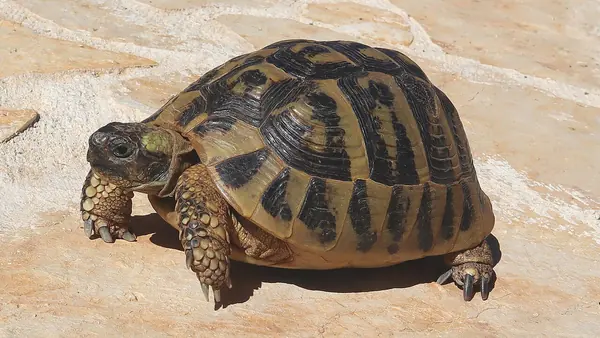
Hermann's tortoise or Greek tortoise: which one to choose?
Published by Planète Pets · managing editor: Clément Lacaille · how our guides are written
The two species are easy to mix up at first glance, but their differences genuinely matter for a future owner's choice. A study by Mitrevichin, Sakelarieva, Peshev and Pulev, published in 2023 in the journal Ecologia Balkanica, used capture-mark-recapture to follow two sympatric populations of Hermann's tortoise (Testudo hermanni) and Greek tortoise (Testudo graeca) in south-western Bulgaria between 2012 and 2022, and found that the Greek tortoise reaches a larger adult size and weight than Hermann's tortoise, while covering a markedly wider home range. Find our other pointers in the bedding and habitat section.
Contents · 5 sections
A difference in adult size
Hermann's tortoise generally stays more compact as an adult, while the Greek tortoise grows somewhat larger and heavier, a gap confirmed by the morphometric measurements in the Bulgarian study. The two also differ visually: horny spurs on the thighs in the Greek tortoise, a horny claw at the tip of the tail in Hermann's.
A very different home range
The study measured a markedly larger home range for the Greek tortoise than for Hermann's on the same site. In practice, this argues for a more generous, more varied outdoor enclosure if you go for a Greek tortoise, while Hermann's copes with a somewhat tighter space for the same perceived comfort.
Legal status: a criterion never to skip
Both species are protected and listed under Annex A of the EU CITES regulation: keeping one requires proof of origin (marking, an intra-EU certificate, or captive-bred documentation) and, depending on the case, a declaration of possession. Hermann's tortoise benefits from enhanced protection in its wild populations, which makes buying from a registered breeder rather than an undocumented private seller all the more essential.
Practical pointers
- Adult size: the Greek tortoise reaches a somewhat larger size and weight than Hermann's, according to field data.
- Outdoor space: plan a larger, more varied enclosure for a Greek tortoise, which is more territorial.
- Mandatory paperwork: a CITES certificate and a declaration of possession for both species.
- Verified origin: favour a registered breeder over an undocumented private seller.
Choosing between them also means planning day-to-day outdoor layout; our article on enriching a Greek tortoise enclosure details how to make the most of that larger space. See also our Hermann's tortoise and Greek tortoise profiles for their full picture.
Frequently asked questions
Can a Greek tortoise live with a Hermann's tortoise in the same enclosure?
This is not recommended as a rule: the two species have different territory needs, and mixing them tends to trigger tension, especially between males. Separate, even adjoining, enclosures work better.
Which of the two lives longer?
Both species can exceed 50 to 80 years in good conditions; longevity depends mainly on the quality of hibernation and diet rather than on the species itself.
Do you need a special permit to keep just one?
No, a keeping permit is only required past a certain number of animals or for breeding; an owner with one or two tortoises mainly needs proof of origin and a declaration of possession with the local authority.
See it in the Planète Pets shop: Stump-effect resin islet and hide for young aquatic turtles (€21.90) · the whole shop
This guide is part of Planète Pets’s Reptiles universe. Our advice is general in nature: for any health concern, your veterinarian remains the only reference.