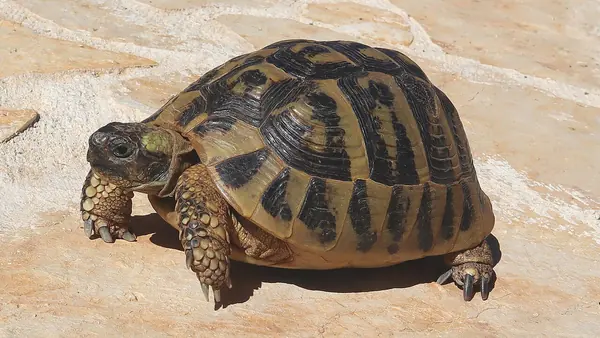
Enriching a Greek tortoise's outdoor enclosure: terrain, digging zones and complexity
Published by Planète Pets · managing editor: Clément Lacaille · how our guides are written
A tortoise's natural foraging and movement behaviour depends directly on how varied the terrain it explores really is. A study by Longepierre, Hailey and Grenot, published in 2001 in Biodiversity and Conservation, compared the home range of Hermann's tortoises (Testudo hermanni) across habitats of different complexity and found that the area covered varied sharply with terrain diversity, with animals making more intensive use of zones with varied vegetation and relief. This principle applies directly to designing a Greek tortoise enclosure. Find our other pointers in the toys and enrichment section.
Contents · 5 sections
Breaking the monotony of a flat enclosure
A close-mown rectangle of lawn, with no relief or obstacles, pushes the animal into pacing the same loop rather than genuinely exploring. Earth mounds, flat stones, low stumps and dense vegetation patches recreate distinct micro-habitats that the tortoise visits for different reasons: basking, cooling off, digging, foraging.
Dedicated digging zones
A strip of loose, untrampled soil, kept separate from the rest of the enclosure, lets the animal express natural digging behaviour, useful for escaping heat or, in females, for egg-laying. This zone benefits from staying away from busy walkways so it does not get compacted underfoot.
Vegetation that gets eaten as much as it gets walked through
Planting edible species directly in the enclosure (plantain, clover, mallow) turns grazing into a genuine exploration activity, rather than a simple daily bowl delivery. The tortoise then spends a real share of its day foraging for food, consistent with field observations on this species.
Practical pointers
- Varied relief: mounds, stones, stumps, rather than flat, uniform ground.
- A dedicated digging zone, away from busy walkways.
- Edible vegetation planted directly in the enclosure for active grazing.
- Distinct micro-habitats: sunny, shaded and cool zones spread across the space.
This terrain diversity pairs naturally with a diet built on wild plants; our article on feeding a Greek tortoise details which species to favour. See also our Greek tortoise profile for its full picture.
Frequently asked questions
Does a Greek tortoise need toys as such?
No, unlike other pets it is not objects it needs but a varied space to explore: relief and vegetation stand in well for any store-bought toy.
What's the minimum area for a genuinely stimulating enclosure?
Beyond the roughly 10 m² generally recommended for an adult, terrain diversity matters most: a small varied space often stimulates more than a large flat, uniform one.
Should the layout be refreshed regularly?
Moving a few stones or adding a new patch of vegetation now and then reignites exploration, much like a territory that naturally shifts with the seasons.
See it in the Planète Pets shop: Stump-effect resin islet and hide for young aquatic turtles (€21.90) · the whole shop
This guide is part of Planète Pets’s Reptiles universe. Our advice is general in nature: for any health concern, your veterinarian remains the only reference.