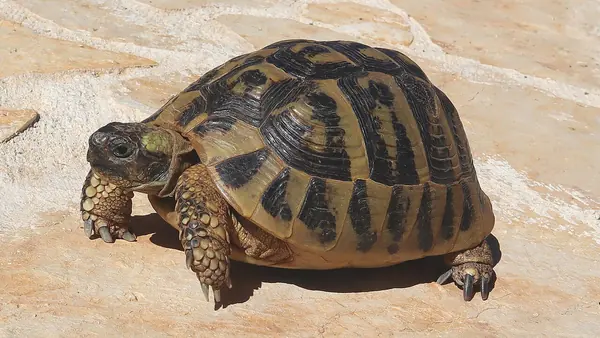
Feeding a Greek tortoise: which wild plants to favour?
Published by Planète Pets · managing editor: Clément Lacaille · how our guides are written
The Greek tortoise (Testudo graeca) selects its food far more precisely than it might appear. A study by El Mouden, Slimani, Ben Kaddour and colleagues, published in 2006 in the Journal of Arid Environments, analysed the diet of wild populations in Morocco through faecal analysis and found that the species actively seeks plants rich in water and protein but low in potassium, concentrating its foraging effort under spiny shrubs where livestock grazing pressure is lowest (see the study). Find our other pointers in the food section.
Contents · 5 sections
A base of wild plants, not store-bought salad
Dandelion, plantain, clover, wild alfalfa, mallow and edible flowers (hibiscus, pansy, nasturtium) form a diet close to what is observed in the wild. Typical salad greens such as lettuce or cucumber, too watery and too low in fibre, should stay an occasional extra rather than a daily base.
Why potassium and protein matter
The Moroccan study notes that wild tortoises avoid plants too rich in potassium, an element that puts long-term strain on kidney balance. In captivity this translates into caution around legumes and protein-heavy commercial pellets, which speed up irregular shell growth in juveniles.
Fruits and foods to sharply limit
A little ripe fruit (fig, tomato) can round out a meal as a rare treat, never as a base: sugar disrupts the gut flora of this strict herbivore. Also ban bread, dairy products and any dog or cat food, which is incompatible with its metabolism.
Practical pointers
- A base of varied wild plants, never the same single species for days on end.
- Limited potassium and protein: few legumes, never dog or cat kibble.
- Fruit as a rare treat, not a daily dietary base.
- Cuttlebone freely available for calcium intake.
This herbivorous diet comes into its own in a well-designed outdoor enclosure; our article on enriching a Greek tortoise enclosure details how to encourage natural grazing. See also our Greek tortoise profile for its full picture.
Frequently asked questions
Can a Greek tortoise eat lawn grass?
Yes in small amounts if the lawn is untreated, but it stays less nutritious than varied wild plants: better treated as a supplement than a base.
Does it need calcium supplementation on top of cuttlebone?
For an outdoor animal with good sun exposure, cuttlebone is generally enough; indoors or under imperfect UVB, occasional dusting is a reasonable safety net.
How long can a Greek tortoise go without eating?
A few days of reduced appetite stay normal, especially in hot weather or before hibernation; a prolonged fast in an otherwise active animal, however, warrants a vet visit.
See it in the Planète Pets shop: Stick-on digital thermometer for aquarium and terrarium glass (€18.90) · the whole shop
This guide is part of Planète Pets’s Reptiles universe. Our advice is general in nature: for any health concern, your veterinarian remains the only reference.