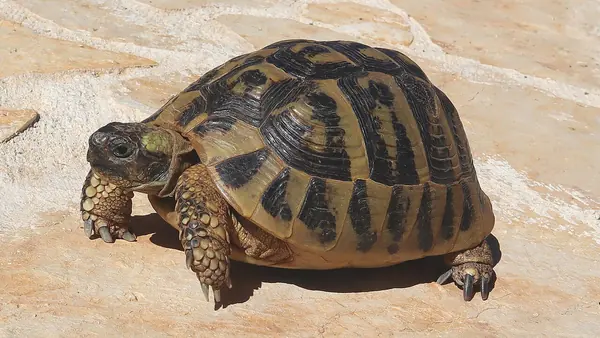
Hermann's tortoise: what a study on its seasonal hormones changes about health monitoring
Published by Planète Pets · managing editor: Clément Lacaille · how our guides are written
Preparing a Hermann's tortoise (Testudo hermanni) for hibernation usually relies on weight and behaviour cues, rarely on what is actually happening hormonally. A study by Olvera-Maneu, Navarro, Serres-Corral, Carbajal, Martínez-Silvestre and López-Béjar, published in 2024 in the journal Animals, tracked corticosterone and total triiodothyronine in semi-captive adult and juvenile Hermann's tortoises across all four seasons, and found that the two hormones vary differently depending on the animal's age and sex (see the study). Find all our pointers in the care and grooming section.
Contents · 5 sections
What the adult monitoring shows
In adult tortoises, corticosterone varies by season, but differently between males and females, while total triiodothyronine follows a seasonal rhythm shared by both sexes. This confirms that the animal's body prepares hormonally for hibernation well before the first visible signs of slowing down.
Why juveniles do not follow this pattern
Juvenile individuals in the study showed no significant seasonal variation for either hormone, unlike the adults. A young tortoise should therefore not be monitored or prepped for hibernation exactly like an adult: its seasonal physiological markers simply are not set up the same way yet.
What this means for the veterinary calendar
Bloodwork done at the wrong time of year, or interpreted without accounting for the animal's sex and age, risks misreading values that are actually normal for that period. Scheduling routine checks on a comparable date year to year, rather than at random, makes it easier to compare seasons for the same individual over time.
What this does not replace in practice
This hormonal reading remains a veterinary monitoring tool, not a substitute for the usual pre-hibernation checks: stable weight, no nasal discharge and normal digestion remain the first signals to check yourself before putting a tortoise into hibernation.
- Adults: corticosterone varies by sex, triiodothyronine varies in both sexes.
- Juveniles: no significant seasonal variation detected for either hormone.
- Good practice: schedule bloodwork on a comparable date year to year.
- Does not replace: the usual weight and general-condition checks before hibernation.
This hormonal tracking complements the seasonal notes in our guide to Hermann's tortoise summer inactivity, and connects with our tips on preparing outdoor hibernation for closely related Mediterranean tortoises.
FAQ
Should bloodwork be done before every hibernation?
It is not systematic for an apparently healthy animal; it becomes useful in case of doubt or when veterinary monitoring is already under way for another reason.
Do these results also apply to the Greek tortoise?
The study specifically covers the Hermann's tortoise; the two species are closely related, but their precise hormonal kinetics have not been directly compared.
Can a juvenile hibernate outdoors like an adult?
Many keepers prefer monitored indoor hibernation for very young individuals, which are more vulnerable to cold and sudden swings.
See it in the Planète Pets shop: Stick-on digital thermometer for aquarium and terrarium glass (€18.90) · the whole shop
This guide is part of Planète Pets’s Reptiles universe. Our advice is general in nature: for any health concern, your veterinarian remains the only reference.