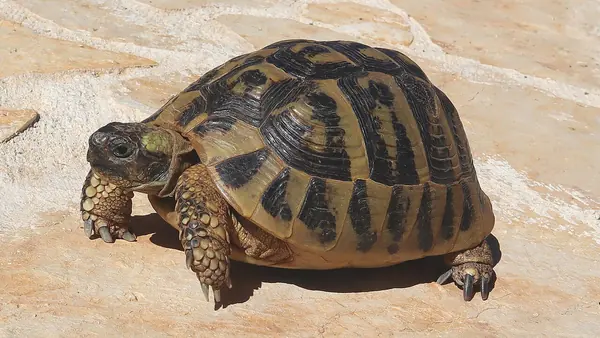
Hibernating a Greek tortoise outdoors: how to prepare it properly
Published by Planète Pets · managing editor: Clément Lacaille · how our guides are written
Like Hermann's tortoise, the Greek tortoise belongs to the Mediterranean tortoise group that genuinely needs a period of winter dormancy to stay healthy in the long run. A landmark study by Roger Meek published in 1988 in the Journal of Zoology, looking at the thermal ecology of Hermann's tortoise, a close relative of the Greek tortoise, shows just how finely these Mediterranean chelonians tune their activity and thermoregulation to seasonal temperature swings — a rhythm that captive hibernation should work with, not against. Our setup guides are gathered in the Greek tortoise bedding and habitat section.
Contents · 5 sections
A health check comes first
Never hibernate a thin, recovering tortoise, or one whose weight has not been checked in the preceding weeks: only an animal in good condition can safely go several months without eating. A vet check in autumn is strongly advised, especially for a recent arrival whose health history is uncertain.
Winding down feeding gradually
As autumn temperatures drop, appetite naturally fades. Stop feeding two to three weeks before the planned hibernation date to let the gut empty completely: undigested food residue can ferment and poison the animal during dormancy.
Choosing and securing the hibernation shelter
- Guaranteed frost-free: an insulated box filled with topsoil and dry leaves, kept in an unheated but never sub-0 °C room, or a shelter buried in the outdoor enclosure.
- Rodent-proofing: fine mesh keeps rodents from attacking a torpid, defenceless tortoise.
- Temperature tracking: a min-max thermometer in the box confirms the temperature stays stable between 5 and 10 °C all winter; our guide on tortoise hibernation equipment covers the full setup.
Monitoring without disturbing
Weigh the tortoise every two to three weeks without waking it fully: a weight loss above 10% of the starting mass over the whole hibernation should raise concern and prompt an earlier wake-up. Keepers with a large enough outdoor enclosure can draw on our guide to the outdoor enclosure for a Hermann's tortoise, which transfers well to the Greek tortoise.
Frequently asked questions
How long does Greek tortoise hibernation last?
Typically eight to twelve weeks depending on climate and the geographic origin of the bloodline, as some more southerly populations cope poorly with a long, cold dormancy.
How should wake-up be handled?
A gradual warm-up over several days, a lukewarm bath as soon as it wakes to support rehydration, then a gentle return to feeding once the animal is fully active. Browse all our guides on the reptile hub.
An accessory from our shop for this use: Stump-effect resin islet and hide for young aquatic turtles (€21.90) · the whole shop
This guide is part of Planète Pets’s Reptiles universe. Our advice is general in nature: for any health concern, your veterinarian remains the only reference.