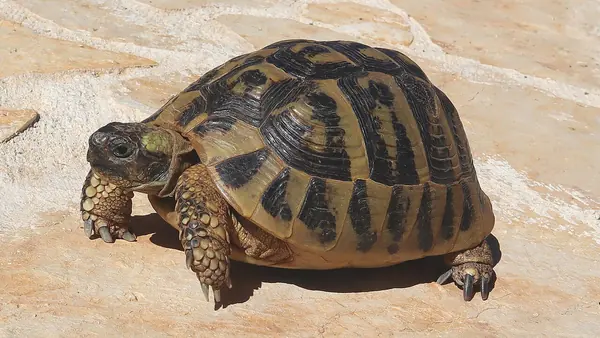
Greek tortoise: what a study on the cost of righting itself changes about enclosure terrain
Published by Planète Pets · managing editor: Clément Lacaille · how our guides are written
A Greek tortoise stuck on its back for a few minutes seems to shake it off once flipped back over, but the effort behind that simple act of righting itself is rarely quantified. A study by Ewart, Tickle, Sellers, Lambertz, Crossley and Codd, published in 2022 in the journal Scientific Reports, used respirometry and video analysis to measure the metabolic cost of self-righting in the Mediterranean spur-thighed tortoise (Testudo graeca), closely related to the Greek tortoise, and compared it with the cost of walking (see the study). Find all our notes in the bedding and habitat section.
Contents · 5 sections
An effort roughly twice as costly as walking
The study's central finding comes with a number: righting itself costs roughly twice as much energy, relative to body mass, as walking at a moderate, easily sustainable pace. Self-righting is therefore not a trivial reflex but a significant metabolic effort for a species not otherwise prone to large energy expenditures.
Why this figure changes the view on enclosure terrain
An enclosure packed with unstable obstacles, steep slopes or deep water dishes with smooth sides multiplies the chances of accidental flipping, each one representing a real energy cost, on top of the well-known risk of overheating or dehydration if the animal stays stuck in direct sun. This figure gives a concrete basis for taking seriously terrain that might have looked like a purely decorative touch to the enclosure.
What this changes about setup in practice
Favouring stable, broad-based terrain features over isolated rounded rocks, avoiding slopes steeper than 30-40°, and banning water dishes with tall, smooth sides all reduce the chances of flipping. An accessible shaded area near terrain features is also essential, so an accidental flip never turns into a heat emergency while the animal rights itself.
What this does not replace as monitoring
This energy benchmark does not excuse regular checks on the enclosure, especially during the hottest hours: a tortoise stuck on its back for more than a few minutes in direct sun risks heatstroke well before exhausting its metabolic reserves to right itself.
- Main finding: righting itself costs roughly twice as much energy as walking in the Mediterranean spur-thighed tortoise.
- Implication for the enclosure: favour stable, broad terrain features, avoid steep slopes and smooth-sided dishes.
- Point of vigilance: accessible shade near terrain features limits the risk in case of accidental flipping.
- What it does not replace: regular checks on the enclosure during hot hours remain essential.
This energy benchmark complements our guide to enriching a Greek tortoise enclosure with terrain and digging areas, and connects with our advice on veterinary monitoring for the Greek tortoise, useful for assessing overall condition after an episode like this.
FAQ
Can an adult Greek tortoise usually right itself alone?
Generally yes if the terrain allows it, but the study shows the effort remains costly; it is better to limit the chances of flipping than to rely on its ability to recover.
Should all terrain features be removed from the enclosure as a precaution?
No, stable and broad terrain features remain beneficial for enrichment and natural behaviour; it is mainly unstable or rounded elements that cause problems.
Does this study specifically concern the Greek tortoise or a related species?
It covers Testudo graeca, the species commonly called the Greek tortoise; the findings are likely transferable to other land tortoises of comparable size and shell shape.
In our shop, for this use: Stump-effect resin islet and hide for young aquatic turtles (€21.90) · the whole shop
This guide is part of Planète Pets’s Reptiles universe. Our advice is general in nature: for any health concern, your veterinarian remains the only reference.