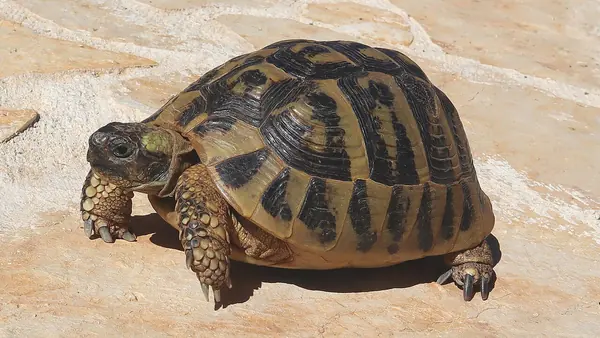
Deworming a Greek tortoise: why regular vet checks matter
Published by Planète Pets · managing editor: Clément Lacaille · how our guides are written
An active, hearty appetite does not necessarily mean a parasite-free animal. A study by Laghzaoui and colleagues, published in 2021, examined 102 wild Greek tortoises (Testudo graeca) across two arid zones of central-western Morocco and found that 92.1% of individuals carried at least one type of intestinal parasite, mostly adult pinworms present in 22.7 to 72.4% of animals depending on the site. Find our other pointers in the care and grooming section.
Contents · 5 sections
A parasite load that is often invisible to the eye
The pinworms and roundworms identified in this study generally cause no visible signs while the load stays moderate. A tortoise with a normal appetite and seemingly good activity can still carry enough of a parasite population to slow its growth or weaken its shell over the long run.
A stool check, not blanket deworming
Rather than deworming blindly, a faecal exam run by an exotics vet once or twice a year identifies which parasite is present and lets treatment be tailored if needed, avoiding unnecessary medication in an already well-balanced animal.
Habits that limit re-infestation
Removing droppings from the enclosure daily, avoiding standing moisture on the ground, and quarantining any newcomer before introducing it to the rest of the group significantly cut the risk of transmission, particularly for the protozoa identified in the study (genera Eimeria and Entamoeba among them).
Practical pointers
- Annual faecal exam even with no visible signs.
- Frequent parasite loads in animals that appear healthy, according to field data.
- Daily removal of droppings to limit re-infestation.
- Quarantine any newcomer before introducing it into a shared enclosure.
Good health monitoring goes hand in hand with well-prepared journeys; our article on transporting a Greek tortoise to the vet details how to keep these visits low-stress. See also our Greek tortoise profile for its full picture.
Frequently asked questions
Should a Greek tortoise from a breeder still be dewormed?
A faecal check remains recommended even then, as origin does not guarantee parasite-free status, especially after transport or a change of environment.
Do intestinal parasites spread between tortoises?
Yes, mainly through contact with contaminated droppings: this is why regular removal of waste and quarantining newcomers matter so much in a group setting.
Is an over-the-counter dewormer enough?
No, the species and dosage must be determined by an exotics vet after the parasite is identified: an unsuitable treatment can be ineffective or even harmful to the animal.
See it in the Planète Pets shop: Stump-effect resin islet and hide for young aquatic turtles (€21.90) · the whole shop
This guide is part of Planète Pets’s Reptiles universe. Our advice is general in nature: for any health concern, your veterinarian remains the only reference.