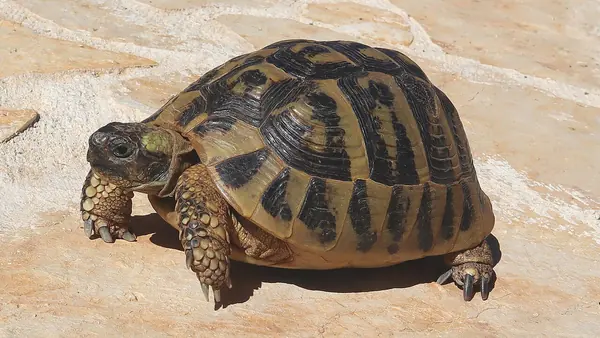
Transporting a Greek tortoise to the vet without stressing it
Published by Planète Pets · managing editor: Clément Lacaille · how our guides are written
Transport is far from a non-event for a tortoise, even over a short distance. A study by Fazio and colleagues, published in 2014 in International Scholarly Research Notices, measured blood corticosterone in Hermann's tortoises (Testudo hermanni), a species closely related to the Greek tortoise, before and after handling followed by a short road trip, and found a durable rise in baseline corticosterone still measurable four weeks later in the transported animals (see the study). Find our other pointers in the travel and safety section.
Contents · 5 sections
A rigid, padded, well-closed carrier
A rigid box sized to the animal, lined with hay or paper towel to limit sliding and knocks, remains the safest option. Avoid mesh carriers that let cold air through and soft bags, unsuited to an animal this heavy with such powerful claws.
Temperature monitored from departure to arrival
The Greek tortoise copes poorly with sudden temperature swings: keep the car cabin temperate, avoid any journey in direct summer sun as well as prolonged parking in a cold car in winter. A travel thermometer tucked near the carrier lets you quickly check ambient temperature.
Cutting down on the number and length of trips
Since the stress rise measured in the study persists for several weeks, it is better to group reasons for travel when possible (a routine check-up and a weigh-in on the same day, for instance) rather than multiplying closely spaced round trips.
Practical pointers
- Rigid, padded carrier, never a soft bag or an open mesh cage.
- Stable temperature throughout the journey, avoiding direct sun and prolonged cold.
- Grouped trips rather than frequent ones, since stress stays measurable for weeks.
- Calm handling when taking the animal out of the carrier, with no sudden movement above it.
This same concern for calm applies to everyday enclosure design; our article on enriching the enclosure explains how to reduce day-to-day stress. See also our Greek tortoise profile for its full picture.
Frequently asked questions
How long does stress last after transport?
The Hermann's tortoise study measured baseline corticosterone still elevated four weeks after a short trip, suggesting a longer-lasting effect than is usually assumed.
Can a sedative be given before a stressful trip?
No, never without veterinary advice: tortoises are sensitive to many compounds, and an incorrect dose can be dangerous. Favour a comfortable carrier and the shortest possible journey instead.
Should the tortoise be fed before the trip?
It is better to avoid a heavy meal right before travelling: a full stomach makes the animal more sensitive to jolts and nausea during the journey.
An accessory from our shop for this use: 100 × 90 cm escape-proof net with 4 corner brackets for turtle tanks (€44.90) · the whole shop
This guide is part of Planète Pets’s Reptiles universe. Our advice is general in nature: for any health concern, your veterinarian remains the only reference.