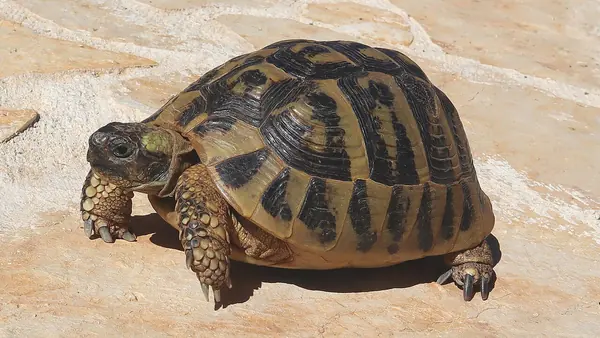
Carapace Pyramiding in Hermann's Tortoises: Causes and Prevention
Published by Planète Pets · managing editor: Clément Lacaille · how our guides are written
Hermann's tortoises grow slowly, but some individuals develop an oddly bumpy shell, with scutes that rise into cone shapes instead of lying flat. This condition, known as pyramiding, has long been documented in captive tortoises. A study by Claudia Wiesner and Christine Iben, published in 2003 in the Journal of Animal Physiology and Animal Nutrition, established a direct link between low ambient humidity, excess protein, and pyramidal shell growth (original study). Our care guidelines are gathered in the reptile care and grooming section.
Contents · 4 sections
Why the shell deforms
In a tortoise kept in air that's too dry and fed too much protein (sugary fruit, overly rich pellets, dog food), keratin builds up on each scute faster than it can spread flat, piling up at the center and forming a cone. Overly rapid growth, whether from excess calories or a lack of exercise, makes the problem worse. Tortoises raised indoors year-round, with little sunlight and reduced movement, tend to show more pronounced pyramiding than those given regular outdoor time.
Correcting humidity and diet
For a Hermann's tortoise, aim for moderate humidity with occasional damp zones (a shallow water dish, a slightly moist patch of substrate in one corner) rather than constantly dry air. On the food side, fibrous, low-protein plants (plantain, dandelion, a little alfalfa) should make up the bulk of the diet, with regular calcium supplementation. A well-designed outdoor pen, like the one described in our guide to an outdoor enclosure for Hermann's tortoise, naturally encourages exercise and steadier growth.
Can pyramiding be reversed?
Once formed, the deformity stays visible for life: keratin that has already been laid down doesn't flatten back out. Correcting humidity and diet, however, stops the progression and lets later scutes grow normally. A tortoise in good overall health, including through hibernation, tends to keep a more even shell over the long run.
Frequently asked questions
Does pyramiding hurt the tortoise?
Mild pyramiding is mostly cosmetic, but a severe deformity can weaken the shell, restrict lung capacity, and hinder movement over time.
Does a calcium supplement alone fix the problem?
No, calcium alone doesn't make up for air that's too dry or excess protein: all three factors need to be corrected together.
Do all captive-bred tortoises develop this issue?
No, a tortoise raised outdoors with a suitable diet rarely develops noticeable pyramiding. Find all our guides on the reptile hub.
See it in the Planète Pets shop: Stick-on digital thermometer for aquarium and terrarium glass (€18.90) · the whole shop
This guide is part of Planète Pets’s Reptiles universe. Our advice is general in nature: for any health concern, your veterinarian remains the only reference.