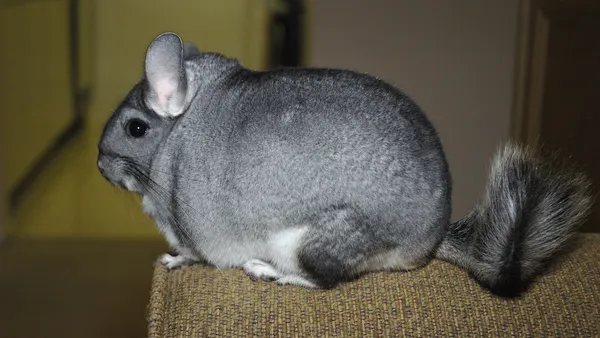
Why a chinchilla needs height: what its wild habitat reveals
Published by Planète Pets · managing editor: Clément Lacaille · how our guides are written
In its native range, a wild chinchilla doesn't live on flat ground — it occupies steep rocky outcrops, often at high altitude, where leaping from one rock face to another is its main way of escaping predators. Jiménez published a landmark review of wild chinchilla status and ecology in the journal Biological Conservation in 1996, describing a natural habitat of steep, crevice-riddled rocky terrain where the animals move mainly through vertical leaps rather than flat-ground travel. Find our comparisons in the bedding and habitat section.

Contents · 4 sections
An animal that thinks in three dimensions
This ecology explains why a chinchilla kept in a wide but low cage often stays frustrated despite generous floor space: its natural movement repertoire relies on repeated vertical leaps between levels, not horizontal travel. A cage offering only a single floor deprives the animal of most of its natural physical activity.
Turning this need into a real setup
Adding multiple levels connected by ramps or branches, set at varied rather than evenly spaced heights, comes closer to a rocky outcrop than a stack of identical platforms. Our guide on chinchilla habitat setup covers the vertical dimensions to prioritize when choosing an aviary-style enclosure over a standard cage, which is often too low for this species.
A need tied to exercise too
This leaping repertoire also explains why an undersized exercise wheel doesn't make up for a lack of height: it engages a linear running motion very different from the vertical leaping that structures the species' movement in the wild. Our guide on chinchilla exercise wheel size and safety covers the criteria to check alongside a vertical setup.
Frequently asked questions
Is a wide cage without height enough for a chinchilla?
No, floor space alone doesn't replace vertical levels; a tall cage with several tiers matches the species' natural leaping behavior far better.
How high should platforms be placed?
There's no single rule, but varying heights and spacing between platforms avoids a repetitive route and comes closer to a natural rocky terrain.
Can a chinchilla get hurt from jumping so much?
A healthy chinchilla gradually introduced to a setup jumps confidently; the main risk comes from poorly secured platforms or falls onto a hard floor, not from the jumping itself.
In our shop, for this use: Wooden hay rack with tray for rabbit, guinea pig and chinchilla (€21.90) · the whole shop
In our shop, for this use: Rolling 4-level ferret and chinchilla cage with hammock ($159.90, ships from the US) · the US shop
This guide is part of Planète Pets’s Rodents universe. Our advice is general in nature: for any health concern, your veterinarian remains the only reference.