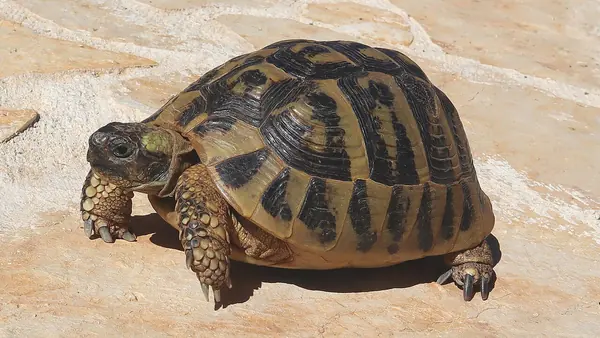
Hermann's tortoise: what a study on tortoise spatial memory changes about enrichment
Published by Planète Pets · managing editor: Clément Lacaille · how our guides are written
Hermann's tortoise (Testudo hermanni) has long been seen as an animal with limited cognitive abilities, simply foraging for food at random. A study by Wilkinson, Chan and Hall, published in 2007 in the Journal of Comparative Psychology, placed red-footed tortoises in an eight-arm radial maze and found they efficiently located food while avoiding arms they had already visited, a spatial memory performance comparable to mammals tested in the same setup (see the study). This study doesn't cover Hermann's tortoise directly, but the two species share a similar cognitive makeup among terrestrial tortoises. Find our other pointers in the toys and enrichment section.
Contents · 5 sections
Why this finding changes the approach to enrichment
If Hermann's tortoise does have comparable spatial memory abilities, a fixed food bowl in the same spot every time denies it a cognitive exercise it's capable of doing. Varying feeding spots then becomes genuine enrichment, not just a gimmick.
How to apply this principle in the enclosure
Spread food across several small piles scattered around the enclosure rather than a single spot, and change their location every meal or every other meal. An enclosure with enough planting, uneven terrain and hiding spots naturally offers more search points than a bare, flat space.
What progression to offer without overcomplicating it
Start with two or three easily reachable scatter zones, then gradually increase the number of spots and the distance between them. The goal is active exploration, not an animal struggling to find its ration: a tortoise that seems lost or stressed signals poorly calibrated enrichment, not a success.
What this enrichment doesn't replace
Scattering food stimulates active searching, but it doesn't substitute for an outdoor enclosure large enough or a balanced herbivorous diet of wild plants. It's a complement to an already-sound setup, not compensation for too little space.
- Principle: spread food across several spots rather than a fixed bowl.
- Change frequency: new location every meal or every other meal.
- Progression: start with two or three zones, increase gradually.
- Warning sign: a tortoise that seems lost signals enrichment that's too complex.
This food scattering complements the setup covered in our guide to an outdoor enclosure for Hermann's tortoise, and ties into our pointers on herbivorous feeding for this species.
Frequently asked questions
Does this enrichment also work indoors, out of season?
Yes, the scattering principle applies to any space large enough to create several distinct spots, even a smaller one than an outdoor enclosure.
Should food be fully hidden to encourage searching?
No, a visible but distant scatter is enough; fully hiding food mainly risks prolonging the fast of an animal that can't find it.
Is this memory ability useful for other kinds of learning?
The same research suggests terrestrial tortoises also retain routes and visual landmarks over several weeks, a cue for varying the exploration paths on offer.
See it in the Planète Pets shop: Stump-effect resin islet and hide for young aquatic turtles (€21.90) · the whole shop
This guide is part of Planète Pets’s Reptiles universe. Our advice is general in nature: for any health concern, your veterinarian remains the only reference.