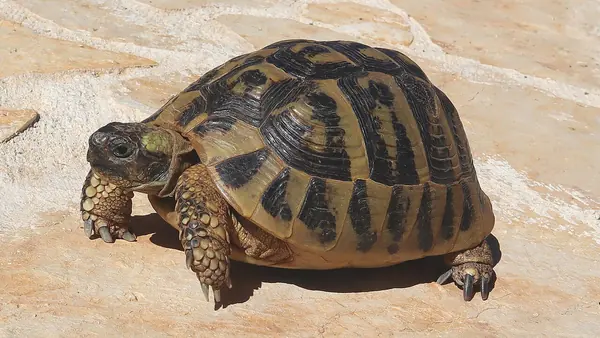
Feeding a Tortoise: The Greek and Hermann's Tortoise
Published by Planète Pets · managing editor: Clément Lacaille · how our guides are written
The Greek tortoise (Testudo graeca) and Hermann's tortoise (Testudo hermanni) are strict herbivores from Mediterranean regions. Their health depends on a diet high in fibre and calcium and low in protein and sugar. An unbalanced diet causes shell deformities and metabolic bone disease, whose nutritional origin is well documented in reptiles. Our benchmarks are in the reptile food section.
Contents · 4 sections
A base of fibrous wild plants
The ideal is a mix of edible wild plants: dandelion, plantain, clover, alfalfa, bindweed, mallow, mulberry leaves. These fibre- and calcium-rich plants reproduce the natural diet. Avoid supermarket lettuces, too poor in nutrients, and above all fruit, reserved for very rare exceptions because its sugar unbalances the gut flora.
Calcium, the absolute priority
The diet's calcium/phosphorus ratio must stay clearly in favour of calcium (around 2:1). A cuttlebone left permanently in the enclosure lets the tortoise help itself, and a powdered calcium source can top it up. Without adequate UVB, the tortoise cannot fix that calcium: diet and lighting go hand in hand, as our guide to the tortoise basking lamp reminds us.
The mistakes that cost dearly
Ban animal proteins (dog or cat food, meat), frequent fruit and an excess of oxalate-rich plants. Fast "pyramiding" growth often signals too much protein or water. Substrate matters too: a tortoise swallowing unsuitable materials while eating risks impaction, a point covered in our guide to tortoise substrate.
Frequently asked questions
Can you give green salad?
Occasionally only: lettuce is poor in nutrients. Fibrous wild plants are far superior.
How often should you feed?
Every day for a young growing tortoise, with one fasting day a week in adulthood to prevent obesity.
Should you provide water?
Yes, a shallow dish at all times, and regular lukewarm baths for the young. See the Hermann's tortoise profile and the reptile hub.
An accessory from our shop for this use: Stick-on digital thermometer for aquarium and terrarium glass (€18.90) · the whole shop
This guide is part of Planète Pets’s Reptiles universe. Our advice is general in nature: for any health concern, your veterinarian remains the only reference.