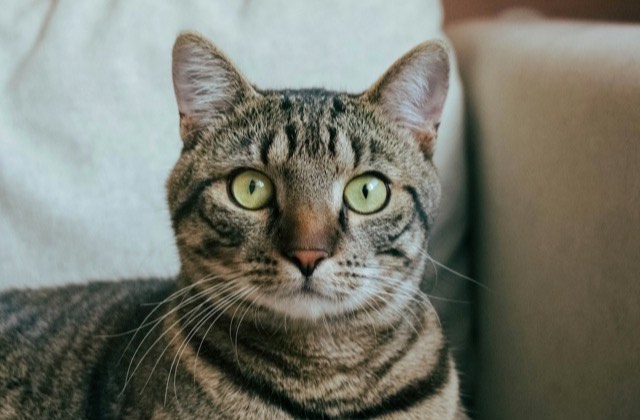
Abyssinian: rdAc retinal atrophy and how to read the DNA test before you adopt
Published by Planète Pets · managing editor: Clément Lacaille · how our guides are written
The Abyssinian is one of the best-documented cat breeds in ophthalmic genetics — for the wrong reason. Two forms of progressive retinal atrophy have been characterised in it, with two genes, two modes of inheritance and two very different ages of onset. Telling them apart is essential if you want to read a breeder's paperwork properly. The Abyssinian breed profile puts these points in context.
Contents · 6 sections
The rdAc form: late-onset and recessive
This is the common one. Marilyn Menotti-Raymond, Victor David, Kristina Narfström and colleagues identified its cause in a study published in 2007 in the Journal of Heredity: a mutation in intron 50 of the CEP290 gene creates an aberrant splice site, truncates the protein and causes late degeneration of the photoreceptors (see the study). The clinical sequence is consistent: the electroretinogram deteriorates from seven or eight months while the fundus still looks normal until around eighteen months to two years, then night vision goes before day vision, ending in complete blindness between three and five years. A three-month-old kitten that sees perfectly therefore proves nothing at all.
How many cats are carriers
The figure matters, because it drives the odds of a mating going wrong. The study by Kristina Narfström, Marilyn Menotti-Raymond and colleagues, published in 2009 in Veterinary Ophthalmology, found excellent genotype-phenotype agreement across 87 Abyssinians and Somalis, and an rdAc allele frequency of 0.20 in Scandinavia, 0.21 in the UK and 0.11 in Australia (see the study). Across a European population, that puts the order of magnitude at roughly one carrier cat in three. Another often-missed point: the mutation is not exclusive to the Abyssinian. Work by the same team, published in 2010 in The Veterinary Journal across 846 cats from more than forty breeds, found it in 16 breeds out of 43, with the Siamese showing an allele frequency of around 33% (see the study).
The Rdy form: early and dominant
Far rarer, it works through a different mechanism: a single base-pair deletion in exon 4 of the CRX gene, identified by Marilyn Menotti-Raymond and her team in a study published in 2010 in Investigative Ophthalmology & Visual Science (see the study). One copy is enough to cause disease, cones are hit before rods, and blindness arrives within the first weeks of life. This is a breeder's problem: it shows up immediately in a litter.
What you can actually ask for
Both mutations are tested separately, from a cheek swab or blood, at any mainstream veterinary genetics laboratory — budget around fifty euros and one to two weeks. Three statuses are possible for rdAc: clear, carrier, affected. A carrier sees perfectly its whole life; risk only arises when two carriers are mated, in which case on average a quarter of the kittens develop the disease. A serious cattery will show you both parents' results, dated and named. There is no treatment: the test exists solely to avoid producing blind cats.
Living with a cat that is losing its sight
A cat that goes blind slowly adapts remarkably well, provided furniture, bowls and litter tray stay put and stairs and balconies are secured. It is also a budget question: ophthalmology consultations, electroretinograms and home adaptations add up, and a condition already diagnosed is excluded from any policy taken out afterwards. Our benchmarks are in insuring an Abyssinian and in pet insurance for cats. On the breed's daily needs, see feeding an Abyssinian and the cat care and grooming section.
Frequently asked questions
Can a kitten be tested?
Yes, from a few weeks old: the test is genetic, so it depends neither on age nor on the state of the retina.
My adult Abyssinian sees fine — should I still test?
If you are considering breeding from it, absolutely. Otherwise the test only helps you plan ahead: there is no treatment for the rdAc form.
Is the Somali affected in the same way?
Yes. Somali and Abyssinian share the same genetic background and the same allele frequencies measured in the studies.
See it in the Planète Pets shop: Litter scoop with stand and bag roll in the handle (€20.90) · the whole shop
See it at Le Félin, a shop from the same family (zero commission): Arbre à chat en osier (from €174.99)
This guide is part of Planète Pets’s Cats universe. Our advice is general in nature: for any health concern, your veterinarian remains the only reference.