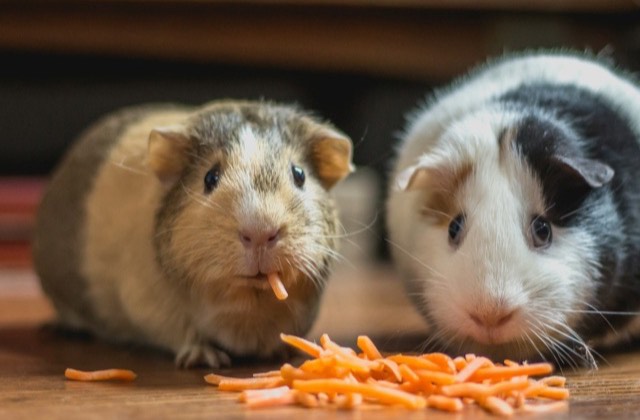
The guinea pig's "wheek": a learned call tied to food
Published by Planète Pets · managing editor: Clément Lacaille · how our guides are written
That high-pitched, repeated squeal a guinea pig lets out the moment it hears a bag of pellets rustling or a fridge door opening isn't random at all. A landmark study by J. C. Berryman, published in 1976 in the journal Zeitschrift für Tierpsychologie, catalogued the guinea pig's vocal repertoire and found that this call, known as "wheeking", is closely tied to food-anticipation situations, and grows stronger as the animal learns which cues predict a meal (see the study). Find our comparisons in the food section.
Contents · 4 sections
A call learned through experience
A young guinea pig settling into a new home won't necessarily wheek from day one: it's by associating specific sounds or actions (a cupboard opening, a bag rustling) with the meal that follows that the reflex builds up, sometimes within just a few weeks. The more consistently the association repeats, the faster and more predictable the response becomes.
A social signal as much as a food one
This call isn't just a simple reflex: it also serves to communicate with other guinea pigs in the group, especially around mealtimes, when it can spread from one animal to another. A well-fed group with a synchronized feeding schedule will often wheek in chorus the moment a familiar cue sounds.
Careful not to reinforce the wrong habit
Consistently giving in to this call by offering a treat outside scheduled meals strengthens the association and can lead to more and more frequent demands, at the expense of a diet balanced for the species. It's better to keep feeding times regular and rely on fresh daily portions, as covered in our guide on daily fresh vegetables for guinea pigs, rather than treats given in response to the call. Vitamin C remains the species' top nutritional priority, covered in our guide on guinea pig nutrition.
Frequently asked questions
Do all guinea pigs wheek?
The vast majority do, but the intensity and frequency vary with the individual's temperament and how consistent its feeding cues are.
Should I ignore this call entirely?
No, it signals a normal state of anticipation; the key is not responding to it systematically with an off-schedule treat.
Is a guinea pig that stays silent at mealtime a problem?
Not necessarily: some individuals are naturally quieter; a sudden change in a usually vocal animal, however, deserves closer attention.
See it in the Planète Pets shop: Wooden hay rack with tray for rabbit, guinea pig and chinchilla (€21.90) · the whole shop
This guide is part of Planète Pets’s Rodents universe. Our advice is general in nature: for any health concern, your veterinarian remains the only reference.