Vertical or horizontal terrarium: how do you choose by species?
Published by Planète Pets · managing editor: Clément Lacaille · how our guides are written
Choosing between a vertical and a horizontal terrarium mainly depends on the species' natural lifestyle: an arboreal animal needs height to climb, a ground-dwelling animal mostly needs floor space. Getting the orientation wrong does not make the terrarium unusable, but the animal makes poor use of a space that does not match its natural habits.
Contents · 5 sections
Which species need a vertical terrarium?
Crested geckos and many arboreal gecko species spend most of their time up high, on branches or against the glass. A tall terrarium with several levels of branches and vines lets them move vertically the way they would in the canopy. A terrarium that is too short forces them to stay near the ground, an environment that does not match their needs.
Which species need a horizontal terrarium?
Bearded dragons, corn snakes and red-eared sliders mostly move around at ground level: they need length and width rather than height. For a bearded dragon, for instance, floor area directly determines the thermal gradient between the basking spot and the cool zone, a point covered in our reptile habitat section.
Are there species that need both?
- Juvenile bearded dragon: benefits from a few raised perches while still spending most of its time on the ground;
- Ball python: appreciates a low branch but remains primarily a ground-dwelling snake;
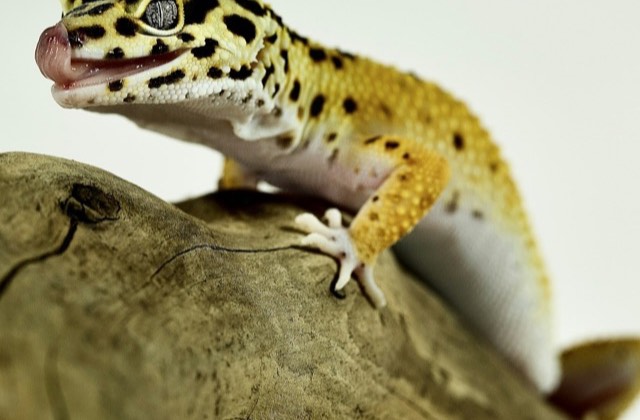
- Leopard gecko: fully terrestrial, no need for height;
- Crested gecko: almost exclusively arboreal, a horizontal terrarium deprives it of essential cues.
When in doubt, research the species' natural behaviour before buying the terrarium: it is simpler than having to replace it once the animal has settled in.
What impact does this have on heating and lighting?
A vertical terrarium often needs a vertical or angled UVB fixture to cover the upper levels where the animal perches, otherwise the higher zones stay under-exposed. A horizontal terrarium makes it easier to spread a classic thermal gradient from one end of the tank to the other. Either way, a thermostat remains essential to avoid any localised overheating.
Frequently asked questions
Can a horizontal terrarium be converted into a vertical one?
No, the frame does not change shape: you need a different terrarium if the orientation no longer matches the species' needs.
Does a roughly square terrarium suit every species?
A near-square footprint can work for a juvenile while waiting for a suitable adult terrarium, but it is never the best long-term option.
Does size matter more than orientation?
Both matter: a large terrarium with the wrong orientation still goes underused by the animal, even if the total volume is sufficient.
An accessory from our shop for this use: Stick-on digital thermometer for aquarium and terrarium glass (€18.90) · the whole shop
This guide is part of Planète Pets’s Reptiles universe. Our advice is general in nature: for any health concern, your veterinarian remains the only reference.