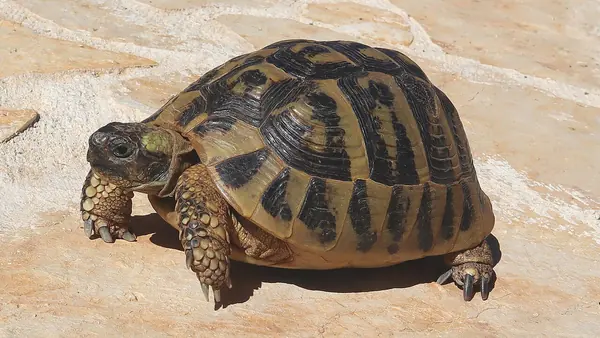
Hermann's tortoise: what a UVB lamp study changes about your lighting choice
Published by Planète Pets · managing editor: Clément Lacaille · how our guides are written
Choosing between a mercury-vapor lamp and a fluorescent tube for a Hermann's tortoise (Testudo hermanni) is a common question, often settled purely on the UVB output printed on the box. A study by Selleri and Di Girolamo, published in 2012 in the American Journal of Veterinary Research, split 18 healthy Hermann's tortoises between an outdoor enclosure under natural sunlight, a self-ballasted mercury-vapor lamp and a UVB-emitting fluorescent tube, then measured plasma vitamin D3 levels after 35 days (see the study). Find all our gear in the accessories section.
Contents · 5 sections
What natural sunlight shows
Tortoises housed outdoors, exposed to unfiltered sunlight, held or increased their vitamin D3 levels over the course of the study. Neither artificial source reproduced this effect, a reminder that even the best lamp remains a fallback compared to genuine outdoor exposure whenever climate allows it.
Why both artificial lamps declined
In tortoises under the mercury-vapor lamp, vitamin D3 levels fell from roughly 368 nmol/L at the start of the study to roughly 156 nmol/L after 35 days; under the fluorescent tube, the drop was comparable, from about 314 to 134 nmol/L. In both cases the level stayed above severe deficiency, but the trend was clearly downward even though nothing else about the animals' care had changed.
What this means for choosing a lamp
A decline within just five weeks suggests a lamp installed once and forgotten is not enough: distance to the animal, no glass or mesh filtering the UVB path, and strictly following the manufacturer's stated bulb lifespan all matter as much as the model chosen at the outset. A mercury-vapor lamp combines heat and UVB in a single source, simplifying setup, while a fluorescent tube needs a separate heat lamp but covers a larger area of the enclosure.
What this does not change about the rest of the protocol
This study does not remove the need for the calcium supplementation usually recommended for Hermann's tortoises: UVB helps synthesise vitamin D3, but without enough dietary calcium, the metabolic chain stays incomplete. Regular outdoor access, whenever weather allows, remains the simplest complement to an indoor UVB lamp.
- Natural sunlight: the only source that held or increased vitamin D3 levels in the study.
- Mercury vapor: dropped from about 368 to 156 nmol/L over 35 days.
- Fluorescent tube: a comparable drop, from about 314 to 134 nmol/L.
- Good practice: respect the tube's replacement schedule and favor outdoor access whenever possible.
This lighting choice complements the seasonal hormone tracking covered in our guide to Hermann's tortoise brumation, and connects with our notes on setting up an outdoor enclosure, which reduces reliance on the lamp in the first place.
FAQ
Should the UVB lamp be replaced even if it still looks bright?
Yes, UVB output often declines well before visible light dims; follow the manufacturer's replacement schedule rather than judging by the bulb's appearance.
Does window glass let sunlight's UVB through?
No, ordinary glass blocks almost all UVB; genuine outdoor access or a suitable indoor lamp remain necessary.
Can a Hermann's tortoise kept indoors year-round stay healthy?
Yes, with a suitable UVB lamp correctly positioned and replaced on schedule, though regular outdoor access remains preferable whenever climate allows.
An accessory from our shop for this use: Stick-on digital thermometer for aquarium and terrarium glass (€18.90) · the whole shop
This guide is part of Planète Pets’s Reptiles universe. Our advice is general in nature: for any health concern, your veterinarian remains the only reference.