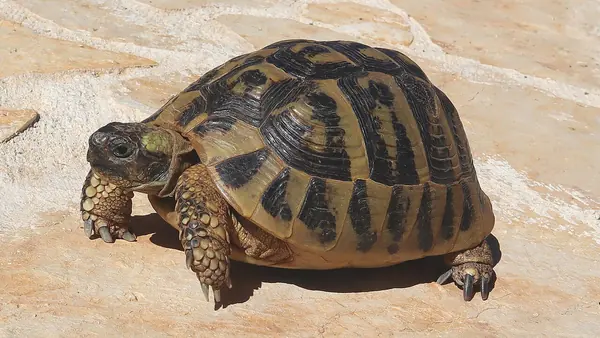
Greek tortoise: what a study on a cousin tortoise reveals about its learning ability
Published by Planète Pets · managing editor: Clément Lacaille · how our guides are written
The Greek tortoise (Testudo graeca) has long been seen as an animal with limited cognitive ability, rarely discussed in terms of behavioural enrichment. A study by Wilkinson, Kuenstner, Mueller and Huber, published in 2010 in the journal Biology Letters, tested social learning in the red-footed tortoise (Chelonoidis carbonaria), another land tortoise likewise considered largely unsocial, with results that challenge that assumption across land tortoises generally (see the study). Find all our gear in the toys and enrichment section.
Contents · 5 sections
A test built for a species assumed to be unsocial
Researchers first trained a "demonstrator" tortoise to walk around a low V-shaped barrier to reach a food reward, then let naive tortoises watch this task performed from behind a glass partition. The observer tortoises later solved the same problem significantly faster than tortoises that had never watched a demonstration.
Why this result surprised researchers
Land tortoises do not live in structured groups and show little complex social behaviour in the wild, which had suggested that observational learning would likely be out of reach for them. This result instead suggests the ability may be more widespread among reptiles than assumed, including in species without notable social lives.
What this means for your Greek tortoise
While the study covered a red-footed tortoise rather than the Greek tortoise directly, it invites a rethink of the assumption that land tortoises are incapable of complex learning. Regularly varying the layout of obstacles, hides and digging areas in the enclosure, rather than settling on a fixed setup once and for all, gives the animal a chance to exercise behavioural flexibility that its captive routine rarely calls on otherwise.
What this does not change about the basics
This cognitive enrichment stays secondary to the already well-documented physiological needs of the Greek tortoise: temperature, UVB and varied plant-based feeding still come first whenever time or budget is limited.
- Apparatus tested: navigating around a V-shaped barrier after watching a demonstrator tortoise.
- Notable result: significantly faster learning in tortoises that had observed the demonstration.
- Relevance to the Greek tortoise: another land tortoise species likewise assumed unsocial, a comparable ability is plausible.
- Priority: basic physiological needs still come before cognitive enrichment.
This enrichment angle complements our notes on enriching the enclosure with terrain and digging, and connects with our guide to feeding wild plants, another lever for daily activity.
FAQ
Does the Greek tortoise normally live in groups in the wild?
No, it leads a largely solitary life in the wild, which makes its possible capacity for observational learning all the more notable.
Should several Greek tortoises then be kept together to encourage this learning?
No, that is not recommended without understanding the species' specific cohabitation needs; varying enclosure layout is enough to stimulate a single animal.
Can a Greek tortoise learn to recognise its owner?
Many owners report a learned association with feeding times and gestures, consistent with real learning ability, without this amounting to demonstrated individual recognition.
In our shop, for this use: Stick-on digital thermometer for aquarium and terrarium glass (€18.90) · the whole shop
This guide is part of Planète Pets’s Reptiles universe. Our advice is general in nature: for any health concern, your veterinarian remains the only reference.