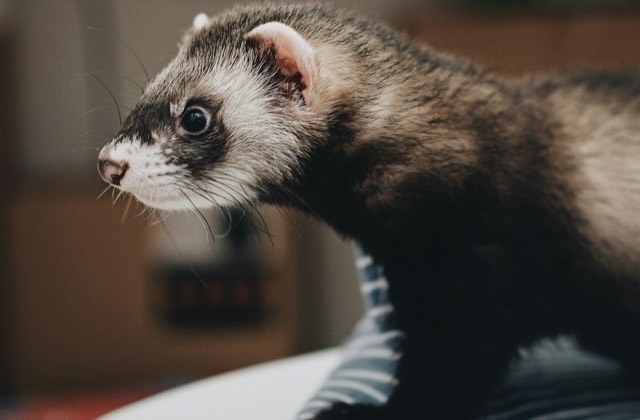
Play fighting or real aggression between ferrets? What a landmark polecat study teaches
Published by Planète Pets · managing editor: Clément Lacaille · how our guides are written
Two ferrets rolling over each other, squealing and mouthing, can worry a first-time owner, even though it is almost always perfectly normal play. Find all our enrichment ideas in the ferret toys and enrichment section.
Contents · 4 sections
What a landmark polecat study shows
A study by Poole, published in 1966 in the Symposia of the Zoological Society of London, analyzed play behavior in detail in the European polecat, the direct wild ancestor of the domestic ferret. This foundational work isolated postures and motor sequences specific to play, clearly distinct from those seen during real aggression between individuals, laying the groundwork for a reading grid still used today by mustelid ethologists.
The signals that separate play from aggression
- A loose, arched body, often paired with sideways hops and a low posture, typical of the "weasel war dance" rather than the stiff, low-to-the-ground body seen during a genuine threat.
- Inhibited bites that leave no mark, interspersed with pauses where the two ferrets swap the roles of chaser and chased.
- High-pitched squeals during the action, very different from the hisses or dull teeth-clacking that signal real aggression.
What this means day to day
Recognizing these signals keeps owners from needlessly interrupting healthy play, while staying alert to genuine shifts into aggression, more common when introducing a new ferret to an established group. This reading grid lines up directly with what is seen in kits, covered in our article on play biting and learning bite inhibition. A useful habit is watching the first few minutes of any new pairing closely, since that is when a role reversal either happens naturally or fails to, giving the clearest early read on how the interaction is likely to unfold.
Frequently asked questions
Should two loudly squealing ferrets always be separated?
No, high-pitched squealing paired with a loose, bouncy posture generally signals healthy play that needs no intervention.
How do you spot the moment play actually tips into aggression?
A body that suddenly stiffens, bites that leave a mark, and no swapping of roles are the most reliable warning signs.
Does this study transfer directly to the domestic ferret?
Since the European polecat is the ferret's direct ancestor, the behavioral repertoire observed largely carries over to today's domestic animal.
Does a solitary ferret show this play behavior too?
Yes, often alone with its toys, in a toned-down form that repeats the same hops and loose postures described in the polecat. Find all our guides on the ferret hub.
See it in the Planète Pets shop: 2-in-1 felt tunnel and hideout for rabbits and ferrets (44 × 60 cm) (€37.90) · the whole shop
This guide is part of Planète Pets’s Ferrets universe. Our advice is general in nature: for any health concern, your veterinarian remains the only reference.