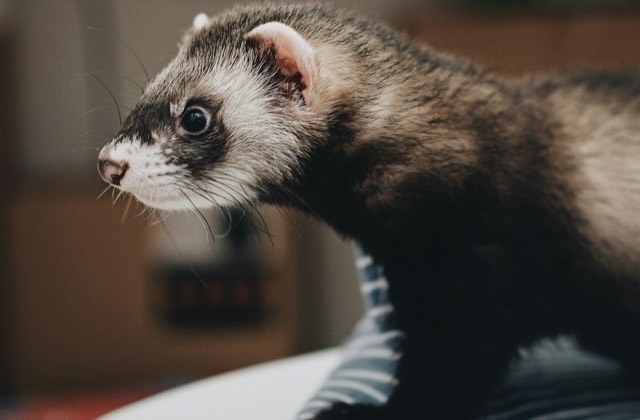
Recognizing your ferret's psychological well-being: what a 2024 behavioural study shows
Published by Planète Pets · managing editor: Clément Lacaille · how our guides are written
A physically healthy ferret isn't automatically a happy one: psychological well-being shows up in specific behaviours, which recent research has tried to catalogue rigorously. Find all our health guidance in the ferret care and grooming section.
Contents · 4 sections
What a 2024 study shows
A study by Goodfellow, Hong, Piskoun and coauthors, published in 2024 in Scientific Reports, built an ethogram of behaviours linked to play and positive mood in young laboratory ferrets, aged 3 months (juveniles) and 6 months (young adults) (study on Nature). Play and positive-affect behaviours, including the "dook" vocalization typical of a playful ferret, were significantly more frequent in adults than in juveniles. Juvenile ferrets also took longer to venture out into a new open space, a sign possibly linked to greater novelty-related anxiety at that age.
Signals to watch for in your own ferret
- The "dook," or play chuckle, often paired with sideways hops and a relaxed posture, remains one of the most reliable indicators of a positive state in this species.
- Quick, spontaneous exploration of a new space or object generally reflects healthy confidence and curiosity, unlike prolonged hesitation before venturing out.
- A normal difference between young and adult ferrets: a kit being more cautious around novelty isn't necessarily a red flag, since this behaviour tends to fade with age according to the study.
How to use these cues day to day
Watching whether your ferret promptly explores a new piece of enrichment, like an indoor playpen, or vocalizes during play sessions, gives a concrete read on its state, alongside keeping an eye on its usual sleep pattern. These informal observations line up with the traits already identified in our article on ferret personality, since some profiles are naturally more expressive than others.
Frequently asked questions
What is "dooking" in ferrets?
It's a low, repeated vocalization made during play, considered one of the most reliable signs of good mood in this species.
Is a ferret that doesn't explore automatically unwell?
Not necessarily in a juvenile, where this caution is normal, but new hesitation in a usually curious adult deserves attention.
Do these signs replace a vet visit?
No, they complement daily observation without replacing an exam if there's any doubt about physical health.
Does psychological well-being change with age?
Yes, the study shows clear differences between juveniles and young adults, a useful reference point to avoid worrying unnecessarily. Find all our guides in the ferret hub.
An accessory from our shop for this use: Double-layer plush hammock for rats, squirrels or ferrets (€18.90) · the whole shop
This guide is part of Planète Pets’s Ferrets universe. Our advice is general in nature: for any health concern, your veterinarian remains the only reference.