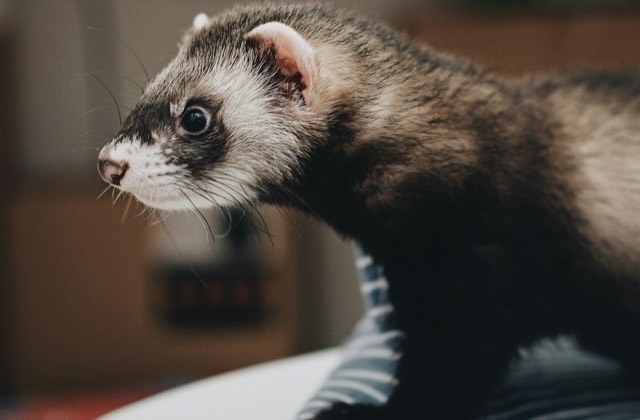
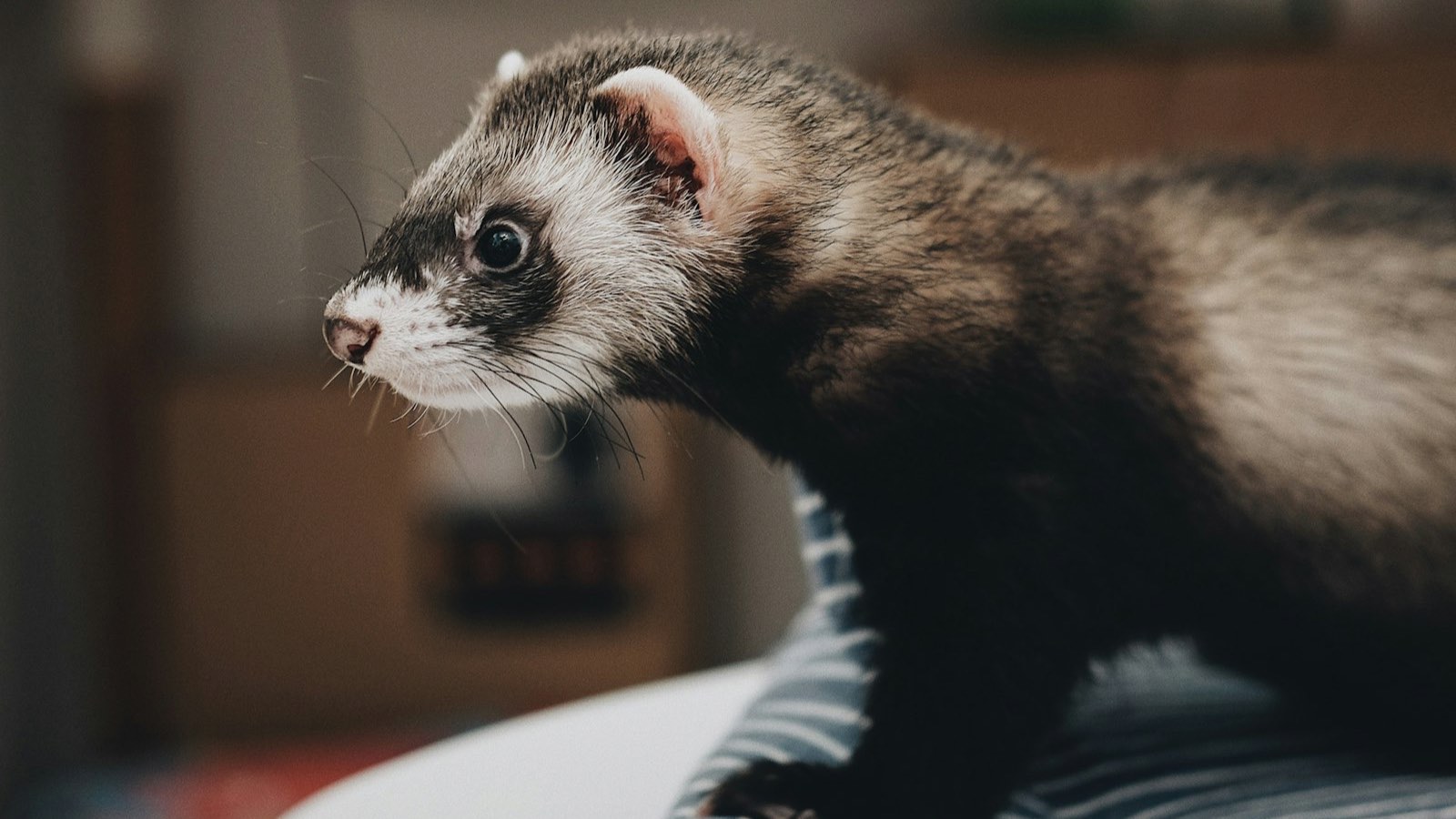
The ferret's "dook": what this little chuckle reveals about its well-being
Published by Planète Pets · managing editor: Clément Lacaille · how our guides are written
That quick little chuckle, often compared to a clucking hen, that a ferret lets out mid-chase or while exploring a new toy has a name among enthusiasts: the "dook." A recent study confirms it's far more than background noise. Find all our enrichment picks in the ferret toys and enrichment section.
Contents · 5 sections
What is a ferret's "dook"?
The dook is a short, repeated vocalization tied to a state of positive excitement: solitary play, chasing a companion, discovering a new object, or interacting with an enrichment item. It often accompanies the famous "weasel war dance," the species' characteristic bouncing, hopping display.
What does the reference study on this vocalization show?
A study by Goodfellow, Hong, Piskoun, Proctor, Cantu and Fiskum, published in 2024 in the journal Scientific Reports, analyzed play and positive-affect behaviors in juvenile and adult laboratory ferrets (study on Scientific Reports). The authors found that the dook is the single most frequent vocalization among all play behaviors observed, that it occurs both alongside a companion and alone while interacting with an enrichment item, and that it strongly drives the overall play and positive-affect score. Its frequency alone could therefore serve as a simple, informative marker of an animal's psychological well-being.
How can this observation be put to use day to day?
- Watch for dook frequency during play sessions as an encouraging signal, alongside posture and energy level.
- Rotate enrichment items regularly to trigger this behavior even without another ferret around, as our ferret toys and tunnels guide covers.
- Don't worry about a ferret dooking alone: the study confirms a social context isn't required to trigger this expression of positive excitement.
Does the absence of dooking signal a welfare problem?
Not necessarily on its own, but a lasting drop in this behavior in a previously expressive ferret is worth weighing alongside the other boredom signals covered in our article on owner perception of ferret boredom, particularly overly confined housing or too little out-of-cage time.
Frequently asked questions
Do all ferrets dook equally often?
No, there's substantial individual variation; the study mainly compared group-level trends between juvenile and adult ferrets rather than setting a universal threshold.
Can dooking express something other than joy?
In the context studied, it stays tied to positive affect; other vocalizations, like hissing or a sharp scream, instead signal fear or pain.
Should you actively encourage this vocalization?
There's no need to prompt it directly: it appears spontaneously once a ferret has a stimulating environment. Find all our guides in the ferret hub.
See it in the Planète Pets shop: 2-in-1 felt tunnel and hideout for rabbits and ferrets (44 × 60 cm) (€37.90) · the whole shop
This guide is part of Planète Pets’s Ferrets universe. Our advice is general in nature: for any health concern, your veterinarian remains the only reference.