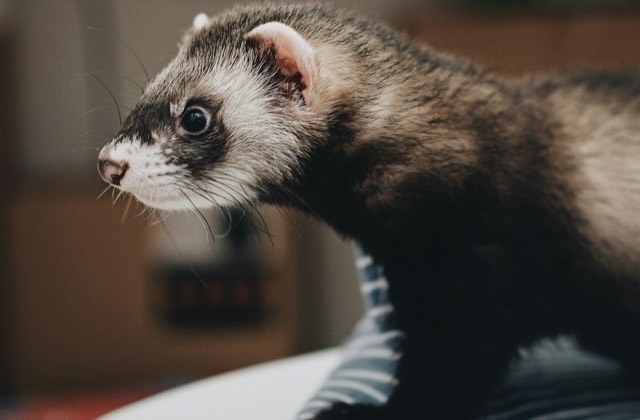
Domestic ferrets and wild polecats: what a comparative study reveals about domestication
Published by Planète Pets · managing editor: Clément Lacaille · how our guides are written
The domestic ferret still carries the manner of a small wild predator: digging, chasing, play-biting. A landmark study compared its behaviour precisely to that of the European polecat, its direct wild ancestor, to measure what centuries of domestication actually changed. Find all our enrichment picks in the ferret toys and enrichment section.
Contents · 5 sections
Why compare the domestic ferret to the wild polecat?
Understanding what domestication changed — or didn't — helps pin down the real behavioural needs of a pet ferret, rather than relying solely on assumptions about a "fully domesticated" animal.
What does Poole's reference study show?
A study by Poole, published in 1972 in the Journal of Zoology, compared the behaviour of the European polecat (Mustela putorius), the domestic ferret (M. furo) and their hybrids, notably in unfamiliar surroundings and in the presence of humans (study on Wiley Online Library). The central finding: the domestic ferret stands apart from the wild polecat by not developing a fear of humans, whereas hybrids of the two, raised by their mother during a critical period between 7.5 and 8.5 weeks of age, instead develop that fear just like the wild polecat. Domestication therefore acted specifically on tolerance toward humans, without erasing the exploratory behaviours inherited from the wild species.
What does this mean for enriching a pet ferret?
- Never underestimate the need for digging and exploring, a behaviour inherited from the wild polecat and not removed by domestication, as shown by our guide to XXL tunnels and modular play circuits.
- Respect the sensitive socialisation window before eight and a half weeks, a benchmark drawn directly from this study, alongside the ideal age to adopt a ferret kit.
- Treat tolerance of humans as earned, not guaranteed: a kit isolated from all human contact during this critical period can, like the hybrids in the study, develop a lasting fear.
Has the ferret lost all its predatory instincts, then?
No, and that's precisely what this study and later work on the species confirm: chasing, play-biting and caching behaviours remain very much present in the domestic ferret, which is why it's worth giving them proper outlets rather than trying to suppress them.
Frequently asked questions
Could a wild polecat become as sociable as a domestic ferret?
Not on the same timeline or with the same reliability: the study shows tolerance of humans remains a far less stable trait in the wild polecat, even with early handling.
Are polecat-ferret hybrids kept as pets?
Rarely, precisely because of the more unpredictable behaviour toward humans this study documented.
This finding dates from the 1970s — is it still relevant today?
Yes, it remains a standard reference in the literature on mustelid domestication and still shapes how modern ferret enrichment is thought about. Find all our guides in the ferret hub.
An accessory from our shop for this use: 2-in-1 felt tunnel and hideout for rabbits and ferrets (44 × 60 cm) (€37.90) · the whole shop
This guide is part of Planète Pets’s Ferrets universe. Our advice is general in nature: for any health concern, your veterinarian remains the only reference.