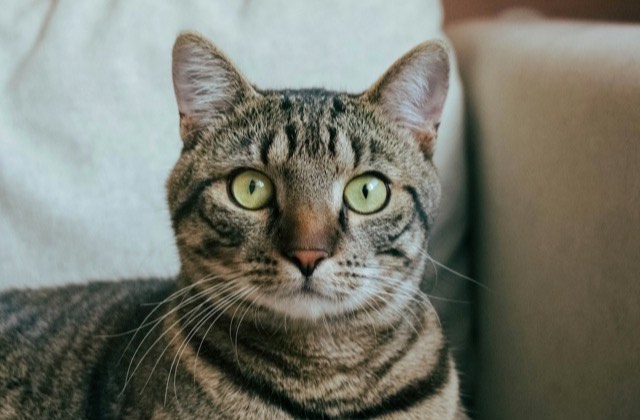
Slow feeder bowl or lick mat for a cat that eats too fast?
Published by Planète Pets · managing editor: Clément Lacaille · how our guides are written
For a cat that gulps its ration in a matter of seconds, a slow feeder bowl remains the simplest everyday fix, while a lick mat suits owners who want to turn mealtime into a proper enrichment session. A study by Dantas, Delgado, Johnson and Buffington, published in 2016 in the Journal of Feline Medicine and Surgery, reviewed the use of food puzzles in cats and found they clearly lengthened mealtime while reducing certain stress- or boredom-related behaviors (see the study). See more pointers in the food section.
Contents · 5 sections
Why do some cats eat so fast?
A cat that experienced food competition early on (a large litter, a former colony life, sharing a home with a faster eater) often keeps that reflex of gulping down its ration without really chewing. Others simply eat fast out of sheer enthusiasm, or because a flat, wide classic bowl offers no obstacle at all between mouth and kibble.
How does a slow feeder bowl work?
Ridges, bumps or dividers built into the bottom of the bowl (8 to 20 €) force the cat to pick kibble out piece by piece rather than hoover up whole mouthfuls. It's the easiest option to slot into an existing routine: it simply replaces the usual bowl without changing the cat's landmarks, and cleanup is easy since most go straight in the dishwasher.
What does a lick mat add on top of that?
A lick mat or snuffle mat (12 to 30 €), with fabric flaps where kibble hides, also engages the cat's sense of smell and patience, in a way that echoes hunting. Mealtime stretches noticeably longer than with a ridged bowl alone, but upkeep demands more discipline: a poorly cleaned mat traps greasy residue and can attract insects in summer.
Which one to pick depending on the situation?
- A cat rushed by the presence of another animal benefits mostly from a slow feeder bowl, quicker to set up at every meal
- An indoor cat lacking stimulation gains more from a lick mat, which adds real occupied time on top of the slowdown
- A kitten or a senior cat with fragile teeth copes better with a shallow-ridged bowl than a mat whose textures can be fiddly to work with
- The two accessories combine without issue, alternating by meal or by day of the week
Our guide to the slow feeder bowl for cats covers the available models, and the article on the snuffle mat for cats walks through how to use it step by step.
Frequently asked questions
Do these accessories stop regurgitation on their own?
They often reduce how often it happens by slowing eating down, but regurgitation that persists despite a real slowdown deserves a vet visit to rule out another cause.
Do I need to change the ration when switching to these accessories?
No, the amount of kibble stays the same; only the time and effort needed to get it changes.
Can a cat refuse these accessories at first?
Yes, some cats get discouraged by an unfamiliar obstacle; starting with a small amount of clearly visible kibble and adding difficulty gradually makes adoption easier.
An accessory from our shop for this use: Raised-edge silicone feeding mat for cats (€25.90) · the whole shop
For your cat, at Le Félin (same family, zero commission): Petit arbre à chat compact (from €84.99)
This guide is part of Planète Pets’s Cats universe. Our advice is general in nature: for any health concern, your veterinarian remains the only reference.