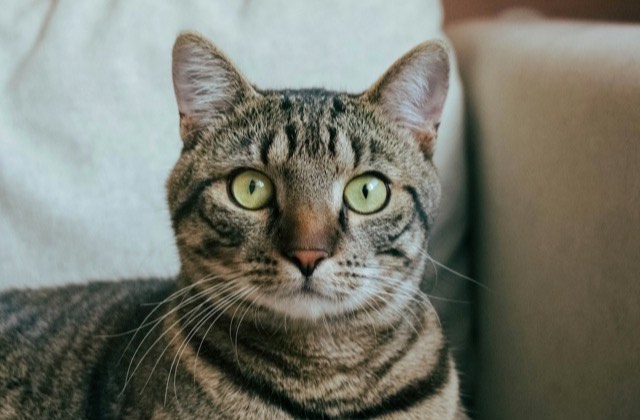
Exotic Shorthair: flat face, tear staining and daily care
Published by Planète Pets · managing editor: Clément Lacaille · how our guides are written
The Exotic Shorthair is often sold as "a Persian without the brushing". True for coat length, false for everything else: its head is a Persian head, with the anatomical consequences that come with it. A study by Claudia Schlueter, Klaus-Dieter Budras, Eberhard Ludewig, Gerhard Oechtering and colleagues, published in 2009 in the Journal of Feline Medicine and Surgery, compared 31 brachycephalic cats with 15 normal-headed cats using CT and dacryocystography (see the study). The flatter the face, the more the facial bones rotate upwards, and the more the tear duct adopts a kinked, V-shaped path passing under the canine tooth: drainage becomes mechanically inefficient. The Exotic Shorthair breed profile covers the other particularities worth knowing before adopting.
Contents · 5 sections
Tear stains are not a grooming failure
An Exotic with two permanent brown streaks under its eyes is not neglected: its tears simply cannot use the intended exit and spill onto the coat instead. The practical consequence is daily care, not weekly. A soft cotton pad dampened with warm water or saline, wiped every morning from the inner corner outwards, with a separate pad per eye, covers most cases. Then dry the area: it is the residual moisture, not the tear itself, that macerates and irritates the skin of the nose fold.
What belongs to the vet
A hygiene routine manages the consequence, never the cause. Tearing that suddenly changes character — thick or yellowish discharge, red eye, half-closed lid, a cat rubbing its face — leaves the cosmetic territory and needs a consultation: corneal ulcers, entropion and tear-sac infections are common on these head shapes. The same logic applies to breathing: a study by Mark Farnworth and his team, published in 2016 in PLOS ONE from an owner questionnaire, showed that the shorter the muzzle, the more respiratory abnormalities owners reported (see the study). An Exotic that snores while awake, breathes open-mouthed after a short play session or recovers slowly from effort is not "laid-back": it is struggling.
Short coat, but a dense one
The Exotic carries a thick undercoat that mats quietly, especially in the armpits, on the thighs and behind the ears. Two weekly sessions with a soft brush or a wide-toothed comb are enough outside moulting season, provided you check those three areas by hand. In autumn and spring, switch to daily: our article on grooming a Persian cat details the technique, which transposes here in a lighter version.
The right bowl changes daily life
A flat-faced cat picks up kibble badly from the bottom of a deep bowl and swallows air while eating. A wide, shallow plate solves it once and for all — the subject is covered in our guide to bowls for flat-faced cats. The rest of the routine-care benchmarks live in our cat care and grooming section.
Frequently asked questions
Can tear stains be removed permanently?
Not when they come from skull conformation. Daily cleaning limits the staining and the irritation, but tear production and overflow remain anatomical.
Does an Exotic Shorthair really need less care than a Persian?
Less brushing, yes. But eye and nose-fold cleaning is identical, and that is what structures the daily routine.
Should I use commercial tear-stain wipes?
They help in a pinch, but many contain cleansing agents poorly tolerated near the eye. Saline and a clean pad remain the safest choice; ask your vet before using any specific product.
An accessory from our shop for this use: Scissor-style nail clipper for cats (€17.90) · the whole shop
For the gear, at Le Félin (same family, zero commission): Grand arbre à chat design (from €149.99)
This guide is part of Planète Pets’s Cats universe. Our advice is general in nature: for any health concern, your veterinarian remains the only reference.