Travelling with a Great Pyrenees: car, crate and rules
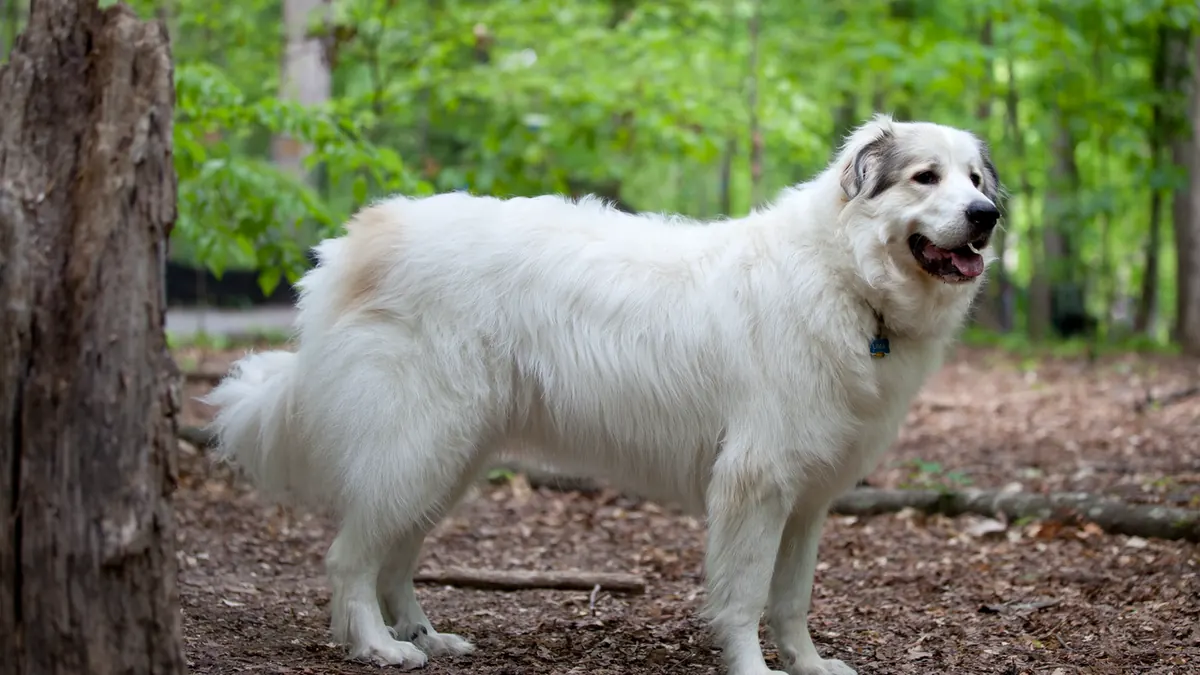

Great Pyrenees: Plan on a giant-size travel crate or a large boot with a certified guard; at this weight a simple seatbelt harness is not enough in a crash. A folding ramp makes loading easier, especially for an aging dog prone to dysplasia.
Our practical guides together, to download: Course: Train Your Dog in 8 Weeks — 2 PDF guides (85 pages in English (86 in French)), in English and French, instant download. Get my bundle — €49
In short: Giant dog, 65 to 80 cm and 40 to 60 kg, long white coat with a thick undercoat, moderate energy but highly vigilant. An autonomous livestock guardian, vigilant at night and wary of intruders. Bred to guard flocks alone: it decides without its owner, patrols and expands its territory the moment a fence weakens.
In the car with a Great Pyrenees
At 40 to 60 kg, the only genuinely safe option is a crash-tested crate of about 120 cm secured in the boot — failing that, a solid partition grille. An unrestrained dog of this weight becomes a projectile under braking — and a possible fine for distracted driving.
Trains, planes, holidays
Too big for the cabin, the Great Pyrenees flies in the pressurised hold in an IATA-approved crate — an ordeal to reserve for unavoidable trips. On trains, a muzzle and lead meet the rules. Tame the crate weeks ahead — open in the living room, seeded with treats — so that on the day, your Great Pyrenees walks in by itself.
Identification and good habits
Identification (microchip or tattoo) is mandatory, with vaccinations up to date for boarding or border crossings (EU passport, rabies shot). In hot weather, never leave a Great Pyrenees in a parked car, even “for five minutes”: the cabin turns lethal within a quarter of an hour.
Frequently asked questions
What crate size for a Great Pyrenees?
About 120 cm long: able to stand without hunching and turn around freely. For flying, check the model’s IATA dimensions.
Can a Great Pyrenees fly in the cabin?
No, it exceeds the cabin limit (8 kg including the bag): it travels in the pressurised hold in an IATA crate — avoid it when you can.
The guides that apply to you
- Dog life jacket: essential for boating and swimming?
Buoyancy, grab handle, size and adjustments: how to choose a dog life jacket for boating, paddleboarding or sporty swims.
- Dogs restrained in cars: what a survey of 2,000 owners in three countries found
Between 55% and 72% of dogs travel restrained depending on the country, a survey of over 2,000 owners found. The rest ride loose on the seat or on a lap.
- Dog safety gate: securing the stairs and rooms of the house
Pressure-mounted or screw-fitted, height, adjustable width: how to choose a dog safety gate to protect the stairs, kitchen or bedroom.
- Flying with your dog: anti-stress products remain underused, a study finds
Among 635 owners whose dog had flown, most animals coped well, but the anti-stress options available to owners remain little used, a study finds.