Goldfish Aquarium Care: Tank Size, Filtration, Water, Feeding and Tank Mates
Who it is for: Your goldfish lives in a bowl or a very small tank, and you want to know what to do today, then what it really needs.
- 35 pages
- 17 chapters
- 6 studies (DOI)
- FR + EN
- Edition November 2026
€24VAT included · one-off payment
Get my guide — €24Refunded within 14 days on a simple email, no questions asked
After payment
- Download your PDFs straight away, on the page that opens.
- You also get the link by email, sent by “Planète Pets” (subject “Your download:” followed by the guide’s name).
- Lost it? Find my purchases with your email address.
- No calls, no texts; at most one email, a week later, asking for your review.
For €125 more, Complete library: 64 PDF guides, €2.33 per guide.
- Goldfish tank size, calculated: 75 litres (about 20 gallons) of real water for the first fancy goldfish then 40 litres (about 10.5 gallons) per extra fish, a tank at least 4 times as long, 2 times as wide and 3 times as tall as the adult fish, and the table of eight common tanks showing that a “54-litre” tank holds only 39.6 litres of water once the substrate is in
- Safe water, in figures: the nitrogen cycle and its 2 to 6 weeks, the ammonia, nitrite, nitrate and oxygen thresholds for cold-water fish, the table of ammonia not to exceed at your pH and temperature, and the calculation of water changes that keep your nitrate low
- The right decisions: bowl or not and what to do today, who it can live with (a study shows the fantail spends about twice as much energy swimming as the common), how much to feed, which signs should make you call a vet, and when a pond becomes the right answer
Checked48 automated checks on every site update (FR/EN parity, internal links, species data, guide PDF files), last checked on 2026-11-2312 sources cited in the guide, including 6 studies with a DOI
Method
- Primary sources: studies with a DOI, official texts
- Every figure linked to its source
- Dated edition, updates included
StandardsBuilt on the guidance of RSPCA
Card, Apple Pay or Google Pay payment on Stripe’s secure page: your card details never touch our servers. Price VAT included.
“Goldfish Aquarium Care: Tank Size, Filtration, Water, Feeding and Tank Mates” is a 35-page printable PDF guide published by Planète Pets (November 2026 edition), sold for €24 VAT included: 17 chapters, 6 studies cited with their DOI, checklists and fill-in sheets, instant download after payment.
Why a bowl does not work and the emergency plan if your fish lives in one, the difference between long-bodied and short-bodied goldfish, the real water volume calculated for eight common tanks, filtration and oxygen, the nitrogen cycle, cold water in summer and winter, water changes calculated, feeding, tank mates, common mistakes, the signs that should make you call a vet, moving to a pond and six printable sheets.
Key facts
- Price
- €24 VAT included, one-off payment
- Format
- A4 PDF, 35 pages, to read or print
- Languages
- English and French (two PDFs)
- Contents
- 17 chapters, checklists, fill-in sheets
- Sources
- 6 studies with verified DOI; 12 sources in all, full list at the end of the guide
- Edition
- November 2026
- Seller
- Lacangel Group (SAS, France), card payment via Stripe
- Guarantee
- 14-day money-back on a simple email
What the guide contains
17 chapters, 35 A4 pages, with tick-box checklists, fill-in sheets and templates. Studies are cited with their DOI. The French edition is included with your purchase.
- Before you start. Who it is for, what the guide contains, where the information comes from (RSPCA Australia, SPCA New Zealand, a vet’s sheet for PetMD, OATA criteria, 6 papers with DOI), what it does not do.
- The bowl: why not, and what to do if your fish lives in one. What the animal welfare sheets say, why a small volume does not work, the fairground goldfish and French law, the six-step emergency plan.
- Know your goldfish: long body or short body. The two families, the Blake, Li and Chan (2009) swimming study, the table of each family’s needs, varieties with extreme traits, size and lifespan.
- The right volume: litres, dimensions and number of fish. The sheets’ rules, stated and real litres, the table of what 1 to 5 fish need, the calculated table of eight common tanks, weight.
- Setting up the tank: location, substrate, decor, plants, lid, light. Where to put it, which substrate, which decor, which plants survive, setting up in order.
- Filtration, water movement and oxygen. What a filter does, flow rate, filter types, maintenance without killing the bacteria, the calculated table of oxygen by temperature.
- The nitrogen cycle and setting up. The cycle in three steps, OATA thresholds, the calculated table of ammonia by pH and temperature (Emerson et al. 1975), nitrite (Lewis and Morris 1986), cycling with or without fish.
- Cold water: the right temperature, summer and winter. The sheets’ benchmarks, heaters, summer measures, winter.
- Water changes, calculated. The rule, nitrate (Camargo et al. 2005), the calculated table of settled nitrate by share of water changed, measuring your own production, step by step.
- Feeding: what, how much, how often. What the three sheets say, what to feed, the benchmarks table, when you are away.
- Tank mates: with whom, and with whom never. Never alone, the sheets’ rules, the who-with-whom table, adding a new fish, never release (Tarkan et al. 2010).
- The most common mistakes. Twelve mistakes, what happens and what to do instead.
- Health: the signs that should make you call a vet. Water first, the table of signs in nine situations, finding a vet who treats fish, what to note before calling.
- Moving to a pond: when, which fish, how. The pond for long bodies, the aquarium-or-pond table, moving without shock.
- The routine: day, week, month. Every task, from daily to yearly.
- Printable sheets. My tank and my fish, cycling log, water care, meals and temperature, health and vet, aquarium or pond.
- Sources. 6 papers with checked DOIs, the care sheets, water quality criteria and official texts.
Who it is for, and who it is not for
This guide is for you if…
- Your goldfish lives in a bowl or a very small tank, and you want to know what to do today, then what it really needs.
- Your tank is set up, but the water turns cloudy or smells, or your fish come up to breathe at the surface, and you want to understand why.
- You are unsure about volume, filter, food or tank mates, and want figures with their source.
- You are about to welcome goldfish and want to set up the tank in the right order, before buying them.
It will not help you if…
- Your fish is ill and you are looking for a treatment: the guide says what should worry you and what to note, but gives no medicine or dose; that is the vet’s role.
- You want to build a garden pond: that is the subject of our pond guide; this one only explains when to move to a pond.
- You want to breed goldfish: the guide does not cover it.
- You are looking for tropical fish to keep with your goldfish: the guide explains why that is not a good idea.
In pictures
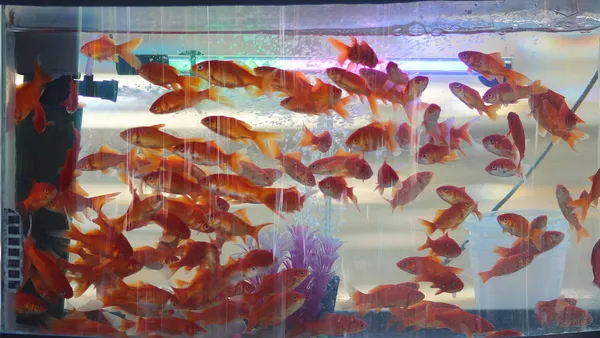

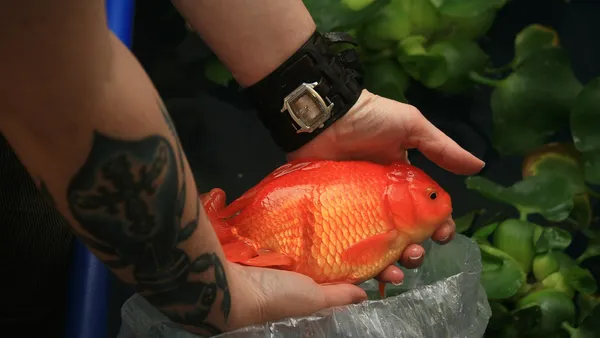

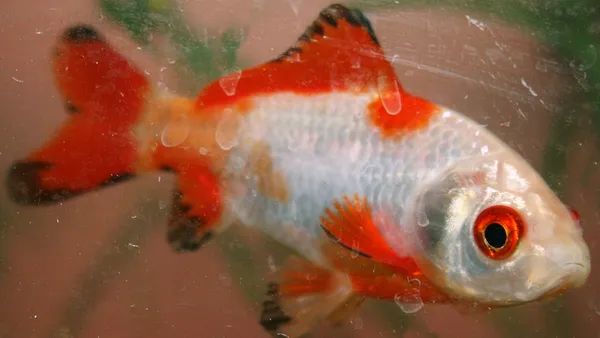

Illustrative photos, published by their authors under free licences.
Free sample
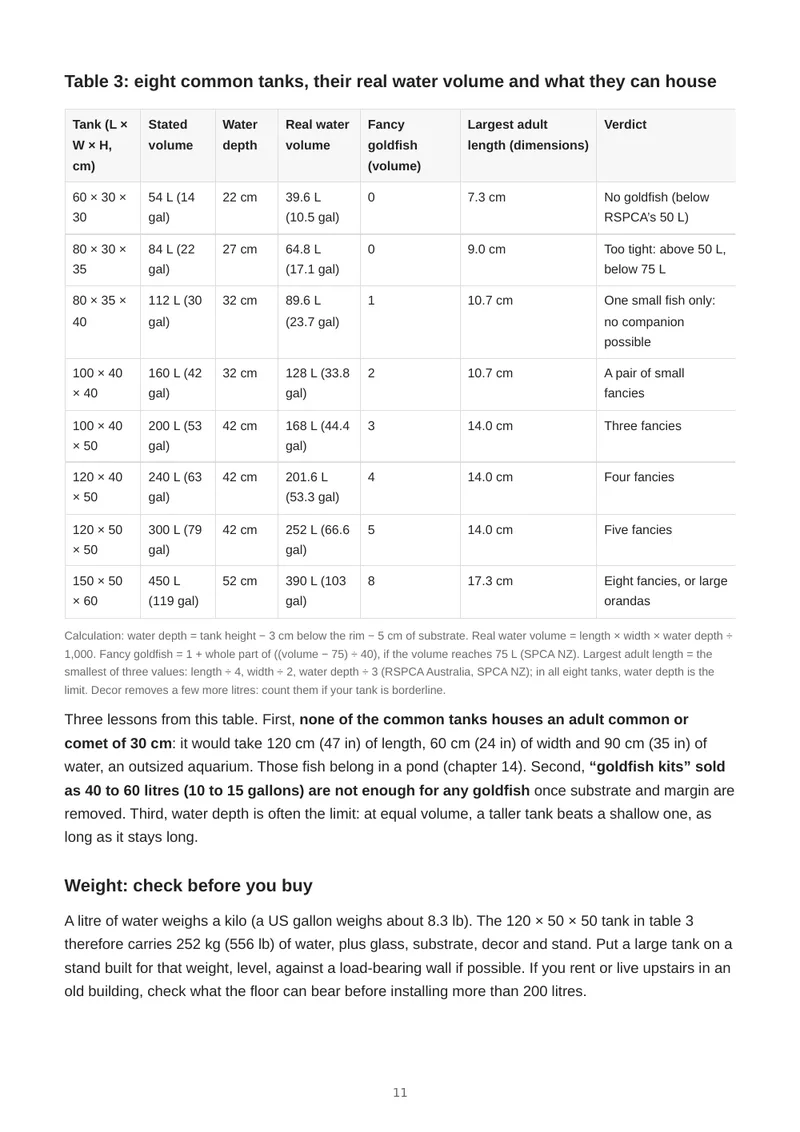
Table 3: eight common tanks, their real water volume and what they can house
| Tank (L × W × H, cm) | Stated volume | Water depth | Real water volume | Fancy goldfish (volume) | Largest adult length (dimensions) | Verdict |
|---|---|---|---|---|---|---|
| 60 × 30 × 30 | 54 L (14 gal) | 22 cm | 39.6 L (10.5 gal) | 0 | 7.3 cm | No goldfish (below RSPCA’s 50 L) |
| 80 × 30 × 35 | 84 L (22 gal) | 27 cm | 64.8 L (17.1 gal) | 0 | 9.0 cm | Too tight: above 50 L, below 75 L |
| 80 × 35 × 40 | 112 L (30 gal) | 32 cm | 89.6 L (23.7 gal) | 1 | 10.7 cm | One small fish only: no companion possible |
| 100 × 40 × 40 | 160 L (42 gal) | 32 cm | 128 L (33.8 gal) | 2 | 10.7 cm | A pair of small fancies |
| 100 × 40 × 50 | 200 L (53 gal) | 42 cm | 168 L (44.4 gal) | 3 | 14.0 cm | Three fancies |
| 120 × 40 × 50 | 240 L (63 gal) | 42 cm | 201.6 L (53.3 gal) | 4 | 14.0 cm | Four fancies |
| 120 × 50 × 50 | 300 L (79 gal) | 42 cm | 252 L (66.6 gal) | 5 | 14.0 cm | Five fancies |
| 150 × 50 × 60 | 450 L (119 gal) | 52 cm | 390 L (103 gal) | 8 | 17.3 cm | Eight fancies, or large orandas |
Calculation: water depth = tank height − 3 cm below the rim − 5 cm of substrate. Real water volume = length × width × water depth ÷ 1,000. Fancy goldfish = 1 + whole part of ((volume − 75) ÷ 40), if the volume reaches 75 L (SPCA NZ). Largest adult length = the smallest of three values: length ÷ 4, width ÷ 2, water depth ÷ 3 (RSPCA Australia, SPCA NZ); in all eight tanks, water depth is the limit. Decor removes a few more litres: count them if your tank is borderline.
Pick the right option
| Feature | This guide€24 | Best valueComplete library€149 |
|---|---|---|
| PDF guides | 1 | 64 |
| Pages | 35 | 2518 |
| Studies cited (DOI) | 6 | 414 |
| English and French | ✓ | ✓ |
| Price per guide | €24 | €2.33 |
| Refunded within 14 days | ✓ | ✓ |
| Get my guide — €24 | See what’s inside |
Library: €149 instead of €1460 if you buy the 62 guides sold on their own one by one, a saving of €1311 (+ 2 guides only sold in bundles).
€24 one-off payment, updates included
Get my guide — €24Refunded within 14 days on a simple email, no questions asked
Frequently asked questions
What format is the guide?
A PDF to download right after payment, in English and French, ready to print, with six sheets: my tank and my fish, cycling log, water care, meals and temperature, health and vet, aquarium or pond.
What size tank does a goldfish need?
RSPCA Australia sets the minimum at 50 litres (about 13 gallons); SPCA New Zealand asks for 75 litres (about 20 gallons) for one fancy goldfish, plus 40 litres (about 10.5 gallons) per extra fish, and a tank at least 4 times as long, 2 times as wide and 3 times as tall as the adult fish. As two goldfish are better than one, a pair of fancies needs 115 litres (about 30 gallons) of real water. Chapter 4 calculates the real water volume of eight common tanks.
Can a goldfish live in a bowl?
No. SPCA New Zealand writes that goldfish should never be kept in a bowl or any small, empty environment, and RSPCA Australia that bowls are too small and should be avoided. Chapter 2 gives the six-step emergency plan if your fish lives in one today.
Does a goldfish need a heater?
Usually not in a heated home: the sheets aim for 20 to 24 °C, 68 to 75 °F (RSPCA Australia, SPCA NZ) or 65 to 75 °F (PetMD), and above all a stable temperature. A heater set low helps in a cold room or one that swings a lot. The real danger is summer heat, which lowers the water’s oxygen (chapter 8).
Can goldfish live with other fish?
With other goldfish of the same type, yes: at least two is better. Not with fish small enough to fit in their mouth, fin-nippers or tropical fish. And no commons or comets with fancies: a study shows the fantail tires sooner and spends about twice as much energy swimming. Chapter 11 has the full table.
When should goldfish move to a pond?
For long-bodied goldfish (common, comet, shubunkin), which can reach about 30 cm (12 in): SPCA New Zealand points them to an outdoor pond with at least 30 cm of water. No common aquarium has the dimensions they would need as adults. Chapter 14 says when and how to move them, and building the pond is covered in our garden pond guide.
Does the guide replace the vet?
No. It says what should worry you (a table of nine situations) and what to note before calling, but it makes no diagnosis and gives no medicine or dose.
Free reading on the site
- Goldfish tank size: how many litres, how many fish and why growth depends on it
- Goldfish in a bowl: why it only seems like a good idea
- Goldfish Alone or in a Group: Do You Need More Than One?
Seller: LACANGEL GROUP, SAS (French simplified joint-stock company) — SIREN 995 268 018 — registered office: 1 rue Marguerin, 75014 Paris, France — president: Clément Lacaille — EU VAT number FR21995268018 — administration@lacangel.fr. Price VAT included. Digital product delivered right after payment; 14-day money-back commercial guarantee. See the terms of sale.
🩺 Reminder: this page informs, it does not diagnose. For any symptom or health question, your veterinarian remains the only reference.
How it works
Seller: LACANGEL GROUP (SAS), Paris, France, VAT FR21995268018. Prices VAT included. Terms of sale