Why guinea pigs should never get a high-level cage
Published by Planète Pets · managing editor: Clément Lacaille · how our guides are written
Rats climb, explore every level of a cage, and happily use a third floor; guinea pigs, on the other hand, almost always stay on the ground, and that's not a matter of personality. A landmark study by researcher Norbert Sachser, published in 1998 in Naturwissenschaften, shows that the domestic guinea pig descends from a wild, group-living cavy that stays close to the ground, whose survival strategy in the face of danger is to freeze or flee horizontally rather than seek shelter up high (see the study). Find more housing tips in our bedding and habitat section.
Contents · 4 sections
A species built to flee sideways, not upward
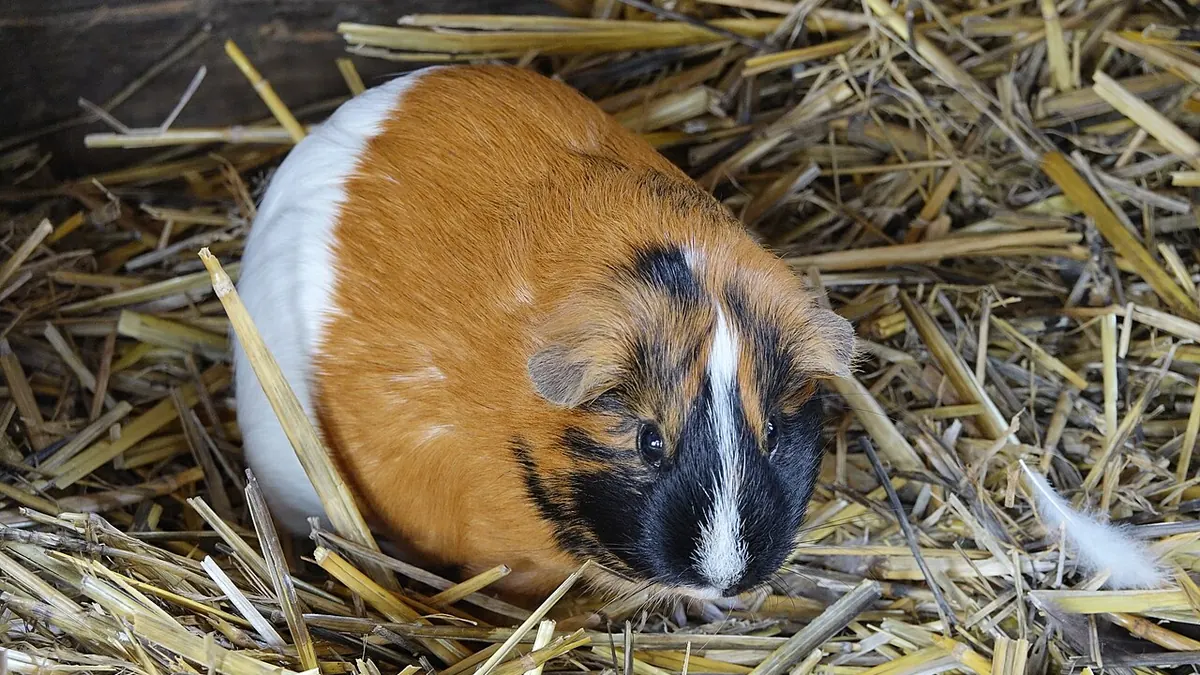
This behavioral heritage explains why guinea pigs never develop the instinct to climb to safety the way rats or mice do. Their heavy, stocky build relative to their legs, and their poor ability to judge distances, reinforce this: a guinea pig placed up high simply cannot gauge the drop between itself and the ground.
Ramps, levels, and platforms: the real risk
A multi-level cage with ramps, designed with a hamster or rat in mind, puts a guinea pig at real risk: even a short fall can cause a hind-leg fracture or a serious injury in an animal that carries so much weight on such short legs. Raised platforms without secure edges should be avoided, as should hideouts stacked more than about eight inches off the ground.
Build outward, not upward
The right approach is to invest in floor space rather than height: a C&C-style enclosure, covered in our guinea pig cage size guide, offers exactly this kind of generous floor area without a risky level. Hideouts should sit directly on the ground; see our pick of materials in rodent hideout materials. This principle matters even more for an older guinea pig, whose balance grows shakier, a point covered in the ageing guinea pig.
Frequently asked questions
Can a guinea pig learn to use a ramp safely?
A wide ramp with a gentle slope and side rails can work to connect two low areas, but it should never replace a habitat designed to stay mostly at ground level.
Should they still get a slightly raised lookout spot?
Yes, a small, wide, stable platform just a couple of inches off the ground is plenty, without exposing the animal to a real fall risk.
Is the risk the same for a young guinea pig?
The risk of injury exists at any age, but it increases with an adult's body weight and especially in older animals, whose bones are more fragile.
See it in the Planète Pets shop: Natural loofah chew carrot for rabbits and rodents, 20 cm (€17.90) · the whole shop
See it in the Planète Pets shop: Electric pet heating pad 45 × 45 cm (17.7 in) with chew-resistant cord ($48.90, ships from the US) · the US shop
This guide is part of Planète Pets’s Rodents universe. Our advice is general in nature: for any health concern, your veterinarian remains the only reference.

_(3).jpg)