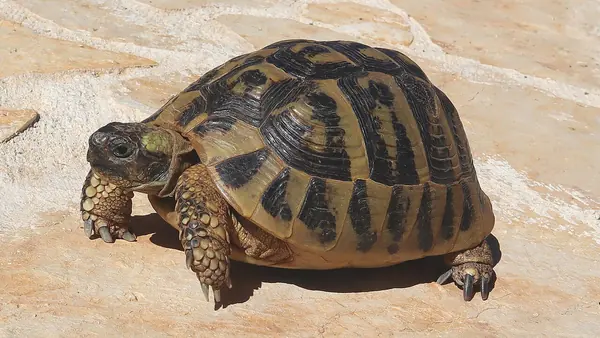
Hermann's tortoise: how long does transport stress stay measurable?
Published by Planète Pets · managing editor: Clément Lacaille · how our guides are written
A Hermann's tortoise that acts normally again within hours of a trip to the vet does not mean its body has forgotten the episode. An Italian study measured just how long the physiological trace of that stress actually lingers. Our travel and safety guidance is gathered in the reptile travel and safety section.

A study on the adrenocortical response to transport
Fazio, Medica, Bruschetta and Ferlazzo published a study in 2014 in International Scholarly Research Notices on whether handling and transport stress influence the adrenocortical response in Hermann's tortoises (Testudo hermanni) (see the study). In twenty-three juvenile tortoises, the researchers measured a 286% rise in plasma cortisol after a handling session followed by transport, compared with baseline values measured before the episode. That elevated level did not drop quickly: it stayed significantly above normal for more than four weeks after the trip.
What this recovery time changes about trip frequency
A rise this sharp, and this slow to resolve, is reason to rethink the idea that a brief transport "leaves no trace" once the tortoise is back and settled in its enclosure.
- Bundle reasons for a trip (vet visit, weighing, enclosure change) rather than multiplying short trips close together, since the measured recovery time far exceeds a single day.
- Avoid stacking two stressful handling episodes within the same month for a young tortoise where the schedule allows it, since the study specifically covered juveniles, which are more sensitive to this kind of stress.
- Don't judge a trip's stress solely by a quick return to normal behaviour: a tortoise eating and moving normally again the next day can still be carrying elevated cortisol for several weeks.
Handling itself deserves the same care as trip frequency; our article on transporting a Hermann's tortoise to the vet details the handling technique that limits stress-related tachycardia. See also our Hermann's tortoise profile for the full picture.
Frequently asked questions
Should all transport be avoided for a juvenile Hermann's tortoise?
No, that is neither realistic nor necessary for essential trips (vet visits, emergencies); the study mainly argues for cutting avoidable trips and spacing them out rather than eliminating them.
Does an adult react the same way as a juvenile?
The study specifically covers juveniles, which are more vulnerable to stress; nothing indicates an identical response in adults, but caution around trip frequency remains a reasonable precaution at any age.
How can you tell if cortisol has come back down without a blood test?
There is no reliable visible sign at home; that is exactly what makes this finding useful, as a reminder that outwardly normal behaviour does not guarantee full physiological recovery. Find all our guides on the reptile hub.
An accessory from our shop for this use: 100 × 90 cm escape-proof net with 4 corner brackets for turtle tanks (€44.90) · the whole shop
This guide is part of Planète Pets’s Reptiles universe. Our advice is general in nature: for any health concern, your veterinarian remains the only reference.