Stocking Density and Fish Stress: What a Trout Study Shows
Published by Planète Pets · managing editor: Clément Lacaille · how our guides are written
The rule of thumb about liters per fish gives a practical starting point to avoid overcrowding a tank, but it says nothing about the real effect of density on the occupants' welfare once that limit is approached. A study by Ellis, North, Scott, Bromage, Porter, and Gadd published in 2002 in Journal of Fish Biology (see the study) shows that the relationship between stocking density and welfare isn't linear: past a certain threshold, stress rises sharply, but too low a density can also encourage aggressive territorial behavior in some species. Find our other pointers in the care and grooming section and on the fishkeeping hub.
Contents · 5 sections
Why can too low a density also be a problem?
Some territorial species, like many cichlids, become more aggressive toward one another when given too much available space without enough group cues, since each individual tends to defend a larger territory. Stocking in an adequate group, rather than leaving excess empty space, limits this risk for the species concerned.
How do you recognize signs of too high a density?
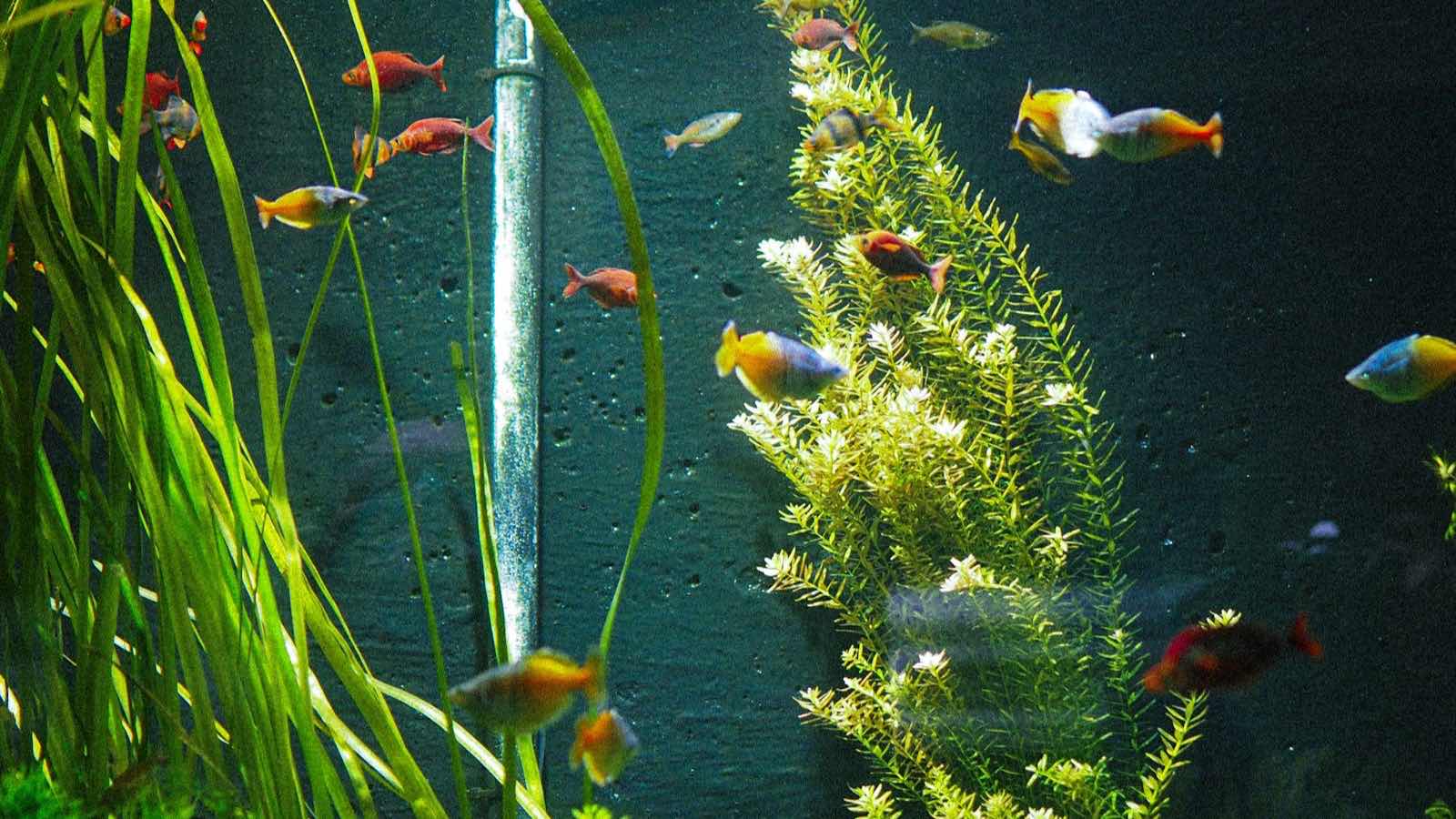
Unusual aggression for the available space, repeated fin damage, slowed growth in younger fish, or water that fouls unusually fast between maintenance sessions are all signals that can point to overcrowding, beyond a simple liters calculation. This ties in with what's already useful for gauging how many fish to keep in an aquarium.
Does density also affect stress at the physiological level?
Yes, the cited study directly measures hormonal stress markers in fish at high density, a mechanism comparable to the one already documented for other environmental stressors such as noise and vibration in a home tank.
Should density be adjusted by species rather than following one rule?
Yes, a shoal of small schooling fish can handle a much higher density than a large territorial cichlid, which makes any general rule imprecise unless it accounts for the social behavior specific to each species kept.
- The relationship between density and welfare isn't linear: too high and too low both cause problems, depending on species
- Too low a density encourages territorial aggression in some species, like cichlids
- Repeated fin damage and slowed growth can signal overcrowding
- The right density depends heavily on the social behavior specific to each species
Frequently asked questions
Does the liters-per-fish rule still hold value despite these nuances?
Yes, as a cautious starting point, then adjusted based on observed behavior and the social needs of the species involved.
Is an overstocked tank easy to fix?
Usually by moving a few fish to another tank or expanding the available volume, two solutions far more reliable than simply boosting filtration.
Does this study only apply to farmed fish?
The physiological stress mechanisms documented largely apply to captive fish in general, including home aquariums, even though the study itself was conducted in a farming context.
See it in the Planète Pets shop: Hang-on isolation and breeding box for aquariums (€28.90) · the whole shop
This guide is part of Planète Pets’s Fishkeeping universe. Our advice is general in nature: for any health concern, your veterinarian remains the only reference.