Classroom or office aquarium: what actually changes versus a home tank
Published by Planète Pets · managing editor: Clément Lacaille · how our guides are written
An aquarium in a classroom or a shared office does not raise the same issues as one at home: no single person decides, pays, or is present every day. The real question is not "which fish to choose" but "who feeds it on weekends, during holidays, and if the usual caretaker is out". Without a clear answer to those three points before buying, the tank degrades within a few weeks.
Contents · 5 sections
Why put an aquarium in a shared space at all?
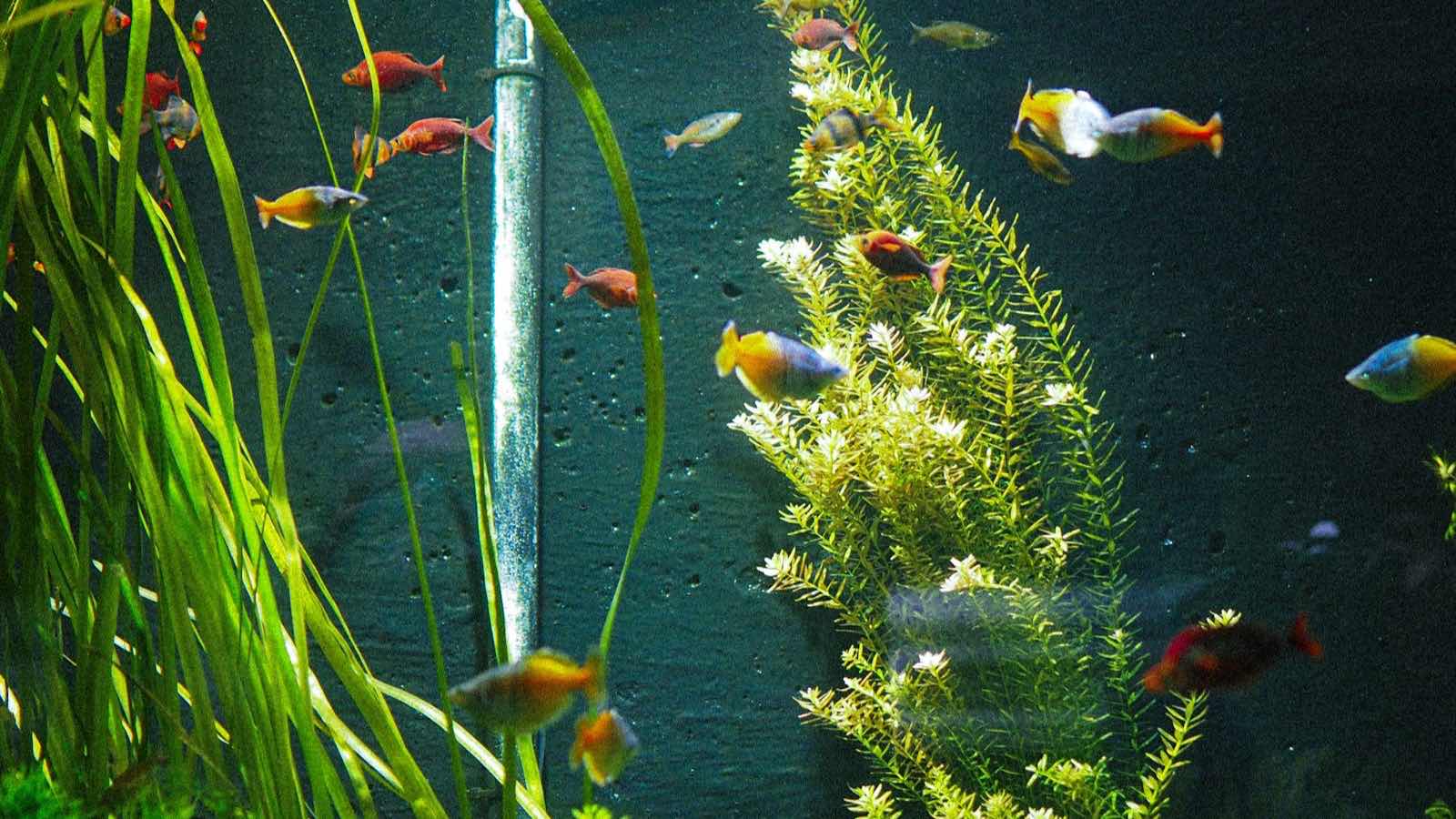
A study run at the National Marine Aquarium in Plymouth by Deborah Cracknell and colleagues, published in 2015 in Environment and Behavior, measured visitors' reactions to increasingly stocked tanks: the richer the marine life on display, the longer people spontaneously watched, the more their heart rate dropped, and the better their reported mood (see the study). A well-stocked, well-kept tank in a classroom or open-plan office genuinely benefits the people looking at it — as long as it stays clean and lively, not cloudy and half-empty.
Who covers weekends and holidays?
This is what sinks most shared-space projects. A teacher cannot feed a tank on a Saturday; someone working from home will not stop by the office on a public holiday. Before buying, name a primary caretaker and at least one backup, and plan for an automatic feeder for closures of several days — never a single compressed food block for more than one long weekend.
What budget, and paid by whom?
A 60-80 litre tank with a complete kit runs €150-250 upfront, then €10-15 a month for routine upkeep (food, tests, electricity). In a shared setting, that budget needs to be formally assigned — a class fund, a department budget line — otherwise replacement purchases (a failed filter or heater) get delayed and the tank quietly deteriorates.
Which fish suit a busy, handled environment?
Favour hardy species that tolerate frequent foot traffic without much stress: corydoras, small catfish, small shoaling characins. Avoid territorial or nervous species that decline under noise and vibration. Sizing the tank starts from its minimum volume for beginners, never the other way round.
- A named primary caretaker, with a backup written down clearly
- An automatic feeder for any absence longer than two days
- A monthly upkeep budget formally assigned, not improvised
- A checklist posted near the tank for the weekly routine
For core hardware, see our habitat and aquarium hub, and for a comparable single-user setup, our guide on an aquarium at the office.
Frequently asked questions
Does a classroom aquarium need a dedicated vet contact?
Not routinely, but for any visible illness (spots, abnormal swimming), an exotics or aquatics-specialised vet remains the reference, exactly as for a home tank.
Should the aquarium be shut down over summer break?
No: a cycled tank cannot simply be paused. Either a caretaker keeps checking in, or the tank is temporarily rehomed with someone who can.
How quickly does a tank decline without a clear caretaker?
Often within a month: water clouds, parameters drift, and the lack of attention quickly shows on stressed fish.
In our shop, for this use: Ceramic pebble hide for shrimp and small fish (€20.90) · the whole shop
This guide is part of Planète Pets’s Fishkeeping universe. Our advice is general in nature: for any health concern, your veterinarian remains the only reference.