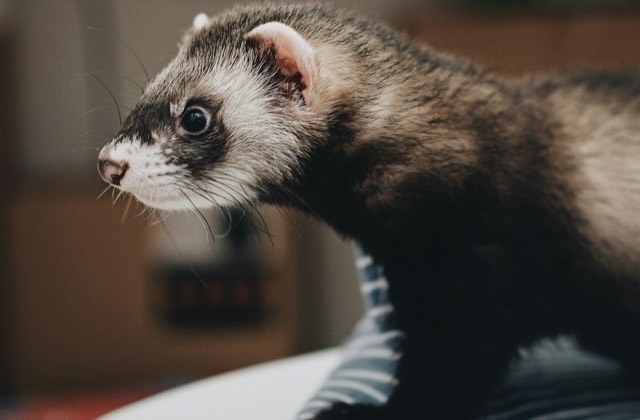
Moving house with your ferret: how to ease the stress of a new environment
Published by Planète Pets · managing editor: Clément Lacaille · how our guides are written
A ferret that refuses to leave its cage, ignores its food bowl, or turns unusually nippy after a move isn't being difficult: it's going through genuine stress from losing its familiar landmarks. Find all our habitat guidance in the ferret bedding and habitat section.
Contents · 5 sections
Why does a change of home unsettle a ferret so much?
- The loss of every familiar scent marker, essential for an animal that explores and reassures itself mainly through smell.
- New sounds and new light that disrupt its sleep rhythm, already pronounced in this species.
- The trip itself, often a source of anxiety on top of the environmental change once you arrive.
What does research show about the stress of environmental change?
A study by Stella, Lord and Buffington, published in 2011 in the Journal of the American Veterinary Medical Association, followed healthy cats and cats with idiopathic cystitis through unusual environmental events (see the study). The authors found that even minor environmental changes triggered sickness-like behaviours — lethargy, appetite loss, social withdrawal — in animals that were otherwise physically healthy, and that these responses were amplified in individuals already prone to stress. Applied to ferrets, who are also strongly attached to the stability of their territory, this finding argues against dismissing signs of distress after a move, even with no identifiable medical cause.
How should you prepare for the move itself?
- Keep the cage, hammocks and litter already carrying its scent rather than replacing everything at the same time.
- Transport the ferret last, once the new home has settled down, to avoid the chaos of unpacking.
- Recreate the cage's placement and orientation as closely as possible in the new home.
How can you help it settle in during the first few days?
Limit free-roam space for the first few days while the ferret maps its new territory by scent, before gradually expanding it. This approach ties in with our guide to choosing between a cage and a dedicated room for a ferret, useful for setting up this new space step by step.
Frequently asked questions
How long does adjustment take after a move?
Expect roughly one to two weeks for a return to normal behaviour, sometimes longer for a ferret that's naturally more anxious.
Should you see a vet if the ferret stops eating entirely?
Yes, beyond 24 hours without food a vet visit is warranted to rule out a medical cause behind the apparent stress.
Can moving-related stress trigger illness?
It can worsen or reveal a pre-existing digestive weakness, which is why it's worth staying alert to digestive signs in the weeks that follow. Find all our guides in the ferret hub.
See it in the Planète Pets shop: Double-layer plush hammock for rats, squirrels or ferrets (€18.90) · the whole shop
See it in the Planète Pets shop: Electric pet heating pad 45 × 45 cm (17.7 in) with chew-resistant cord ($48.90, ships from the US) · the US shop
This guide is part of Planète Pets’s Ferrets universe. Our advice is general in nature: for any health concern, your veterinarian remains the only reference.