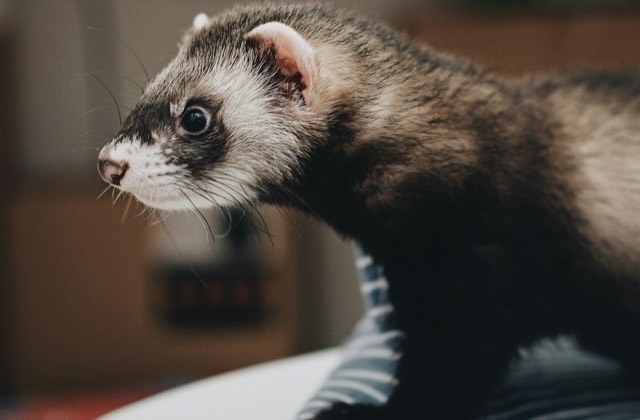
My ferret twitches in its sleep: REM sleep or a warning sign?
Published by Planète Pets · managing editor: Clément Lacaille · how our guides are written
A ferret deeply asleep that suddenly starts twitching its paws or wiggling its whiskers often worries its owner, somewhere between fear of a seizure and simple curiosity. All our housing guidance is gathered in the ferret bedding and habitat section.
Contents · 4 sections
What a study on ferret sleep shows
A study by Marks and Shaffery, published in 1996 in the journal Sleep, recorded brain activity in adult ferrets across full sleep cycles (see the study). The results show a mean daily proportion of 36.0% slow-wave sleep, 24.4% REM sleep and 39.4% wakefulness, making the ferret the carnivore with the highest known proportion of REM sleep among the placental mammals studied so far. The authors also identified a second REM-like state, distinct from classic REM sleep.
What this explains about a sleeping ferret's behavior
- Twitching and paw movements during REM sleep, comparable to what's seen in a dreaming dog, unrelated to a seizure.
- An exceptional proportion of REM sleep, which partly explains why a ferret can seem so deeply out of it during a nap.
- Sleep that stays normally spread across several bouts throughout the day, consistent with the ferret's already very long sleep schedule.
Telling normal twitching apart from a sign worth watching
Brief twitching during deep sleep that stops as soon as the ferret wakes up normally fits the pattern this study describes, and lines up with the observations in our article on a ferret that sleeps a lot: is it normal. On the other hand, twitching that persists into wakefulness, unusual limpness, or trouble waking the ferret up point more toward hypoglycemia, covered in our guide on ferret insulinoma, which calls for a prompt vet visit.
Frequently asked questions
Should a ferret twitching in its sleep be woken up?
No, in the vast majority of cases this twitching is part of normal REM sleep and stops on its own without needing intervention.
How can this twitching be told apart from a seizure?
Twitching that stops as soon as the ferret wakes up naturally, with no lingering limpness, generally matches the REM sleep described in the study, unlike a seizure.
Why does a ferret get so much REM sleep?
The exact reason is still debated, but the study places the ferret well above the other placental mammals studied on this specific measure.
Should a lethargic ferret upon waking be a concern?
Yes, limpness that persists after a normal wake-up differs from the passing twitch of REM sleep and is worth a vet check, especially to rule out hypoglycemia. Browse all our guides on the ferret hub.
See it in the Planète Pets shop: Double-layer plush hammock for rats, squirrels or ferrets (€18.90) · the whole shop
See it in the Planète Pets shop: Rolling 4-level ferret and chinchilla cage with hammock ($159.90, ships from the US) · the US shop
This guide is part of Planète Pets’s Ferrets universe. Our advice is general in nature: for any health concern, your veterinarian remains the only reference.