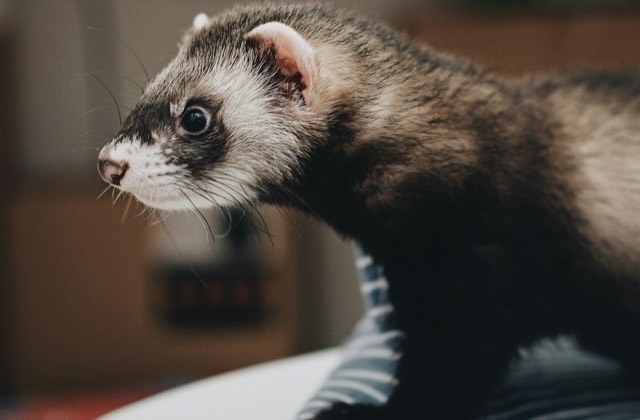
Artificial light and ferret adrenal disease: what a melatonin study shows
Published by Planète Pets · managing editor: Clément Lacaille · how our guides are written
A room lit artificially for long hours every day seems harmless, but it may play a role in an endocrine disease that's particularly common in neutered ferrets. All our health guidance is gathered in the ferret care and grooming section.
Contents · 5 sections
What a melatonin and adrenal disease study shows
A study by Ramer, Benson, Morrisey, O'Brien and Paul-Murphy, published in 2006 in the Journal of the American Veterinary Medical Association, gave a once-daily oral melatonin suspension to ten ferrets with confirmed adrenal disease, with follow-up exams every four months over a year (study on PubMed). Nine of the ten ferrets showed moderate to dramatic clinical improvement — coat regrowth, reduced vulvar swelling or reduced prostate size — though without a measurable reduction in the size of the adrenal glands themselves.
The link between artificial light and the adrenal glands
- An artificially long photoperiod (more than eight hours of light) stimulates GnRH and LH synthesis while lowering circulating melatonin, a hormone that's normally antigonadotropic in ferrets.
- A ferret neutered young loses the natural regulation normally provided by the gonads, leaving the adrenal glands more exposed to this chronic hormonal stimulation.
- Household lighting that mimics permanent summer, all year round, may keep up a hormonal signal that a ferret's body isn't built to handle continuously.
What this means in practice at home
Moving closer to a winter-like photoperiod — roughly nine hours of light to fifteen hours of darkness — by avoiding artificial lighting in the ferret's room early in the morning or late at night is the most directly actionable step suggested by this mechanism. It complements, rather than replaces, choosing a medical or surgical treatment discussed with an exotics vet, as covered in our comparison of deslorelin implants versus surgical neutering. Cage placement, already covered in our guide on choosing where to place the cage, benefits from factoring in this light criterion alongside noise and calm.
Don't confuse it with seasonal shedding
Hair loss that follows a regular seasonal cycle most often has nothing to do with adrenal disease, a distinction covered in our article on seasonal shedding versus adrenal disease. Only a vet can confirm a diagnosis of adrenal disease, and melatonin should never replace veterinary advice or a prescribed treatment.
Frequently asked questions
Does melatonin cure adrenal disease?
No, the study shows symptom improvement in most treated ferrets, but without shrinking the adrenal glands themselves.
Should the ferret's room be kept dark all day?
No, the goal is a reasonable winter-like cycle, not depriving the animal of all natural light.
Does this mechanism apply to unneutered ferrets too?
Adrenal disease risk is far more documented in neutered ferrets, especially those neutered young.
Can melatonin be given without veterinary advice?
No, dosing and the treatment's relevance need to be confirmed by an exotics vet, especially alongside other treatments. Browse all our guides on the ferret hub.
See it in the Planète Pets shop: Double-layer plush hammock for rats, squirrels or ferrets (€18.90) · the whole shop
This guide is part of Planète Pets’s Ferrets universe. Our advice is general in nature: for any health concern, your veterinarian remains the only reference.