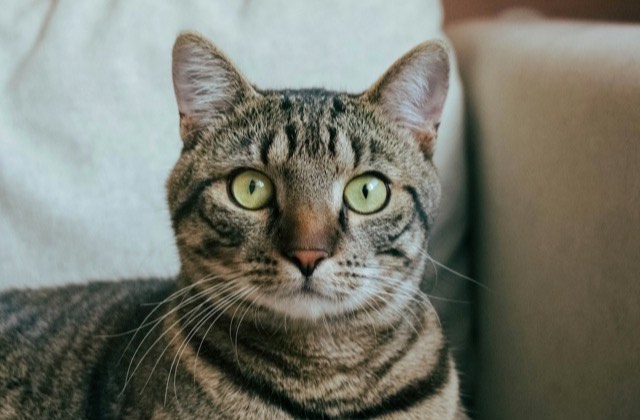
Ocicat: with no wild blood at all, what explains its spots and its need for intense play
Published by Planète Pets · managing editor: Clément Lacaille · how our guides are written
The Ocicat owes its name and spotted coat to a deliberate resemblance to the ocelot, a wild cat. Yet the breed has no wild ancestor whatsoever in its family tree: it was created by crossing the Abyssinian, the Siamese and the American Shorthair, and its coat is explained by ordinary domestic tabby genetics. The Ocicat breed profile covers the rest of its profile.
Contents · 4 sections
The gene behind the spots, identified in 2012
Christopher Kaelin, Xiao Xu, Leslie Hong and colleagues, including Gregory Barsh (Stanford) and Stephen O'Brien, published the identification of the Taqpep gene in Science in 2012, showing how it drives the shift from a classic thick-striped tabby coat to a spotted or marbled one in cats, domestic and wild alike (see the study). The authors show that this same gene explains the shift from striped to spotted coats across several wild cat species, which is exactly what fuelled, through visual convergence, the resemblance Ocicat breeders were after — with no actual relatedness to those species at all.
A wild look, a thoroughly domestic and highly social temperament
This complete absence of wild ancestry has a direct behavioural consequence: unlike hybrids such as the Bengal or the Savannah, whose wild-cat blood explains specific needs, the Ocicat is a fully domestic cat, bred first and foremost for sociability and trainability. It is one of the breeds most often cited as suited to leash walking and trick training, with high energy levels and a strong need for interaction.
What that means for enrichment
An under-stimulated Ocicat gets bored quickly and can develop unwanted behaviours for lack of an outlet for its energy. Clicker training works particularly well on this breed, which is highly motivated by human interaction; our guide to clicker training covers the method step by step. Rotating toys regularly prevents boredom, a point covered in toy rotation for cats, and food puzzle toys usefully channel its energy into a task, as covered in the food puzzle toy for cats. The rest of our play equipment guides are in cat toys and enrichment.
Frequently asked questions
Does the Ocicat really have wild cat blood?
No, none at all: its spotted coat comes from ordinary domestic tabby genetics, not from crossing with a wild species.
Is the Ocicat suited to leash walking?
Yes, it is one of the breeds most often cited for this, provided harness training starts gradually from a young age.
How much playtime should be planned each day?
At least two active sessions a day are recommended for such an energetic cat, varying the toys to prevent boredom.
In our shop, for this use: Automatic tail ball for cats (€17.90) · the whole shop
For your cat, at Le Félin (same family, zero commission): Arbre à chat cactus (from €149.99)
This guide is part of Planète Pets’s Cats universe. Our advice is general in nature: for any health concern, your veterinarian remains the only reference.