Guinea pigs and maternal separation: what cortisol levels reveal
Published by Planète Pets · managing editor: Clément Lacaille · how our guides are written
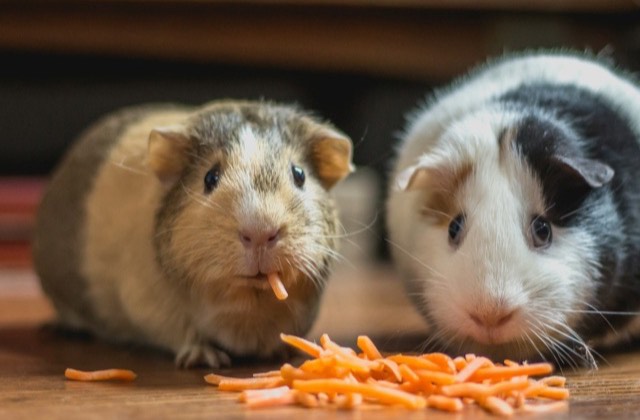
A young guinea pig separated from its mother in an unfamiliar cage doesn't stay quiet — it vocalizes heavily and its cortisol level rises sharply within minutes. Hennessy and Ritchey published a landmark study on hormonal and behavioral responses to separation in mother and infant guinea pigs in the journal Physiology & Behavior in 1987, showing that the mother's presence — even simply nearby — sharply reduces both responses, while a familiar environment alone, without an attachment figure, doesn't blunt them nearly as much (see the study). Find our comparisons in the care and grooming section.
Contents · 4 sections
It's not just the environment that soothes
This result runs against a common assumption: you might expect a young animal placed back in its familiar cage, even without its mother, to settle down simply because the setting is known. That's not what this study found: it's the presence of an attachment figure, not just the familiarity of the location, that shapes the stress response. A guinea pig stays sensitive to who's around it, not only to where it is.
What this means at weaning time
This sensitivity explains why separating an entire litter all at once, in a new environment, stacks two stressors instead of one. A more gradual weaning process that keeps visual or scent contact with the mother or a familiar figure during the transition limits that overlap — our guide on weaning baby rodents covers this timing species by species.
A stress response that doesn't stop with the mother
Guinea pigs remain a fundamentally social species well past weaning: an isolated adult still shows comparable stress signs when facing novelty, eased by the presence of a companion rather than by the setting alone. Our guide on guinea pig social life covers why cohabitation stays recommended beyond the weaning period.
Frequently asked questions
Should every cage change be avoided during weaning?
No, a change of setting is sometimes unavoidable; the key is not to stack it with a sudden separation from every familiar figure at the same time.
Does a toy or fabric scented with the mother help?
It can offer a temporary reassuring scent cue, but nothing durably replaces the presence of a companion once weaning is complete.
Does this sensitivity to separation fade with age?
It gradually eases but doesn't fully disappear; later studies have measured detectable vocalization and cortisol responses even after full weaning, in cases of social separation.
In our shop, for this use: Hanging chew garland for rabbits and rodents (€17.90) · the whole shop
This guide is part of Planète Pets’s Rodents universe. Our advice is general in nature: for any health concern, your veterinarian remains the only reference.