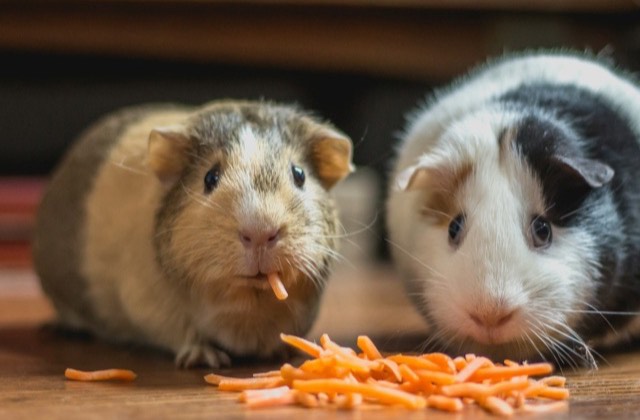
Why your guinea pig explores a new toy faster than its wild ancestor would
Published by Planète Pets · managing editor: Clément Lacaille · how our guides are written
A domestic guinea pig approaches an unfamiliar object far faster than its wild ancestor, the cavy: domestication has deeply reshaped this cautious reflex. Find our accessory picks in the rodent accessories section.
Contents · 4 sections
A direct comparison between the domestic and wild forms
Künzl and Sachser published a study in the journal Hormones and Behavior in 1999 comparing the behavior and hormonal physiology of the domestic guinea pig and its wild ancestor, the cavy, Cavia aperea (see the study). Over 120 hours of observation spread across several groups of both forms, the authors found that the domestic form explored its surroundings more, showed markedly less vigilance, and had lower resting cortisol levels than the wild form, despite identical housing conditions.
What domestic selection actually changed
This difference isn't a matter of individual learning: it reflects a lasting transformation, selected over generations, of the stress-response system itself. The domestic guinea pig hasn't just learned to tolerate human presence; it carries a physiological predisposition to react less to novelty than its wild ancestor.
How to factor this in for a new accessory
- Place the new object directly in the cage rather than introducing it from a distance: spontaneous exploration is the most likely reaction in a well-socialized domestic guinea pig.
- Don't assume this tolerance for a young, isolated, or rarely handled individual, whose personal caution level still varies despite the domestic genetic background.
- Leave the object in place for several days before concluding it's been rejected if the animal doesn't approach it right away.
This low reactivity also makes regular toy rotation easier, which stays worthwhile even for a not-so-fearful animal. For the full habitat setup that will hold these new accessories, our guide on guinea pig cage size covers the space needed.
Frequently asked questions
Is a guinea pig that's afraid of a new object unusual?
No, the general trend described in the study doesn't erase individual differences; some domestic guinea pigs stay more cautious than others.
Can a wild cavy be tamed to the same level as a domestic guinea pig?
Available data suggest a lasting difference tied to domestic selection, one that's hard to close through individual learning alone in a wild animal.
Should the animal still be watched when introducing a new accessory?
Yes, a brief check is still worthwhile to rule out any mechanical hazard from the object itself, regardless of how fearful the animal is. Find all our guides on the rodent hub.
An accessory from our shop for this use: Natural loofah chew carrot for rabbits and rodents, 20 cm (€17.90) · the whole shop
This guide is part of Planète Pets’s Rodents universe. Our advice is general in nature: for any health concern, your veterinarian remains the only reference.