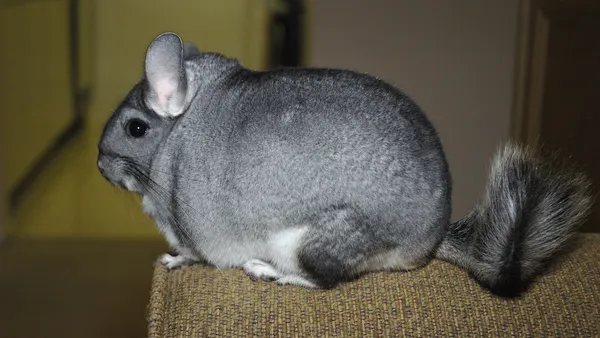
Spacious cage, but your chinchilla hides in a corner: why it still needs a tight shelter
Published by Planète Pets · managing editor: Clément Lacaille · how our guides are written
A chinchilla that spends its days tucked into the tightest corner of its cage, despite having several spacious levels available, isn't necessarily signaling a problem. A recent study shows this choice reflects a natural preference of the species. Find our setup ideas in the bedding and habitat section.

Contents · 4 sections
What does the study on chinchilla enclosure preferences show?
Szendrő, Łapiński, Matics and Gerencsér published a study on the enclosure preferences of juvenile chinchillas in the journal Animals in 2025, placing animals in front of compartments of different sizes and heights. The authors found that the animals consistently chose the smallest and lowest compartments, a preference especially marked during resting periods.
A reflex inherited from life in the wild
This choice matches the lifestyle of the wild chinchilla in the Andes, where it takes refuge in narrow rocky crevices to escape predators and only comes out at dusk to forage. A tight, covered space recreates that sense of security, even when the surrounding environment poses no real threat.
A large cage, but not just a large one
The study's authors note that this preference for small spaces doesn't justify shrinking the overall cage, which remains inadequate for welfare if too cramped, but rather calls for adding one or more closed, low hideouts on top of the space needed for jumping and exercise.
- An untreated wood or ceramic hideout, low and enclosed enough to limit ambient light.
- A low placement within the cage, closer to the behavior observed during daytime resting periods.
- Several hideouts if the cage is shared, to avoid competition for a single available shelter.
This need for a low, enclosed refuge adds to the species' already well-documented need for cool temperatures: our article on chinchilla habitat and cool rooms covers the temperature benchmarks to follow alongside the hideout.
Frequently asked questions
Is a chinchilla that stays hidden all day unhappy?
Not necessarily: it's a normal diurnal resting behavior, as long as it actively comes out to eat and move once night falls.
Should the open levels of the cage be removed?
No, quite the opposite: keep a large volume for jumping and exercise, and add a closed hideout rather than shrinking the overall space.
Do adult chinchillas share the same preferences as the juveniles studied?
Available data mainly cover young individuals, but refuge-seeking in narrow spaces remains documented in adult chinchillas both in captivity and in the wild. Find all our guides on the rodent hub.
In our shop, for this use: Hanging chew garland for rabbits and rodents (€17.90) · the whole shop
In our shop, for this use: Rolling 4-level ferret and chinchilla cage with hammock ($159.90, ships from the US) · the US shop
This guide is part of Planète Pets’s Rodents universe. Our advice is general in nature: for any health concern, your veterinarian remains the only reference.