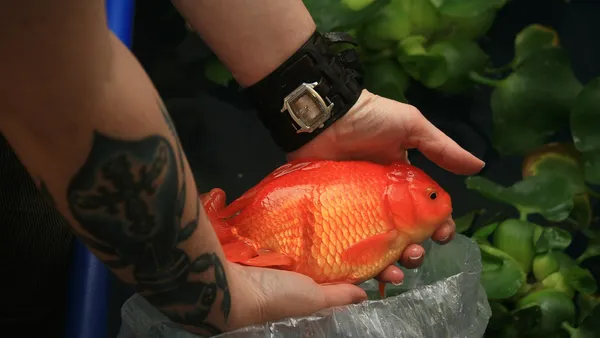
Does a dietary probiotic protect goldfish from ich? What a study found
Published by Planète Pets · managing editor: Clément Lacaille · how our guides are written
Ich (Ichthyophthirius multifiliis, white spot disease) remains one of the most common ailments in home aquariums, and off-the-shelf treatments mostly target the free-swimming parasite in the water rather than the fish's own immunity. A study by Shahbazi, Sheikhzadeh, Nazarpour Siahtan, Keshavarz Ghadimi, Soltani, Nofouzi, Mousavi, Khordadmehr, Marandi and Firouzamandi, published in 2023 in Veterinary Medicine and Science, tested whether a dietary probiotic could help goldfish already infected with ich (, doi 10.1002/vms3.1183). Guidance on feeding is gathered in the fishkeeping food section.
Contents · 5 sections
A live probiotic, and its "dead" version
The researchers fed goldfish infected with ich either live Bacillus subtilis or the same bacteria heat-killed (a "paraprobiotic" that can no longer multiply in the gut), at one billion bacteria per gram of feed for 80 days, compared with a control group on the base diet alone.
What the measurements show
Both forms improved goldfish growth compared with the control group, reduced parasite density along with the skin and gill damage seen under histological examination, and raised the expression of two immune-response markers, lysozyme and TNF-alpha. Notably, the heat-killed version, easier to stabilise in a commercial feed, performed comparably to the live one — a probiotic does not need live bacteria to have an effect.

What this study does not show
It does not compare this probiotic against a standard anti-parasitic treatment (salt, raised temperature, a commercial product): nothing indicates it could replace such treatments once an infestation is established, only that it lessens the damage and supports immunity alongside them. It covers goldfish under controlled experimental conditions, with a specific bacterial strain and dosage: there is no guarantee that a generic commercial probiotic, at a different concentration, would produce the same effect in other species.
What this means in practice
This result supports using a probiotic-enriched feed as background immune support rather than a crisis fix: best kept for higher-risk periods (a newly introduced fish, transport stress, a tank change) rather than as a substitute for treatment once ich is already visible on the fish.
Frequently asked questions
Does a probiotic powder sprinkled onto flakes have the same effect?
The study tests a feed formulated with the probiotic built in beforehand, not a home add-on sprinkled onto an existing food; dosage and bacterial stability are not guaranteed in that case.
Does this probiotic also work for tropical fish?
This study covers goldfish only; the effect in other species remains to be checked. Find all our guides on the fishkeeping hub.
This guide is part of Planète Pets’s Fishkeeping universe. Our advice is general in nature: for any health concern, your veterinarian remains the only reference.