Can a Fish Learn Tricks? What Cognitive Training Studies Show
Published by Planète Pets · managing editor: Clément Lacaille · how our guides are written
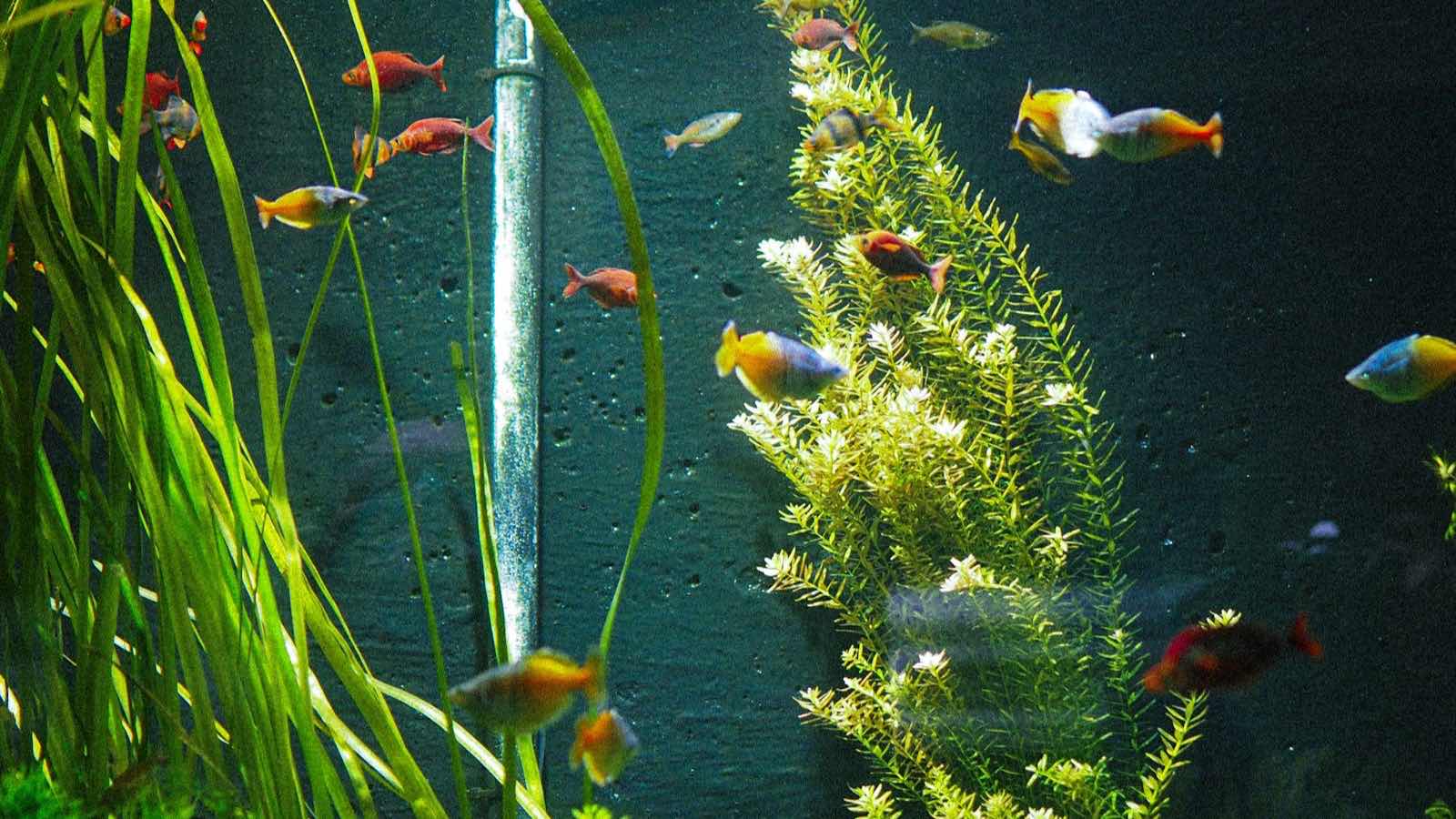
A bare tank with no decor or variation isn't just less pleasant to look at: it may also limit the learning abilities of the fish living in it. A study by Brunet, Lafond, Kleiber, Lansade, Calandreau and Colson published in 2023 in Frontiers in Veterinary Science compared rainbow trout raised in a tank enriched with plants, rocks and pipes to trout raised in a bare tank, then tested their visual discrimination abilities. Find our other pointers in the toys and enrichment section and on the fishkeeping hub.
Contents · 5 sections
What exactly did this cognitive test involve?
The fish had to learn to associate a color with a food reward, and researchers then reversed the rule to observe how well they adapted to that change, a classic measure of cognitive flexibility. Trout raised in the enriched environment handled this adaptation phase better than those raised in a tank with no structures.
Why does environmental variety affect learning?
A varied decor multiplies opportunities to explore, navigate around an obstacle or choose one path over another, which constantly engages a fish's decision-making abilities. This repeated stimulation appears to keep cognitive circuits active that, by contrast, go largely unused in a completely uniform tank.
Can a home aquarium fish actually be trained?
Yes, many hobbyists already practice a simple form of training with their betta using a mirror as stimulation, a principle close to the visual discrimination tested in this study. Pairing a consistent visual cue, like a colored target, with feeding time can be enough to observe a form of learning in a curious fish such as a betta or certain cichlids.
How can a tank be enriched without upsetting its biological balance?
Occasionally rearranging the decor, adding an extra hiding spot, or alternating feeding locations is enough, as detailed in our guide on hiding spots and enrichment for shy fish. There's no need to change everything at once: small, regular variations are enough to maintain this cognitive stimulation.
- Trout raised in an enriched tank show better cognitive flexibility than those raised in a bare tank
- A varied decor constantly engages a fish's exploration and decision-making abilities
- Simple training using consistent visual cues is possible in certain home aquarium fish
- Small, regular changes to the decor are enough to enrich a tank without upsetting its balance
Frequently asked questions
Are all aquarium fish capable of this type of learning?
Discrimination and adaptation abilities have been documented in many species, though the exact level varies by species and individual, somewhat like in mammals.
Is a heavily decorated tank always better than a sparser one?
Not necessarily: what matters most is variety over time rather than the amount of decor present at any given moment, and a balanced tank remains easier to maintain.
Do you need special equipment to cognitively stimulate a home aquarium fish?
No, a simple consistent visual cue like a colored target or an occasional mirror is enough to observe a form of learning, with no dedicated equipment required.
In our shop, for this use: Tall artificial aquarium plant, 45 to 49 cm, weighted base (€23.90) · the whole shop
This guide is part of Planète Pets’s Fishkeeping universe. Our advice is general in nature: for any health concern, your veterinarian remains the only reference.