Do fish feel stress? Setting up the aquarium to reduce it
Published by Planète Pets · managing editor: Clément Lacaille · how our guides are written
Long assumed to be a fairly unfeeling animal, a fish actually has a nervous system capable of detecting unpleasant stimuli and reacting to them over time. Understanding what science has established on this point changes how you set up an aquarium. All our habitat guides are gathered in the fish tank bedding and habitat section.
Contents · 5 sections
What does scientific research show about fish sensitivity?
A study by Sneddon, Braithwaite and Gentle, published in 2003 in Proceedings of the Royal Society B, identified nociceptive receptors on the head of rainbow trout, activated by unpleasant mechanical, thermal or chemical stimuli, with measurable behavioural effects lasting several dozen minutes after exposure (study on Royal Society Publishing). This work played a major role in establishing that fish perceive and retain negative experiences, well beyond a simple reflex.
What signs give away a stressed fish?
- Erratic swimming or gliding along the glass: a common sign of environmental discomfort, often linked to water quality.
- Dulled colours: a rapid loss of vibrancy frequently accompanies chronic stress, independent of any visible disease.
- Permanently hiding in decor: a fish that stays hidden most of the time signals a lack of perceived safety in its environment.
- Prolonged refusal to eat: beyond one day of occasional fasting, this is a sign worth taking seriously.
How do you set up the aquarium to reduce stress?
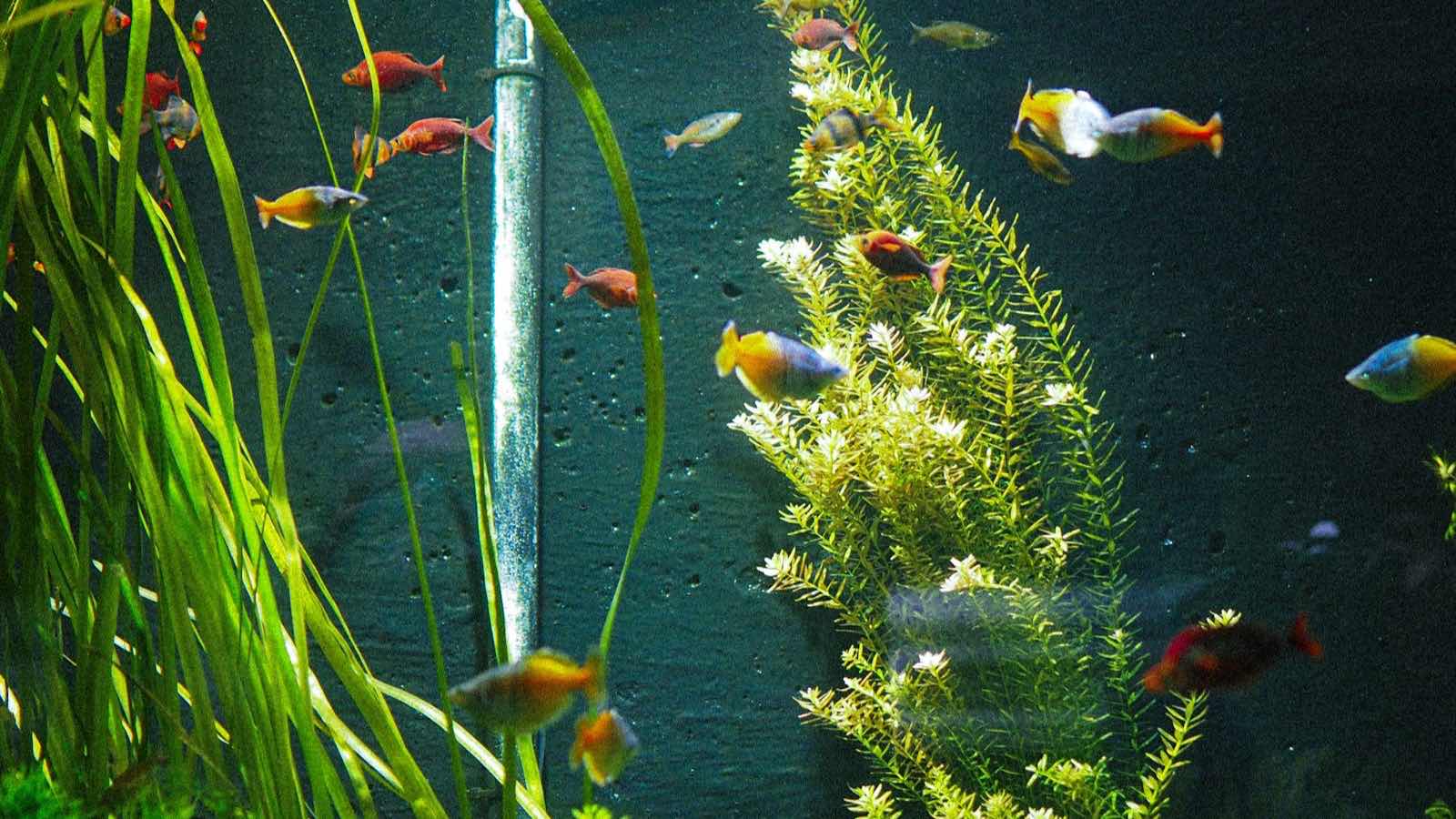
Enough plants and hiding spots provide essential retreat zones, particularly for less dominant individuals in a group. Stable water, tested regularly as covered in our water tests and nitrogen cycle guide, also cuts down a large share of chronic stress factors that are often invisible to the naked eye.
What budget for a stress-reducing setup?
Extra plants and hiding spots represent a modest budget, €15–40 depending on tank size, largely paid back by fewer illnesses linked to chronic stress, which are often more costly to treat.
Frequently asked questions
Does stress make a fish more vulnerable to disease?
Yes, chronic stress weakens a fish's immune defences, a mechanism comparable to what's observed in mammals.
Is a lack of hiding spots really a major stress factor?
Yes, especially for species that live in hierarchical groups, where subordinate individuals need retreat zones to avoid ongoing stress.
Can a stressed fish go back to normal behaviour?
Yes, by fixing the identified cause: most signs of stress ease within days to a few weeks once the environment stabilises. Browse all our guides on the fish hub.
See it in the Planète Pets shop: Hollow moss-effect resin log for aquariums (€20.90) · the whole shop
This guide is part of Planète Pets’s Fishkeeping universe. Our advice is general in nature: for any health concern, your veterinarian remains the only reference.