Corner or rectangular aquarium: which should you choose?
Published by Planète Pets · managing editor: Clément Lacaille · how our guides are written
The choice mostly comes down to the space you have and the fish you want to keep: a corner aquarium makes use of an unused corner and keeps walkways clear, but it costs more for the same volume (curved glass or complex cuts, a dedicated cabinet), offers less swimming length and makes the bottom of the tank harder to reach for maintenance. A rectangular tank stays the simplest and cheapest choice for a first aquarium.
Contents · 9 sections
- Triangle, quarter-circle, pentagon: the three corner aquarium shapes
- Why is the corner aquarium so appealing?
- Which fish suit a corner aquarium?
- The weight in a corner: cabinet, floor and safety
- Filtration and lighting: making use of the blind spot
- Is a corner tank harder to maintain?
- Standard, custom-built and budget
- Which one suits your situation?
- Frequently asked questions
Triangle, quarter-circle, pentagon: the three corner aquarium shapes
- Triangle with a flat front: two panes along the walls and one straight front pane. The view is not distorted, but the front is short and the tank is deeper than it is long.
- Quarter-circle with a curved front: the bowed pane gives a sense of depth and softens the corner. It slightly distorts the image at the edges and needs a soft, adapted scraper.
- Pentagon with a cut front: the sides run straight along the walls before the front, giving a wider viewing pane and a little more usable floor area. It is the shape closest to a real swimming tank.
In all three cases, the shape puts a good share of the water in the back point, out of sight and out of reach. For a comparable floor footprint, a rectangular tank offers more swimming length: for many fish, that matters more than the volume printed on the box.
Why is the corner aquarium so appealing?
It turns a dead corner of the living room into a focal point, visible from several spots in the room. It’s a popular solution in small flats where every square metre counts, much like the constraints discussed in our aquarium at the office guide. Its downside: the curved glass or complex cuts push up the manufacturing cost, and the matching cabinet is not mass-produced the way rectangular cabinets are.
Which fish suit a corner aquarium?
A tank that is deeper than it is long is a poor fit for strong swimmers. Space really matters: a study by Maierdiyali and colleagues published in 2020 in the journal Animals compared zebrafish kept in tanks of different sizes; those in small tanks were less bold and had poorer stamina, although their cortisol levels did not differ (see the study). Our species attribute database gives concrete pointers for a 100-litre corner aquarium:
- Good fits: corydoras (100 litres minimum, a group of 6, bottom dwellers), the platy (80 litres, a group of 5, mid-water swimmer), the neon tetra (60 litres, a school of 10) or a single gourami (100 litres, a calm surface fish).
- Avoid: the swordtail, a sprinter that needs a long swimming lane, the danio, which races against the current in a school, and the angelfish, whose serious minimum volume is 240 litres.
For the layout, think about several viewpoints: a focal point in the centre, tall plants in the back point to hide the equipment, and an open front for swimming.
The weight in a corner: cabinet, floor and safety
An aquarium weighs about 1.5 times its volume in kilos, water, glass, substrate and decor included: a 100-litre corner aquarium therefore puts about 150 kg of permanent load in one corner of the room. It needs a corner cabinet designed for that load, usually sold with the tank by the same manufacturer, perfectly level in both directions. Our guide to aquarium stand weight sets out the calculation and the levelling. Before buying, also check the socket in the corner, the cable route along the walls and the room to slip a hand behind the tank.

Filtration and lighting: making use of the blind spot
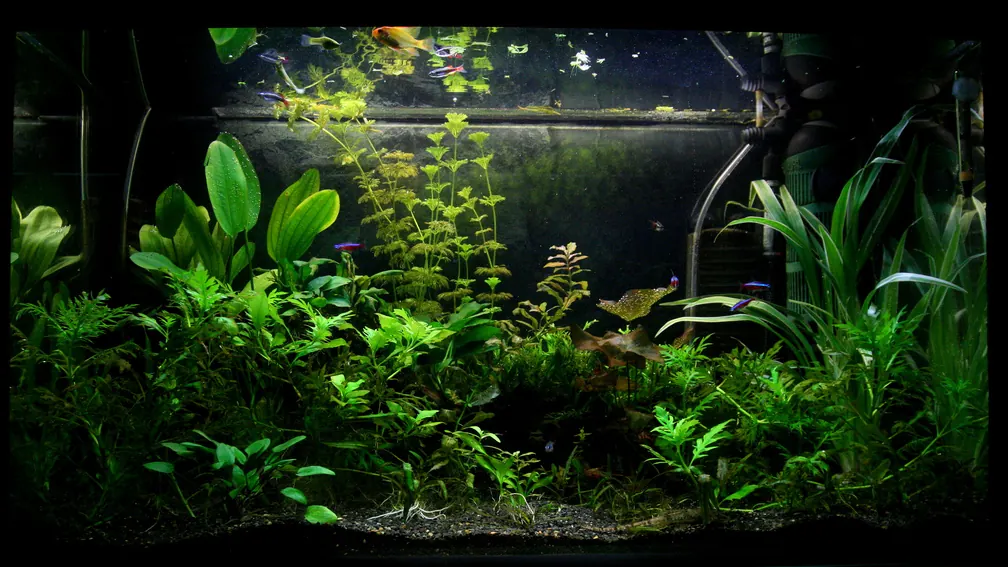
The back point is the ideal place to hide an external filter, its hoses or a built-in filter column. Aim the water outlet so it sweeps the whole tank: in a triangular shape, the back of the corner easily becomes a dead zone where waste builds up. For lighting, a rectangular LED bar often leaves the point or the sides in shadow: prefer the lit hood designed for the model or adjustable spotlights.
Is a corner tank harder to maintain?
Yes, on two points: cleaning curved panes needs a soft, adapted scraper (rigid ones scratch curved acrylic or glass), and reaching the back of the tank is more restricted when siphoning the substrate. Nothing dealbreaking, but it’s worth knowing before investing, especially if you’re just starting out and exploring our range of tanks and habitats.
Standard, custom-built and budget
What drives the price of a corner aquarium: the curved glass, the dedicated cabinet, lighting suited to the shape and, for a custom build, cutting to the exact dimensions of the corner. Always compare the price per litre with a standard rectangular tank of the same volume, cabinet included. If your corner is unusual, our comparison of custom-built or standard aquariums helps you decide. For a first tank on a small budget, our guide to the 60-litre beginner aquarium kit starts from a standard rectangular tank.
Which one suits your situation?
A rectangular tank suits most beginners: more choice of standard equipment, simpler maintenance, a better litres-per-euro ratio and more swimming length. A corner tank makes sense mainly when floor space is genuinely tight or when the aquarium needs to be a strong decorative feature. Compare real volumes on our fishkeeping hub before deciding.
Frequently asked questions
What is the downside of a corner aquarium?
It costs more for the same volume, offers less swimming length than a rectangular tank, needs a dedicated cabinet and makes the back of the point harder to reach when siphoning.
What volume should a corner aquarium be?
Choose the volume for the fish you want, not for the corner: a 100-litre corner tank can house a group of corydoras, for example, but not an angelfish, which needs at least 240 litres according to our attribute database.
Where should a corner aquarium go in a room?
In a corner close to a socket, away from a sunny window and a radiator, on a floor that can bear the load, with enough room to slip a hand behind the tank.
Does a corner aquarium really hold more water than a rectangular one of the same footprint?
No, usually the opposite: for the same floor footprint, the triangular or pentagonal shape of a corner tank often holds fewer litres than a classic rectangular tank.
Can a corner aquarium sit on a standard cabinet?
No, the base has a different geometry: you need a dedicated cabinet, usually sold as a kit with the tank by the same manufacturer.
Does the curved pane distort the fish’s view?
Slightly at the edges, like a gentle magnifying effect. It doesn’t affect the fish’s well-being or water quality, only the look from certain viewing angles.
This guide is part of Planète Pets’s Fishkeeping universe. Our advice is general in nature: for any health concern, your veterinarian remains the only reference.