60-litre freshwater aquarium: dimensions, filled weight and placement
Published by Planète Pets · managing editor: Clément Lacaille · how our guides are written
A 60-litre aquarium usually measures 60 × 30 × 36 cm (length × depth × height), which is 65 litres of gross volume. Once the substrate is in and the water stops below the rim, it actually holds about 50 litres, and the whole filled set-up easily weighs 70 to 80 kg with the tank, sand and decor. This page covers those dimensions, how to work out the real volume, and placement; to choose a kit and fill it, see our guide to the beginner 60-litre freshwater aquarium.
Contents · 7 sections
The essentials before setting up a 60-litre tank
- Usual size: 60 × 30 × 36 cm, i.e. 65 L gross; the 60 × 30 × 30 cm format is only 54 L gross.
- Real water: about 50 L once the substrate is in and the water stops below the rim.
- Filled weight: 70 to 80 kg with the tank, sand and decor, resting permanently on 60 × 30 cm.
- Order of decisions: the spot and the stand first, the tank next, then the equipment and filling.
60-litre aquarium dimensions: gross and real volume
A tank’s gross volume is length × depth × height in centimetres, divided by 1,000. The real water volume is always lower, because the substrate fills the bottom and the water stops a few centimetres below the rim. Both examples below assume 5 cm of substrate and water 3 cm below the rim.
| Size (L × D × H) | Gross volume | Real water, approx. | Water + sand |
|---|---|---|---|
| 60 × 30 × 30 cm | 54 L | 40 L | about 54 kg |
| 60 × 30 × 36 cm | 65 L | 50 L | about 64 kg |
The weight calculation is simple: a litre of fresh water weighs 1 kg, and 5 cm of sand over 60 × 30 cm is 9 litres of sand, roughly 13 to 14 kg (dry sand weighs around 1.5 kg per litre). Add the weight of the empty tank and lid, given by the manufacturer, then the rocks. Before buying, compare the exact dimensions on the product page rather than the “60 L” on the box.
The space to plan around the tank
Beyond the tank itself, allow a few centimetres at the back for the filter hoses, clearance above to open the lid and dip the net, and easy access for weekly maintenance. A tank pushed against a wall with no margin makes every task awkward. Also plan for a nearby socket, without stacking extension leads.
A weight that demands a solid stand
70 to 80 kg spread over 0.18 m² (60 × 30 cm) is a heavy, concentrated load. A standard shelf or a salvaged cabinet will not do: you need a stand designed for this weight and perfectly level, otherwise the stress concentrates on one corner of the glass. If you count the volume on the box (60 L) rather than the real water, with 15 kg of tank and 15 kg of substrate and decor, the estimate rises to about 90 kg: that cautious figure, used in our stand article, is the one to ask of the stand. Our article on the aquarium stand and the weight mistake covers this. Also check that the floor, especially upstairs or on old parquet, can bear the load.
Why dimensions matter as much as litres
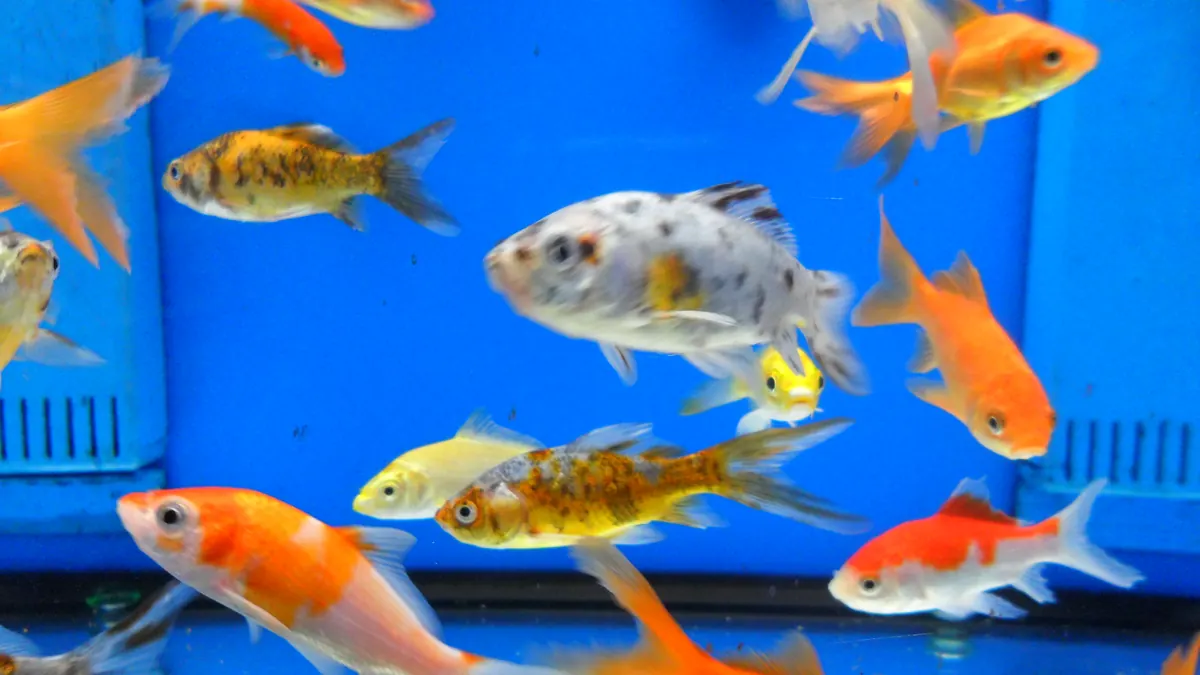
Two “60-litre” tanks are not equal: at a similar volume, a long, low tank gives more floor area and more swimming length than a cube or a tall tank. Space is not just a comfort detail: a study by Maierdiyali and colleagues published in 2020 in the journal Animals compared zebrafish kept in tanks of different sizes; those in small tanks were less bold and had poorer stamina, although their cortisol levels did not differ (see the study). In fresh water, this volume also limits your choice of inhabitants: our attribute database keeps only five species compatible with a 60-litre tank. To work out how many, see our guide on how many fish in a 60-litre aquarium; to combine them, which fish get along in 60 litres.
Putting the tank on its stand, in order
- Place the empty stand in its final spot, with the socket within reach and the planned gap at the back.
- Check the spirit level in both directions and correct under the stand’s feet, never with shims under the tank.
- Lay the foam mat if the manufacturer recommends one, then the empty tank.
- Fill to a third and check the level again, while the tank is still easy to empty.
- Then add the substrate, decor and equipment, and start filling and cycling the filter.
Choosing the right spot
Keep the tank away from windows in full sun, which encourage algae and temperature swings, as well as radiators, slamming doors and noisy through-traffic. A stable surface, away from draughts, in a room with a steady temperature, is ideal. See our guide on where to place your aquarium in the house, then our method to set up a 60-litre aquarium step by step.
Frequently asked questions
How long is a 60-litre aquarium?
60 cm in most cases; it is the height, roughly 30 to 36 cm, that changes the volume.
Can you move a filled 60-litre tank?
No: even half full, the weight and twisting can crack the seals or the glass. Always empty a tank before moving it.
Do you need a mat under the aquarium?
Many modern tanks have a frame or reinforced base, but a dedicated aquarium mat absorbs small irregularities in the stand. Follow the manufacturer’s recommendation.
Can a 60-litre aquarium go on ordinary furniture?
Not on a particle-board shelf or dresser: those tops sag under 50 kg and swell with the moisture of maintenance. You need a stand made for aquariums or a solid structure, perfectly level.
Is a 60-litre aquarium suitable for a freshwater beginner?
Yes: the volume is stable enough to forgive small mistakes and compact enough for a living room. The kit, budget and cycling are covered in our guide to the beginner 60-litre freshwater aquarium.
This guide is part of Planète Pets’s Fishkeeping universe. Our advice is general in nature: for any health concern, your veterinarian remains the only reference.